Over the last decade, the global economic and strategic balance has been shifting eastwards. Asia is the largest and the most populous continent, with China and India alone already accounting for one-third of the global population. Asia is home to some of the world’s most dynamic and fastest growing economies, but also to some most complex security hotspots. From tensions on the Korean Peninsula to maritime territorial disputes in the East and South China Seas, there are a number of issues which have the potential to spark more serious conflict. The rise of China is affecting the balance of power in the region, and has resulted in increased competition with the US for influence. This is also increasingly visible in the Indian Ocean, which has become a new theatre of strategic competition between China and India. While there are various multilateral cooperative mechanisms in the region, such as the ASEAN Regional Forum (ARF) or the East Asia Summit, their capacity to address such security issues remains limited.
As a key trading partner of many Asian economies, the EU has a major stake in regional stability, as well as in the security of its Sea Lanes of Communication. Since announcing its ‘pivot to Asia’ in 2012, Brussels has been trying to step up its security role in Asia by boosting cooperation with its various Strategic Partners, as well as through existing multilateral fora. The EUISS has been working to support these efforts by providing relevant expertise and analysis and conducting research in domains that have the potential to enhance regional stability and raise the EU’s security profile. Key areas of focus are maritime security and governance, preventive diplomacy, confidence and capacity building, crisis prevention, multilateralism, regional integration and institution building.
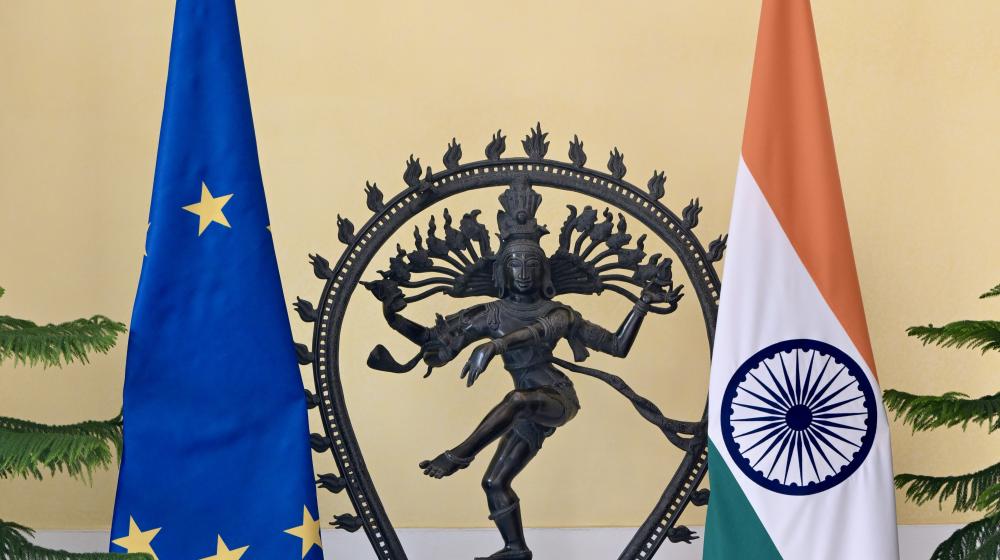
The EU and India are drawing closer in response to shared pressures, but divergent threat perceptions set clear limits. Cooperation works best through a modular approach, shifting beyond trade towards practical collaboration in defence, technology and economic security amidst a...
The Global Risks to the EU survey highlights the most acute security risks facing the EU in 2026, as assessed by European experts. A hybrid attack on EU critical infrastructure tops the risk list, alongside threats from Russia and a US withdrawal of security guarantees.
China is deeply embedded in Europe’s energy system, creating strategic and cybersecurity risks. The EU must de-risk its energy transition by tightening procurement, trade and cybersecurity rules, and prioritising European control over critical energy infrastructure.
Beijing has reshaped the US-China tech war by weaponising critical minerals, forcing Washington to abandon non-negotiable controls in favour of G2-bargaining. Europe now faces growing dependence and exposure to economic coercion, and must reindustrialise with partners to protect...
Talk of a US–China 'trade truce' may lull Europe into a false sense of security. Beijing's export controls on rare earths and critical materials remain disruptive, unpredictable and coercive. Unless the EU accelerates de-risking, its industries and defence sector will stay...
Europe’s prosperity depends on secure Western Indian Ocean routes, yet governance remains fragmented. The EU can strengthen stability by supporting the alignment of vision, resources, and partnerships across a region where strategic competition is intensifying.
Critics blame Europe’s ‘summer of humiliation’ on the EU’s timidity in trade negotiations with President Trump. Yet the greater threat to European prosperity is Beijing’s twin strategy of flooding markets with cheap goods while weaponising supply chains.
Tracing where pragmatism ends and geopolitical signalling begins.
Despite polished summits and ambitious rhetoric, the EU–India partnership risks drifting without purpose. To unlock its potential, both sides need clarity, focus and realism.
As he concludes his mission as Head of the EU Delegation in Myanmar, Ranieri Sabatucci reflects on the country he first encountered and the one he is leaving behind.