Over the last decade, the global economic and strategic balance has been shifting eastwards. Asia is the largest and the most populous continent, with China and India alone already accounting for one-third of the global population. Asia is home to some of the world’s most dynamic and fastest growing economies, but also to some most complex security hotspots. From tensions on the Korean Peninsula to maritime territorial disputes in the East and South China Seas, there are a number of issues which have the potential to spark more serious conflict. The rise of China is affecting the balance of power in the region, and has resulted in increased competition with the US for influence. This is also increasingly visible in the Indian Ocean, which has become a new theatre of strategic competition between China and India. While there are various multilateral cooperative mechanisms in the region, such as the ASEAN Regional Forum (ARF) or the East Asia Summit, their capacity to address such security issues remains limited.
As a key trading partner of many Asian economies, the EU has a major stake in regional stability, as well as in the security of its Sea Lanes of Communication. Since announcing its ‘pivot to Asia’ in 2012, Brussels has been trying to step up its security role in Asia by boosting cooperation with its various Strategic Partners, as well as through existing multilateral fora. The EUISS has been working to support these efforts by providing relevant expertise and analysis and conducting research in domains that have the potential to enhance regional stability and raise the EU’s security profile. Key areas of focus are maritime security and governance, preventive diplomacy, confidence and capacity building, crisis prevention, multilateralism, regional integration and institution building.
The launch of China's DeepSeek R1 model marks a pivotal moment in the global AI landscape. This breakthrough highlights China's technological resilience and growing capacity to challenge US leadership in AI innovation, signalling a shift towards a more plural AI ecosystem.
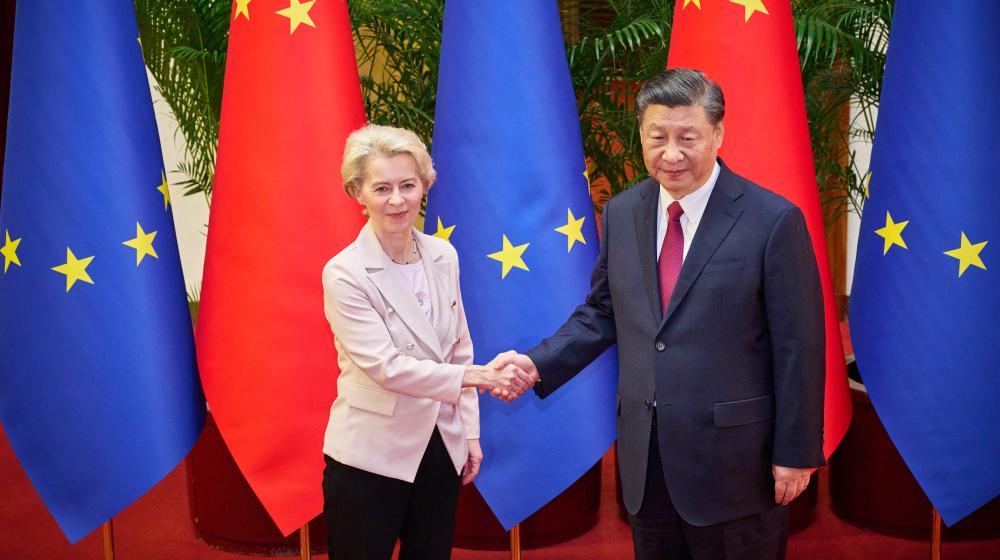
The upcoming EU-China summit may give the impression of business as usual. But the geopolitical context has changed. Beijing may be recognising that, despite transatlantic strains, fundamental EU–China divergences remain unchanged.
As the upcoming EU-China summit in Beijing approaches, China shows little willingness to make significant concessions to the EU. Clearly Beijing does not see the EU as a priority partner – even less so today than in the past. It is wooing the 'Global South', with a clear and...
The EU's notable absence from key Indo-Pacific trade frameworks risks undercutting its long-term ambitions in the region. Deepening ties with one of the region's leading trade pacts offers a low-friction way to signal intent, relevance, and credibility.
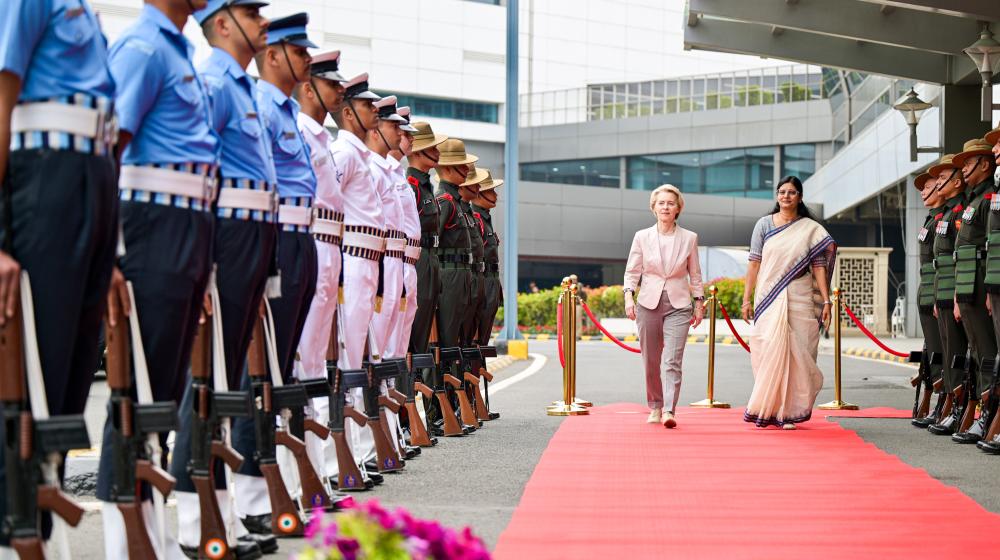
In late February, a high-level delegation from the European Commission visited India. In the context of negotiations that have been ongoing since 2007, the EU is seeking to overcome hurdles which so far have prevented it from concluding a Free Trade Agreement (FTA) with New Delhi...
What are the biggest risks to the EU in 2025? We asked close to 400 experts to rank the likelihood and expected impact of 30 predefined risks affecting EU interests. Experts highlighted the following top risks: a bad ceasefire deal in Ukraine, US abandonment, hybrid attacks, and...
The Indo-Pacific is rapidly emerging as the world’s geopolitical and economic centre of gravity. To regain relevance, amid concerns about its long-term commitment to the region, and Southeast Asia in particular, Europe needs to recalibrate its approach and step up its engagement.
If the EU does not engage proactively with Washington, the new Trump 2.0 administration may proceed without taking the bloc’s interests into account. Intent on countering Chinese technological and industrial dominance, Trump 2.0 may push Europeans towards a degree of decoupling...
The EU is increasingly concerned about strategic dependencies on Chinese technology, particularly with regard to China’s output of legacy semiconductor chips. This Brief explores what steps the EU can take to build resilience against economic security risks in this domain.
The EU has a chance to exert influence over the incoming Trump 2 administration if it moves swiftly to make a ‘China pitch’ focused on ‘three Ts’: trade, tech and Taiwan.