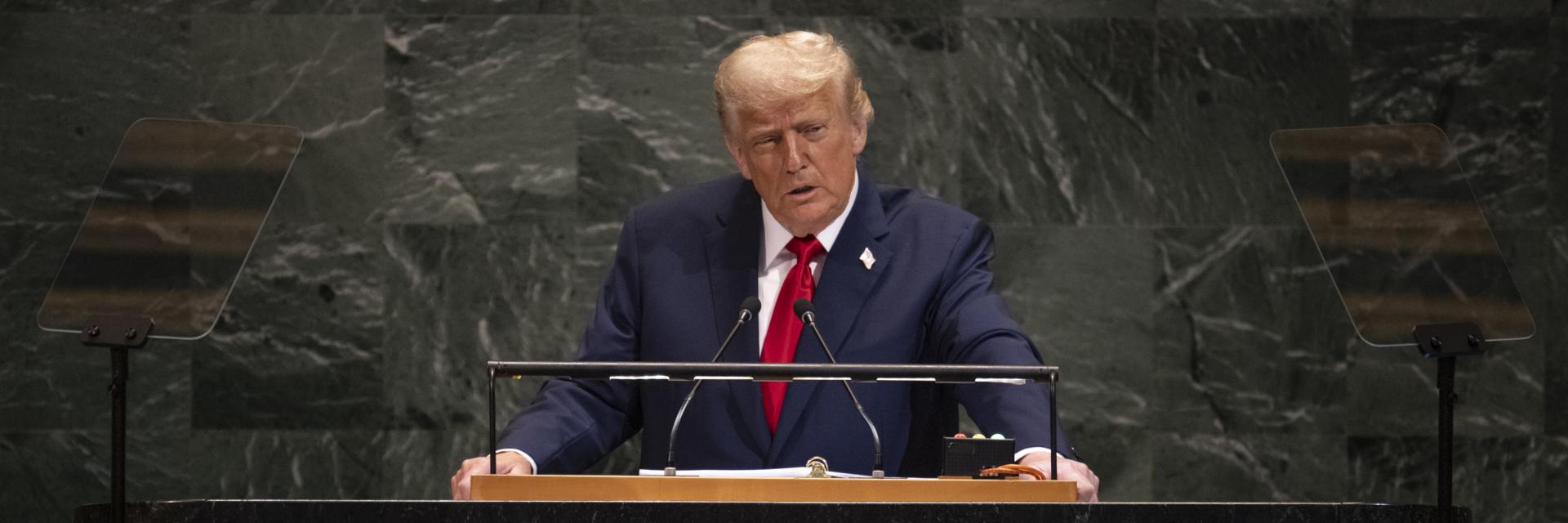
In his second inaugural address, on 20 January 2025, President Trump declared: ‘I will, very simply, put America first’. This slogan, a mantra throughout Trump’s three electoral campaigns, suggested a focus on domestic priorities over international affairs. Many therefore expected a more inward-looking United States, marked by a reduced military presence abroad, an end to external interventions, and the abandonment of allies.
Instead, foreign policy has defined Trump 2.0 so far. The US has reshaped the architecture of international trade, recalibrated relations with allies, and carried out military interventions both near home and across the globe, culminating in the Caracas raid that removed Nicolás Maduro from power. To those who were expecting an isolationist foreign policy, even within the MAGA movement, this activism has come as a surprise.
This analysis will explore the main lines of action pursued by the Foreign Policy-First administration. Do the facts so far confirm or confound our assumptions about Trump 2.0? Where is US foreign policy headed next, and what are the implications for Europe? In what areas can the EU still cooperate with the US, and in which ones does it need to adopt a more assertive approach?
Why the focus on foreign policy?
Trump 2.0 has explicitly linked foreign policy action to the achievement of its domestic goals. The administration has framed the use of force in the Caribbean and the removal of Maduro as law-enforcement operations – complementing domestic measures such as mass deportations. Tariffs are presented as a necessary step to obtain external revenue, reduce taxes, encourage production within the US and create jobs for Americans. Slashing foreign aid and withdrawing from international organisations is portrayed as necessary to redirect resources towards US citizens. And the doctrine of ‘peace through strength’ is invoked to force others to stop taking advantage of the US.
Trump is also using foreign policy to secure his legacy – either by obtaining the Nobel Peace Prize or by physically expanding the US territory. He also wants to achieve goals left unfinished from his first term, such as reshaping trade and defence relations with allies or settling confrontations with long-standing adversaries, including Maduro and the Iranian regime. In short, many US actions reflect one objective: ‘finish what we started’.
Trump’s policy-making style works particularly well in the international arena. Despite the growing concentration of power, the president faces domestic constraints. Congress, the courts and state governments can slow or block policies. Internationally, by contrast, Trump operates with far fewer checks. He can leverage personal relationships with world leaders and use US military and economic power to coerce or entice counterparts.
This approach is working well with Trump’s base. According to a November 2025 survey, almost 80% of MAGA Republicans want the US to play a leading role in global affairs, up from 51% in June 2024. More recently, 74% of Republicans supported the US military action in Venezuela. Trump has thus managed to keep on board both foreign policy ‘hawks’, like Marco Rubio and Lindsay Graham, and politicians focused on domestic issues, such as JD Vance and Steven Miller.
Foreign policy is therefore likely to remain high on the agenda throughout Trump 2.0.
The main axes of US foreign policy
The interventionist president
The US National Security Strategy (NSS) proclaims that the US should return to its ‘predisposition to non-intervention’ (p. 9). The National Defense Strategy (NDS) of January 2026 further states: ‘No longer will the Department be distracted by interventionism’.
However, in the last 12 months, the US carried out 493 military strikes.
During the entire Biden presidency (2021-24), the total was 287 strikes.
In the entirety of Trump’s first term (2017-20), the US carried out 558 strikes.
Hence, this administration is proving to be way more interventionist than the previous two.
Despite the administration’s proclaimed focus on the Western Hemisphere, most US operations have targeted other theatres.
By far the largest number of strikes (347) took place in Yemen between March and May 2025 as part of Operation Rough Rider, which concluded with a truce between the US and Houthi rebels. The second most-hit country was Somalia, with 116 strikes throughout the year, mostly targeting ISIS and Al-Shabaab.
One difference between Trump 2.0 and previous administrations is the former’s emphasis on a ‘shock and awe’ approach: carrying out short but complex military raids, designed to maximise impact, and avoiding boots on the ground. Operation Midnight Hammer in Iran (22 June 2025) consisted of strikes on three nuclear facilities, involving 125 US aircraft – including B-2 stealth bombers that flew 21 hours from US bases – and represented the first operational use of the GBU-57A/B Massive Ordnance Penetrator bunker-buster bomb.
On 25 December 2026, the US attacked two alleged Islamic State camps in the Nigerian state of Sokoto, using more than a dozen Tomahawk missiles as well as MQ-9 Reaper drones. The raid against Maduro in Venezuela (3 January 2026) involved 150 aircraft launching from 20 different bases across the Western Hemisphere, as well as special operation forces and other assets moved to the region from other theatres.
Trump 2.0 has also deployed military power in new ways. The US campaign in the Caribbean Sea and Eastern Pacific Ocean (September 2025-January 2026), which involved strikes against suspected drug traffickers, was part of Trump’s promise to use all means of power to crack down on crime, including the USS Gerald Ford, the world’s largest aircraft carrier. Despite its shaky legal basis and accusations of breaking international law, the campaign proved popular with the US public: 90% of MAGA Republicans (and 62% of US citizens) approved using military force against suspected drug traffickers in Latin America.
The peace-business nexus
During his inaugural address, Trump claimed: ‘My proudest legacy will be that of a peacemaker and unifier’. He took aim at the conflicts that started during the Biden administration, particularly Russia’s war against Ukraine, claiming that he could end it in 24 hours.
Israel and Hamas announced a ceasefire in Gaza right before Trump’s inauguration. That appeared to be an early diplomatic success for the President and his Special Envoy, Steve Witkoff. However, as the ceasefire collapsed, and efforts to end the war in Ukraine proved more difficult than anticipated, Washington expanded its diplomatic engagement.
Trump claims to have resolved eight conflicts over the course of his first year in office.
His role as a mediator is reflected in the second Gaza ceasefire and Peace Plan;
in the agreements signed in Washington between the Democratic Republic of Congo (DRC) and Rwanda (who have since resumed hostilities) and between Armenia and Azerbaijan;
and in the Kuala Lumpur Peace Accord between Cambodia and Thailand.
Trump is also credited with brokering an end to the Twelve Day War between Israel and Iran, after the US used military force to degrade Iran’s nuclear programme and pressure Tehran into negotiations.
In other areas, the US role is less obvious. Trump claims to have prevented a major escalation between India and Pakistan, but Delhi disputes the claim.
He has also argued that he resolved the dispute between Ethiopia and Egypt over the Grand Ethiopian Renaissance Dam – where tensions resurfaced in early 2026 – and between Serbia and Kosovo, apparently referring to the 2020 Economic Normalisation Agreement, which the US brokered during Trump’s first term.
Trump’s diplomatic objectives are encapsulated in the formula ‘Realignment through peace’ (NSS, p. 12). This wording suggests that the US could use peace deals as an opportunity to reset relations with countries, including long-term adversaries such as Russia – one of Trump’s stated wishes, as reflected in the substance of negotiations between Witkoff and Kremlin envoys Dmitriev and Ushakov.
But the realignment can also be understood in material terms: as a tool for the US to forge new business ties and obtain access to new resources. Several of the peace or ceasefire agreements brokered by Trump involve an explicit economic or business dimension.
Ukraine, for example, signed a Critical Minerals Deal with the US in exchange for the resumption of US intelligence sharing and weapons deliveries. The 28-point draft peace plan and its successive counter-proposals also have economic components – such as US access to immobilised Russian assets and the creation of a special economic zone in the Donbas.
The list extends beyond Ukraine. The DRC-Rwanda agreement is aptly called the ‘Critical Minerals for Security and Peace Deal’: it establishes a regional economic integration framework for the exploitation of natural resources. The Armenia-Azerbaijan agreement creates a ‘Trump Route for International Peace and Prosperity’ (TRIPP), an economic corridor. And several Southeast Asian countries signed trade and critical mineral agreements with the US on the occasion of the Kuala Lumpur Accord.
Reshaping the global trade order
The NSS sets out a number of goals under the umbrella of ‘economic security’: balanced trade; secure access to critical supply chains and materials; the reindustrialisation of the US and the revival of its defence industrial base; energy dominance; and the preservation of US leadership in the financial sector. To achieve these goals, Trump 2.0 has relied primarily on two instruments: tariffs and trade deals.
The first time Trump deployed tariffs, in 2018, these were limited to a small set of countries and to specific products like steel and aluminium. These pale in comparison to the scope and scale of tariffs imposed in 2025.
On 2 April 2025, Trump invoked the International Emergency Economic Power Act (IEEPA) to impose ‘reciprocal tariffs’ on imports from all countries not already subject to other sanctions or levies. The tariffs were implemented, with subsequent adjustments, on 7 August. In addition, the US used the IEEPA to target China, Canada and Mexico over the fentanyl crisis, India for its purchase of Russian oil, and Brazil for alleged restrictions on free speech. The tariffs threatened against several European countries for their decision to send troops to Greenland, if implemented, would also fall under the IEEPA.
In addition, the Trump 2.0 administration has threatened or imposed sectoral tariffs on 28 products, ranging from aluminium and steel, automotive parts and timber to agricultural products, integrated circuits, critical minerals and even foreign films.
In total, tariffs accounted for USD 163.8 billion in US customs revenue in 2025, up from USD 40 billion in 2024. The administration argues that these tariffs are paid by foreign companies, and that the extra revenue could substitute for federal income taxes. However, according to a recent study, 96% of the tariff burden was absorbed by US citizens: rather than increasing their unit price to remain competitive, foreign producers decided to export less to the US, resulting in fewer supplies for US consumers, but at the same price.
EU-US trade volumes illustrate this point.
Transatlantic trade rose dramatically in March 2025, as US firms increased their stocks in anticipation of the tariffs.
Then trade fell well below 2024 levels as exports were curtailed. The summer deal did trigger a renewed increase in EU exports in September, but no clear path towards sustained transatlantic trade growth has yet been found.
Trump 2.0 has sought to replace the previous system with a new network of bilateral deals built around trade balance, access for US products and economic security.
In 2025, the US signed 15 trade deals with partners in the Americas (Argentina, Ecuador, Guatemala, El Salvador), Europe (UK, EU, Switzerland and Lichtenstein), Southeast Asia (Malaysia, Cambodia, Vietnam, Indonesia, Thailand) and Northeast Asia (Japan and South Korea). In addition, Trump signed a ‘Deal on economic and trade relations’ with China in November, pausing the escalating trade war between the two countries for one year.
Furthermore, the US has signed several critical minerals deals – including those signed in the context of peace negotiations – as well as separate agreements with the UAE, Saudi Arabia, Australia, Japan and Kazakhstan.
Looking at the main provisions in the bilateral trade deals, we can highlight the main building blocks of the new trade order the US is seeking to construct.
First, the US uses the newly imposed tariffs as bargaining tools in exchange for tariff reductions, partners grant greater market access for US goods, commit to removing non-tariff barriers, and agree to align with US standards.
Second, the trade agreements elevate economic security to a central objective. Washington uses the deals to create alternative supply chains which bypass China and generate new dependencies. Some agreements also include provisions for digital trade, including crypto assets, and cooperation in the development of new technologies. The latter culminated in the Pax Silica Summit of 11 December 2025, which connects the US with a number of partners (Japan, Israel, Australia, Singapore and Korea as signatories, alongside the UAE, Canada and the EU as additional participants) to advance the development of a secure AI supply chain.
Third, the US wants to address the trade imbalance. This is accomplished through ‘Buy American’ provisions, through which partners commit to purchasing US weapons and energy, as well as to investing in the US economy and American companies. This set of provisions is linked to the other goals listed in the NSS – reindustrialisation, energy and financial dominance.
The transatlantic defence link holds — for now
The year 2025 began with fears of a US disengagement from Europe. However, this withdrawal has yet to take place.
Between 2024 and 2025, US troop levels in Europe have remained largely unchanged.
Why has Trump not heeded calls for a quicker reduction in the US presence in Europe? Most likely, NATO allies’ pledge to spend 5% on defence at the Hague Summit – the target Trump set at the beginning of his second term – persuaded the President to remain committed to the alliance. European leaders and US personnel in Europe – such as SACEUR and EUCOM Commander, General Alexus Grynkewich, or Ambassador to NATO Mark Whitaker – may also have persuaded Trump to roll back these plans. In fact, the National Defense Strategy (NDS) praises European allies for their commitment to the 5% spending target – putting them just below Israel on its list of ‘model’ allies.
This does not mean that selective withdrawals from certain functions are not taking place. In October, the US Army announced that the 2nd Infantry Brigade combat team of the 101st Airborne division, based in Romania and due to redeploy back to the US, would not be replaced. In January 2026, the Pentagon announced plans to reduce personnel in NATO’s force structure. These could be the first steps of a shift towards ‘critical but more limited support from the United States’ (NDS, p. 4).
Europe continues to be a major purchaser of US weapons, as shown by data on Foreign Military Sales (FMS), which account for the vast majority of US military sales. Over the year 2025, FMS notifications to Congress amounted to USD 104.2 billion, down from 2024 (USD 146 billion) but comparable to 2023 (USD 107 billion).
Europe accounted for USD 38.6 billion, making it the largest purchaser of US defence products that year (37% of total FMS).
However, this number represents a significant reduction from 2024 (USD 76.7 billion) and 2023 (USD 77.7 billion). This may indicate the early stages of a reduced reliance on US weapons purchases, as intra-European production gathers pace.
Zooming in on EU Member States offers further evidence of this trend. In 2025, EU countries spent USD 31.2 billion on FMS, accounting for 28% of total that year (around €100 billion, or 109 billion USD). This represents a significant drop from 2024, when FMS accounted for 50% of EU weapons purchases(1).
However, individual European countries still top the charts. Denmark was the largest purchaser of US weapons through FMS, followed by Taiwan and Israel. Other major European purchasers include Germany, Poland, Norway, the Netherlands and Ukraine.
Ukraine’s presence on the FMS list is both significant and emblematic of 2025. Kyiv, no longer able to rely on US military aid, is now a big purchaser of US weapons through FMS, amounting to USD 2.4 billion. The country also received USD 4 billion in US weapons procured by NATO allies through the PURL initiative.
European purchases are skewed towards certain categories: they spent USD 14 billion on missiles (accounting for 57% of FMS in this category), USD 9.4 billion on air defences (67%), and USD 5.3 billion on command-and-control systems (73%). Additionally, Europeans spent almost USD 5 billion on US combat aircraft and helicopters. These figures reflect a continued dependency on the US for specific capabilities such as long-range fires, air and missile defence, C2 and ISR. This dependency is unlikely to diminish until European alternatives come online.
Conclusion
Dealing with the Foreign Policy-First President
Several conclusions emerge from the data:
- Trump 2.0 is likely to remain interventionist, in the Western Hemisphere and beyond. The key uncertainty lies in where the next use of force might occur. Interventions against allies remain unlikely: widespread opposition to military action against Greenland, including among Republicans, ultimately led Trump to back down. Countries such as Cuba or Iran remain more exposed to new military action. For Europe, the greater risk is not a direct attack but the continued erosion of the global norm of non-intervention.
- Trump’s ‘peace agenda’ is now US policy. The NSS states that the United States will pursue ‘peace deals at the President’s direction, even in regions and countries peripheral to our immediate core interests’ (p. 12). Europe’s challenge is to channel this impulse away from short-term, transactional bargains and towards durable settlements — above all in Ukraine. Attempts to distance Trump from Putin failed in 2025, pointing to the need for a different approach, such as developing an independent role in negotiations, without relying on a US–Russia track.
- Tariffs are here to stay. Even if the Supreme Court strikes down Trump’s use of the IEEPA, the administration plans to reimpose tariffs under other legal authorities (such as Sections 232 or 301). Tariffs are therefore likely to persist throughout Trump 2.0. The EU should adapt to this reality rather than wishing it away. It could link the implementation of the trade deal to progress on broader EU-US disputes. It should also learn from countries such as Brazil and India who have been targeted by politically motivated tariffs.
- US forces remain in Europe — for now. The NDS promises ‘critical but more limited’ support for European allies, but uncertainty persists in the absence of a force posture review. A gradual drawdown, such as the redeployment of US troops from Romania, would be better than a sudden withdrawal. Yet Europe may face a tighter deadline: in December 2025, the Pentagon asked Europeans to take over most of NATO's conventional deterrence capabilities by 2027.
- Defence industrial relations will test the transatlantic partnership. US calls to promote ‘transatlantic defense industrial cooperation and reduce defense trade barriers’ (NDS, p. 19) may clash with the EU’s Readiness 2030 goals. Managing this tension will shape EU–US and EU-NATO relations in the years ahead.
There are still some areas for cooperation between Europe and Trump 2.0:
- Defence trade: The US remains willing to sell weapons to Europe, helping to address near-term capability gaps – at least until the rising Pentagon budget forces industry to de-prioritise European orders.
- Deterrence: Trump’s interventionism seems to deter direct escalation against the United States, creating openings for Europe to back tougher action on Russia. Ukraine has already exploited this dynamic by using US-provided intelligence to strike Russian energy infrastructure. Europe could encourage Washington to sustain this posture.
- Economic security: China’s ability to impose costs on the US in 2025 underscored the value of working with partners. The Pax Silica summit could indicate the beginning of a new approach. The EU should keep nudging Washington towards pragmatic economic coordination rather than trade confrontation.
Yet one cannot ignore that the space for cooperation with the US is shrinking. The NSS describes Europe in terms of ‘civilizational decline’ (p. 25) and signals an intention to interfere in European electoral processes. Tensions over Greenland are arguably the greatest transatlantic rift to date. Deeper crises may lie ahead, testing Europe’s resilience and increasing the urgency to assume more responsibility for our own security.
References
* The author would like to thank Christian Dietrich, Data Visualisation Designer, who is responsible for all the visuals in the publication, and Katja Elizabeth Hermann-Eufracio, former EUISS Trainee, for her support in gathering data.
1. In 2024, EU countries spent €48.8 billion on FMS. Defence equipment procurement in the bloc was €88 billion or USD 95.2 billion.