Summary
- Energy availability is increasingly shaping the global AI race. While the US, China and the Gulf countries combine technological ambition with abundant and affordable energy, the EU faces high prices, grid constraints and import exposure.
- Expanding the EU’s AI capabilities could therefore become an energy security challenge, as new data centres add significant pressure to already overstretched energy systems. Yet Europe could turn this constraint into an advantage by matching AI workloads and locations with surplus renewable electricity, reducing curtailment and enabling more efficient use of the energy system.
- The EU needs a computing geography aligned with energy realities. Location incentives, flexible power-use requirements and compute allocation priorities can steer private investment towards a more efficient, sustainable and resilient AI rollout.
Access to cheap, reliable and abundant energy is a core determinant of technological power. As AI systems grow more computationally intensive, the ability to secure, deliver and manage electricity at scale will shape the global AI race. This favours actors able to combine computing capacity with ample energy supplies, grid resilience and rapid infrastructure deployment, whether through the United States’ hyperscaler-led model, China’s state-coordinated approach, or the Gulf countries’ energy-backed bid to host AI infrastructure.
For the EU, expanding its AI capabilities is becoming an energy security issue. New data infrastructure will add pressure to already strained European energy systems and could exacerbate external dependencies. While domestic renewables accounted for almost 50% of electricity generation in 2025, imported fossil energy, especially gas, continues to play an important role, including in maintaining grid stability. Reconciling the twin transition’s digital and energy objectives therefore requires aligning infrastructure deployment with grid capacity and demand flexibility, underscoring the need for public planning of data centre location and for computing resources to be allocated according to strategic priorities.
Energy in AI geopolitics
Long treated as a background infrastructure issue, energy is becoming a core variable in AI power. Yet the rapid adoption of AI is placing growing pressure on the global energy grid. In 2024, data centres consumed around 415 TWh (1.5% of global electricity demand), with the United States accounting for 45% of this consumption, China 25% and Europe 15%(1). By 2030, global data centre electricity demand is expected to more than double, driven largely by AI facilities which require over seven times more power than conventional data centres(2).
AI power is therefore increasingly linked with energy power, benefiting both established AI leaders such as the US and China, and emerging actors such as the Gulf countries. The US combines hyperscaler dominance, chip leadership and large capital markets with abundant domestic fossil fuel reserves. Such resources are necessary to sustain the scale of projected demand: data centre electricity consumption rose from 58 TWh in 2014 to 176 TWh in 2023, and could reach 325-580 TWh by 2028, or 7-12% of total US electricity consumption(3).
The rapid adoption of AI is placing growing pressure on the global energy grid.
China follows a similar trajectory, with data centre energy demand expected to triple by 2030, reaching up to 600 TWh(4). Its advantage lies in abundant electricity, as well as state capacity to coordinate infrastructure, energy planning and industrial policy. Through its 2022 ‘East Data, West Computing’ initiative(5), Beijing is shifting less time-sensitive computing tasks (such as storage, back-office processing or large-scale model training) towards western regions with large renewable resources, while keeping services for latency-sensitive applications (such as financial transactions or real-time industrial applications) closer to eastern hubs.
The Gulf countries are not frontier model producers, but could become hubs in the AI economy by hosting the energy-intensive infrastructure on which these models depend. The US Stargate UAE project announced in May 2025, for example, is planned as a 1 GW compute cluster in Abu Dhabi as part of a broader 5 GW UAE-US AI campus, powered by nuclear, solar and gas. This model faces constraints, especially cooling and water provision, as well as geopolitical disruption from the US-Iran war, but it shows how energy-rich states can gain AI infrastructure leverage.
In parallel, Europe is constrained by a combination of high energy prices, grid congestion, ageing infrastructure and import exposure. In 2024, data centres in the EU accounted for approximately 3.1% of its overall electricity demand and could represent 10% of demand growth in the next decade(6). This additional load comes on top of short-term gas-supply risks linked to the US-Iran war and longer-term grid constraints, with much of Europe’s electricity infrastructure over 40 years old and connections taking years to acquire, ranging from 3 years in the Nordic countries to 10 years in Germany or the Netherlands(7). In parallel, Europe’s shift towards renewable electricity makes energy systems more complex to manage, due to renewable output variability, while data centres require reliable, continuous electricity supplies.
Digital sovereignty, energy dependency?
The EU’s AI ambitions sit within the broader framework of the twin transition, which seeks to advance both Europe’s digitalisation and decarbonisation. Digital technologies can support the green transition by optimising grids, managing information flows and improving resource efficiency, but they also generate new demand for energy, water and critical raw materials. The development of European AI infrastructure may therefore strengthen digital sovereignty, but it could also create new energy dependencies.
Gas, in particular, has historically played an important role in the European grid as it provides dispatchable power which enables the constant and high-load electricity demand of data centres. But the EU is a major gas importer. Although Russian gas accounted for just 12% of EU imports in 2025, down from 45% in 2022, the EU is increasingly dependent on the US, which supplied 58% of EU LNG imports in 2025, potentially reaching 80% by 2030(8).
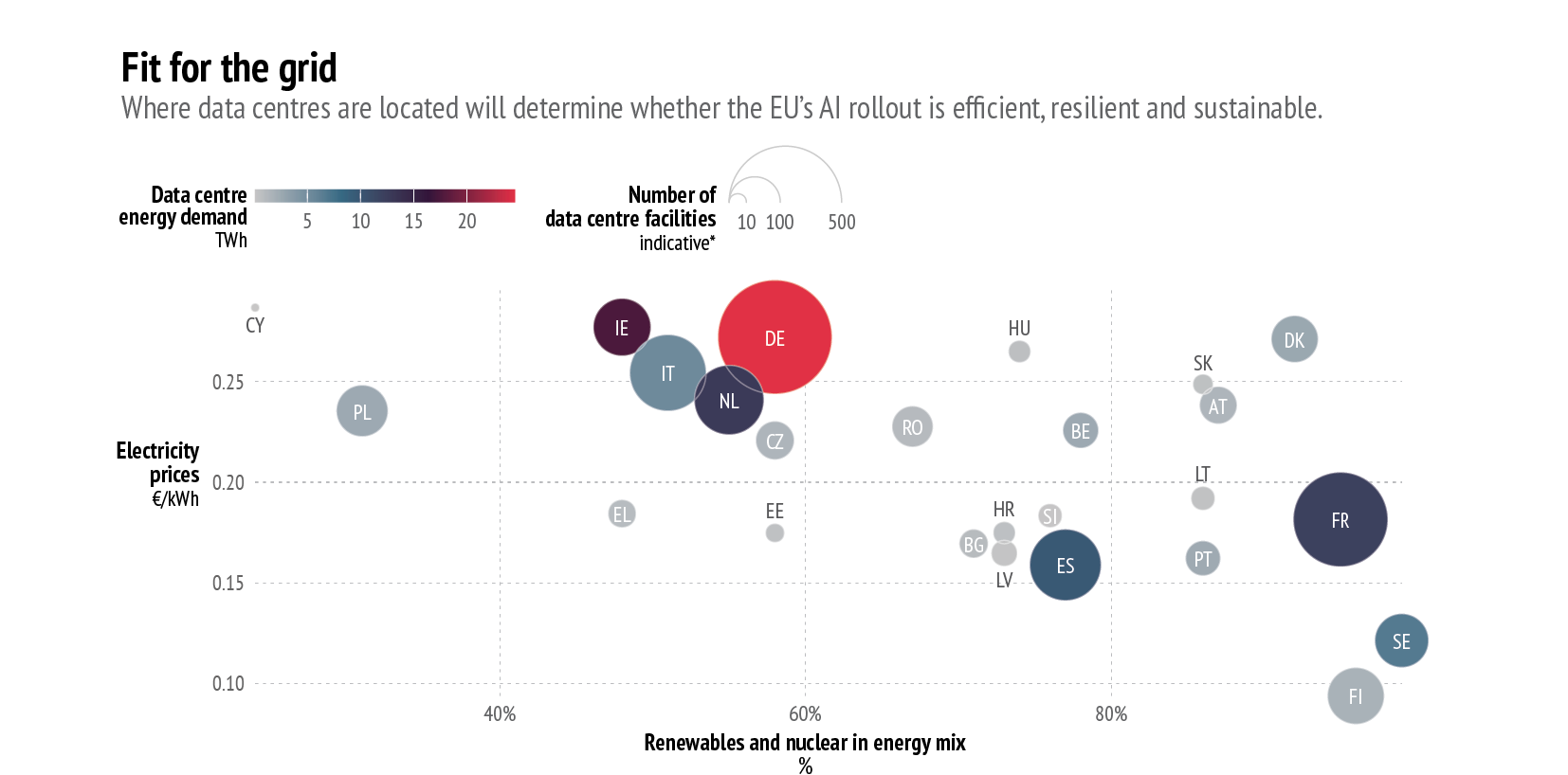
Data: DataCentreMap, 2026; European Commission, Eurostat, 2026; ICIS, 2025
Meanwhile, to strengthen domestic AI capabilities, the EU has launched the development of a network of supercomputing centres known as AI Factories. The Commission now lists 19 AI Factories and 13 Antennas, with overall investment expected to reach €10 billion between 2021-2027. This is a major industrial policy effort, but its energy implications remain insufficiently addressed. The problem is not only total demand, but also concentration and timing. Data centres tend to cluster geographically, intensifying pressure on local grids and creating trade-offs over land use, energy affordability and climate goals.
This raises the question of how Europe’s energy mix is distributed, dispatched and connected to demand. The EU increasingly experiences periods of surplus electricity generation and curtailment – where system operators cut off electricity generation. In 2024, an estimated 72 TWh of mainly renewable power was curtailed in the EU(9). In Germany alone, curtailment reached almost 10 TWh in 2025(10). As electricity supply occasionally exceeds demand, negative prices are also becoming more frequent: they occurred during 5% of hours in 2025 in seven EU Member States and fell to -€499 per MWh in Germany on 1 May 2026. This reflects a structural mismatch between variable renewable supply, limited storage, insufficient interconnection and demand that is not flexible enough to absorb excess electricity.
Depending on how it is planned, AI development could therefore either help absorb surplus electricity and reduce curtailment, or reinforce gas dependence, grid congestion and price volatility.
Location, prioritisation and market steering
Such a planning challenge creates an important opening for the EU’s AI policy, as Europe’s compute deployment must be aligned with its energy geography. Its AI electricity demand should be located where sufficient energy supplies are available across Europe.
A clearer understanding of AI demand itself is therefore essential. Energy consumption is distributed across the AI lifecycle: data and model preparation, training, fine-tuning and inference. Each stage has distinct energy requirements. Training a frontier model is the most visible and energy-intensive phase, as it requires large clusters of specialised chips running close to full capacity for days or weeks. Inference, by contrast, consumes far less electricity per individual query, but it occurs continuously and at scale once a model is deployed; the cumulative cost comes from embedding AI into search engines, office software, coding tools, public services, image and video generation and autonomous agents.
This differentiation could provide the basis for a European AI energy strategy, shaping prioritisation by both usage and location. In terms of usage, subsidised compute access and priority grid connections should be directed towards AI uses that generate clear public, economic or security value. These include cybersecurity, defence, health, scientific research, grid optimisation, climate adaptation and industrial competitiveness. By contrast, AI uses characterised by high redundancy or primarily extractive commercial purposes should not automatically receive the same level of public support or preferential access to scarce infrastructure.
In terms of location, AI workloads could be deployed across Europe according to the strengths and weaknesses of the European energy system. For instance, training frontier models can, in principle, be shifted across time and space. It can therefore be located where renewable generation is abundant, where grid pressure is lower, or where surplus electricity would otherwise be curtailed. By contrast, because it often requires continuous availability and low latency, inference may need to be located closer to users, industrial clusters or areas with reliable baseline supply, including hydropower, geothermal or nuclear power.
At present, the geography of AI demand is largely shaped by private actors. Hyperscalers, cloud providers and data centre developers indirectly determine where electricity demand materialises through investment decisions, power-purchase agreements and grid connection requests. Their choices are driven not only by energy prices and availability, but also by factors such as land costs, tax incentives, permitting conditions and connectivity. This market-driven infrastructure geography does not necessarily match Europe’s energy resources.
The EU should therefore steer the market. One option is stronger price signals through more local or nodal electricity pricing. Another is coordinated planning, using ‘acceleration zones’ to guide the rollout of new data centres in sites where there is suitable grid capacity, clean energy resources, cooling conditions and water availability. Both approaches should be combined with flexibility requirements. Flexible connection agreements (FCAs), for instance, could make grid access conditional on temporary load reduction during peak demand, thus lowering pressure on the overall energy system. According to an Agora and Deloitte 2026 study(11), requiring data centres to operate flexibly for only 120 hours per year could avoid the need for 4 GW of fossil backup capacity.
Conclusion
Technological leadership is inseparable from energy security. In order to sustain its AI ambitions, the EU needs a more energy-aware strategy for locating computing infrastructure. AI Factories and data centres should be assessed as assets or liabilities for the energy system. This will allow for more flexibly taking account of grid capacity, surplus electricity, and heat reuse and cooling constraints. Without such alignment, Europe’s AI capabilities will remain constrained and could deepen external energy dependencies. By steering private investment through location incentives, the EU could instead turn AI development into an opportunity for optimising Europe’s energy system.
References
* The authors would like to thank Maria Loredana Campione, EUISS trainee, for her research assistance.
1. International Energy Agency, ‘Energy and AI’, IEA, Paris, 2025.
2. Wilson, M., ‘Data center rack power costs: A condensed analysis’, Nlyte, 11 June 2025.
3. US Department of Energy, ‘DOE releases new report evaluating increase in electricity demand from data centers’, 20 December 2024.
4. Ye, Y., ‘Explainer: How China is managing the rising energy demand from data centres’, Carbon Brief, 16 April 2025.
5. National Development and Reform Commission, ‘Eastern Data, Western Computing’ Project Series, 10 March 2022.
6. Jacamon, V., Dallard, J. and Spencer, T., ‘Overcoming energy constraints is key to delivering on Europe’s data centre goals’, IEA, Paris, 16 November 2025.
7. Ember, ‘Grids for data centres: Ambitious grid planning can win Europe’s AI race’, 19 June 2025.
8. Jaller-Makarewicz, A. M., ‘EU risks new energy dependence as US could supply 80% of its LNG imports by 2030’, IEEFA, 19 January 2026.
9. Aurora Energy Research, ‘Europe’s three-fold solar and wind growth sparks urgent grid investment, Aurora finds’, 4 December 2025.
10. Ember, European Electricity Review 2026, 2026.
11. Agora Energiewende, ‘How data centre flexibility can help solve Europe’s grid bottleneck’, 20 April 2026.