Summary
- The second year of Trump’s presidency has brought new challenges to the transatlantic relationship. In response, Europeans have deployed multiple strategies, mixing cooperation, deterrence and resilience.
- Europeans should not expect the US midterm elections to restore a more predictable relationship. The Trump administration is likely to continue exerting pressure on allies, while shifts in domestic politics may do little to improve transatlantic ties.
- Europe must build on the lessons of the past year. Its playbook should combine strategies for facilitating cooperation with Washington with more effective measures to counter coercion: strengthening deterrence, maintaining European unity, raising the costs of hostile US measures, and offering credible options for de-escalation.
Transatlantic relations went through major crises in 2026 but did not collapse. The Trump administration confronted European allies over Greenland, and threatened to withdraw forces from NATO commitments in response to disagreements over the war in Iran. Yet Europe largely resisted this pressure without triggering a wider rupture, maintaining cooperation with the US where interests aligned.
Europe’s balancing act may, however, rest on the assumption that the 2026 midterms will change Washington’s approach. An electoral defeat, the thinking goes, will force the administration to adopt a less combative stance. That is unlikely to happen. Political setbacks may constrain the administration, but they will not remove the underlying sources of transatlantic tension.
Europeans should prepare for at least two more years of recurrent confrontation. To manage this, they need a broader and more flexible playbook: one that combines efforts to facilitate cooperation with Washington with more effective measures to counter coercion. Europe must also address the challenges of maintaining unity and developing credible deterrence. Finally, the playbook should take account of changing US politics and the road towards 2028.
Managing the rift
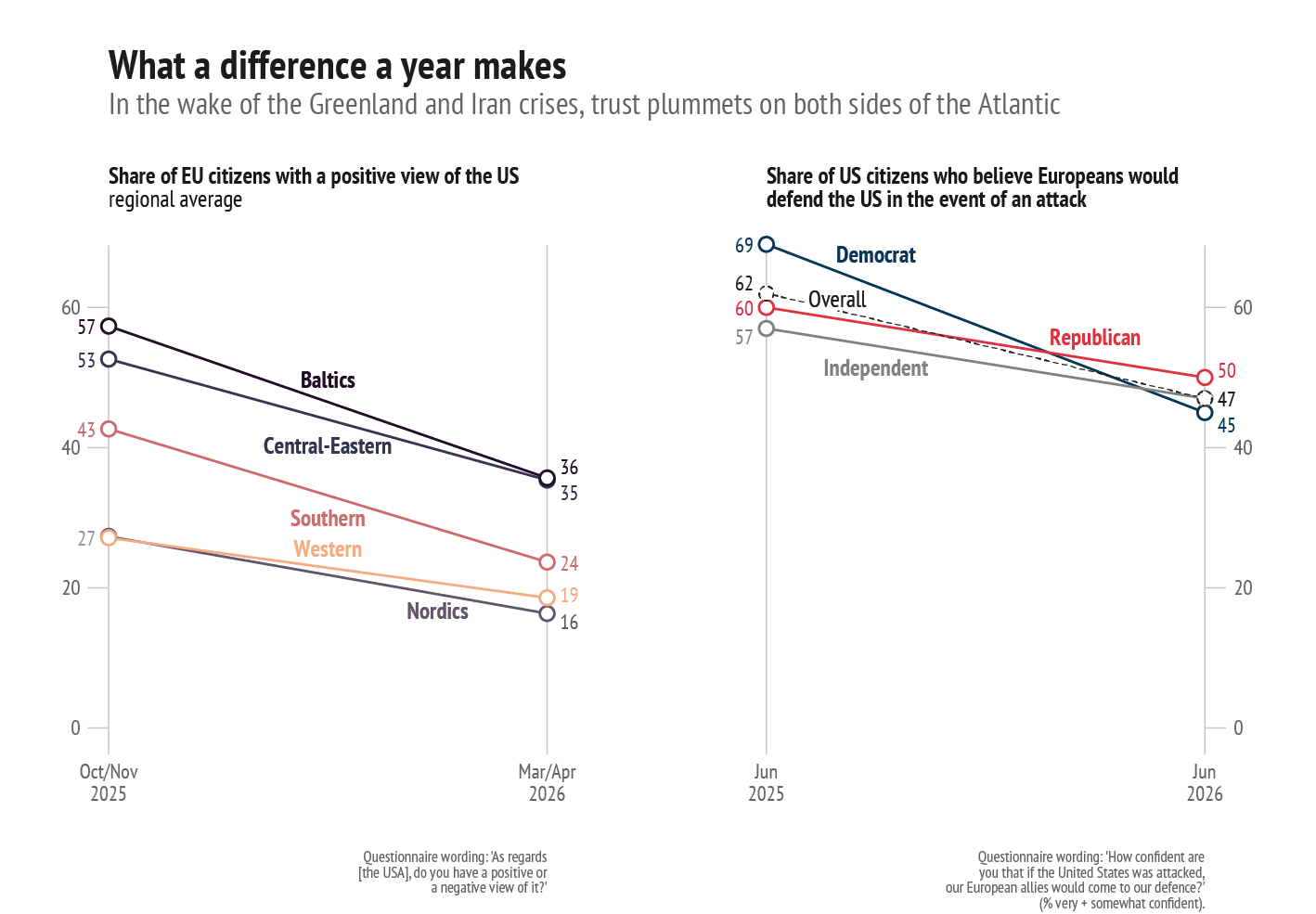
Transatlantic trust, already at record-low levels, plummeted further in 2026(1). The share of EU citizens with a negative opinion of the US rose by 14 percentage points between autumn 2025 and spring 2026. The biggest swings took place in traditionally Atlanticist countries like the Baltics, Italy and Greece. An erosion of trust has also talen place on the other side of the Atlantic. The US public shows less confidence that European allies would support the US in the event of a crisis, mirroring Europeans’ own loss of trust in Washington’s security commitment(2).Notably, this shift is more pronounced among Democrats than among Republicans.
European governments have responded to the challenges in several ways. First, Europe has actively pushed back against the most overt forms of US coercion – most obviously during the Greenland confrontation. European countries deployed troops to Greenland, while the EU paused the ratification of the Turnberry deal, threatened to lift the suspension of retaliatory measures covering €93 billion of US imports, and signalled its readiness to activate the Anti-Coercion Instrument (ACI) against Washington. Member States conveyed this message clearly to their US counterparts(3). These measures rattled the US stock market, an indicator that strongly influences the Trump White House. This credible deterrent, combined with low domestic support for the annexation of Greenland, persuaded the White House to back down.
Country groupings: Baltics (Estonia, Latvia, Lithuania), Nordics (Denmark, Finland, Sweden), Western (France, Germany, Belgium, Netherlands, Austria, Ireland, Luxembourg), Southern (Italy, Spain, Portugal,
Greece, Malta, Cyprus), Central-Eastern (Poland, Czechia, Slovakia, Hungary, Slovenia, Croatia, Romania, Bulgaria)
Beyond Greenland, there were other cases in which Europeans held firm against US demands. For instance, European countries declined to actively take part in Operation Epic Fury – despite US threats to withdraw troops and close bases in retaliation. Washington has also pressured the EU to revisit its digital rules and refrain from investigating US companies. At the time of writing, the EU has not been deterred from fining major firms such as Google, X or Meta for breaching digital antitrust regulations, while the US has so far not followed through on its threat to impose new tariffs, although a Section 301 investigation is underway.
Second, Europeans have continued to pursue transatlantic cooperation. In some cases, the objective has been to maintain good relations with Trump and prevent political tensions from spilling over, even when such efforts produced little concrete action. For example, Europeans and Ukrainians used the G7 in France and the NATO summit in Ankara to nudge Trump closer to Kyiv. Europeans also lobbied Congress to pass the Russia sanctions bill. While such efforts may not result in durable change due to Trump’s own volatility, they helped forestall a renewed rapprochement with Putin.
In other cases, cooperation was more substantive. The EU Council and Parliament ratified the Turnberry deal in June 2026, improving the transatlantic economic outlook(4). The EU and the US signed a memorandum of understanding and an action plan on critical raw materials, while the EU and several Member States joined Pax Silica. On defence, European countries have worked closely with US counterparts to rebalance responsibilities within NATO, for instance by reshuffling posts in the NATO command structure. Additionally, European and US defence companies announced new initiatives to co-produce AMRAAM missiles and PAC-3 interceptors(5).
Third, Europe has focused on building its own strengths, thereby increasing its resilience to pressure. Rising defence spending enabled European countries to react quickly to US troop and weapons withdrawals: by the summer, they had filled in the gaps in NATO’s force model and announced new programmes to replace some US enablers(6). Europeans have also strengthened ties with Ukraine’s innovative defence industry, aiming to make Kyiv not simply a recipient of assistance but also an active security provider, while partly offsetting Europe’s dependence on key US military assets. The EU concluded new trade agreements with Mercosur, Mexico, India and Singapore, laying the foundations for a more diversified trade relationship.
Prospects for change
Political developments within the US could change American foreign policy, with significant implications for transatlantic relations. The administration’s popularity is at a record low, due to the prolonged war in Iran and concerns over the cost of living. Should Democrats win the House of Representatives (and potentially the Senate), they could constrain a lame-duck Trump administration and curb its foreign policy adventurism through budget cuts and congressional hearings. Some analysts conclude that as domestic constraints weaken the administration’s ability to exert pressure abroad, the US will have to revert to a more conciliatory foreign policy style(7).
Several factors could prevent this scenario from materialising. First, while the Republicans are at a clear disadvantage in the polls, the outcome in November remains uncertain, especially in the Senate. The Democrats’ own unpopularity and intra-factional disputes add to this uncertainty. Second, the new majority is unlikely to place much emphasis on foreign policy. Even if political control of Congress changes, the new legislature will likely focus on domestic issues and battles with the administration. The newly elected legislators will reflect the priorities of the US public, for whom domestic issues take precedence over foreign policy. This applies to both MAGA Republicans and the ascendant progressive wing of the Democratic Party. Removing tariffs or reversing troop cuts in Europe may not be among their priorities.
Third, the outcome may not necessarily alter Trump’s approach. So far, the prospect of electoral defeat has not deterred the administration. A Democratic Congress would likely entail more hearings, appropriations, subpoenas, and war powers resolutions. But the White House has often disregarded dissent from the current Republican-led Congress, preferring to govern by executive order, particularly on foreign policy. This tendency could become more pronounced if the legislative branch turns hostile. Less engagement with Congress and less sensitivity to approval ratings could make the administration’s next moves even more unpredictable.
Uncertainty and tension will likely remain at the core of US strategy towards allies, as officials believe this approach is yielding results: as Under-Secretary of War for Policy Elbridge Colby recently said, if countries ‘can no longer take the United States for granted’, they will be more willing to shoulder a greater share of the defence burden and to end ‘unfair’ trade practices(8). The administration will likely continue to link issues – such as trade and defence – to gain leverage, calculating that Europeans will prefer to accept new agreements rather than risk breaking ties with Washington.
A more versatile playbook
The outcome of the midterms will not change Europeans’ fundamental dilemma: despite deepening mistrust, they will need to avoid a complete break with the US. Such a rupture could weaken deterrence and invite aggression before Europeans are fully able to defend themselves. Cooperation on shared interests that will outlast Trump 2.0 should also be preserved. At the same time, Europeans must be ready to push back against future episodes of coercion, adopting a more flexible approach tailored to different scenarios.
First, Europeans should strengthen the versatility of their deterrent toolbox. During the Greenland crisis, the issues at stake – territorial integrity and the indivisibility of the Single Market – facilitated unity and resolve. It is not guaranteed that the same degree of unity and clear signalling will be achieved in future confrontations – especially if they are engineered to pit Member States against each other. Coalitions of the willing, which are helpful in areas such as defence readiness, might not be equally effective when the issue is coercion against the Single Market. Drawing attention to how apparently limited threats can affect the fundamental principles of the Union could help foster unity. At the same time, Europe should avoid overreacting to US statements which are often part of Trump’s playbook of ‘flooding the zone’ and dominating the media, but may not always reflect genuine policy priorities. Europe should therefore focus on distinguishing real threats from empty messaging, and calibrate its response accordingly.
Second, Europe could seek to increase the costs to the US of resorting to coercion. Building on the precedent of the EU-US trade deal and on the Greenland crisis, Europeans could introduce snapback mechanisms to suspend cooperation in areas that are high on the list of US priorities, like pausing energy purchases or blocking investments in the US, in response to renewed coercion(9). Europeans could also consider linking issues across different domains, for example by threatening to restrict US military access to Europe in response to coercive measures elsewhere. However, such a threat may be credible for only some countries, while others will be reluctant to put security cooperation at risk – especially at a time when the US Posture Review is explicitly linked to base access and overflight rights(10). Whatever course of action Europeans choose, it must be credible, demonstrating awareness of the costs involved and a willingness to bear them. The easier it is to initiate a certain course of action, the stronger its deterrent power will be.
Third, deterrent measures and tools for managing escalation must be combined with credible options for de-escalation. During the Greenland crisis, Europeans offered an off-ramp in the form of NATO’s Arctic Sentry mission, as well as trilateral talks with Denmark and Greenland. This facilitated Trump’s decision to back down. Combining deterrence with conciliatory alternatives should remain central to Europe’s future dealings with this administration after the midterms – and with other political forces in the run-up to the 2028 presidential election.
As mentioned above, this playbook would be a response to future coercion. Yet, when possible, Europeans should also try to ring-fence areas of cooperation where clear transatlantic interests converge from broader political tensions. Arrangements with the Trump 2.0 administration may not remove the underlying volatility, but may allow Europe to buy time to strengthen its own defence capacity, reduce critical dependencies, and become less vulnerable to future coercion. But other forms of cooperation may prove more durable, both with sectors of the US government that remain committed to working with allies, and with private businesses that see commercial opportunities in dealing with European partners(11).
Concretely, Europe and the US could enhance cooperation with Ukraine’s innovative defence industry – an area of strong interest to US companies, even more so than to the administration, and where Europeans risk being left behind – or seek to deconflict their approaches to Ukraine’s reconstruction(12). Europeans should also actively work with US forces to shape the ongoing Europe Posture Review, facilitating the transfer of responsibilities within NATO and avoiding gaps in deterrence(13). Furthermore, the EU, the US and partners could translate the economic security agreements signed in 2026 into actionable projects to build secure supply chains.
Ultimately, through these courses of action, Europeans should dispel the belief in Washington that pressure on allies works, demonstrating instead that it carries both short-term and long-term costs. In the short term, when the US has decided to act against allied interests, the outcomes have been suboptimal for Washington. In the longer run, mounting mistrust will make transatlantic policies harder to defend vis-à-vis a public increasingly sceptical of the US, potentially undermining some of the successes touted by the administration. Europeans should ensure that the US does not draw the wrong lessons – either for the remainder of Trump 2.0 or for the administrations that will follow.
References
1. Spatafora, G., Everts, S. and Ekman, A. (eds.), ‘Low Trust – Navigating transatlantic relations under Trump 2.0’, Chaillot Paper No 187, EUISS, October 2025.
2. Fix, L., ‘Back-stabbing myths are driving the US and Europe further apart’, Financial Times, 21 June 2026.
3. Interview with European Commission officials, April 2026.
4. American Chamber of Commerce to the European Union, ‘Turnberry Deal has brought a degree of predictability to transatlantic trade and investment, anniversary survey finds’, 27 July 2026.
5. NATO, ‘NATO Allies strengthen the transatlantic defence industrial base with new coproduction initiatives’, 7 July 2026.
6. Siebold, S., ‘Europeans fill almost all gaps left by US in NATO defence plans, source says’, Reuters, 1 July 2026.
7. Agrawal, R., ‘Trump has peaked’, Foreign Policy, 31 August 2026.
8. Douthat, R., ‘Iran, China, Canada? A defense of Trump’s Grand Strategy’, The New York Times, 23 July 2026.
9. Demarais, A., Gehrke, T., and Torreblanca, J., ‘Mitigate, deter, escalate: Europe’s options against US economic coercion’, ECFR, 11 June 2026.
10. ‘US defense review presses NATO allies to prove they are taking the lead in Europe’, Associated Press, 27 August 2026.
11. Campbell, K. and Doshi, R., ‘How alliances survive: The case against pessimism and the path to a new allied order’, Foreign Affairs, 18 August 2026.
12. Ditrych, O. (ed.), ‘Empowering Ukraine: Spend smarter, support harder’, EUISS, 20 July 2026.
13. Spatafora, G., ‘Replacing the backbone? The challenges of moving away from US-led deterrence’, in Everts, S. and Scazzieri, L. (eds.), ‘Defending Europe, Deterring Russia – Resources, readiness and resolve’, Chaillot Paper No 190, EUISS, June 2026.