Explore the interactive introduction below to discover the main themes and chapters. Full report available for download.
Facing the facts
A sea change in transatlantic relations
Less than a year into Donald Trump’s second term, the transatlantic relationship looks profoundly different. A complete rupture between the United States and Europe has not taken place. However, transatlantic trust has been shattered. And we must now move forward in a low-trust environment.
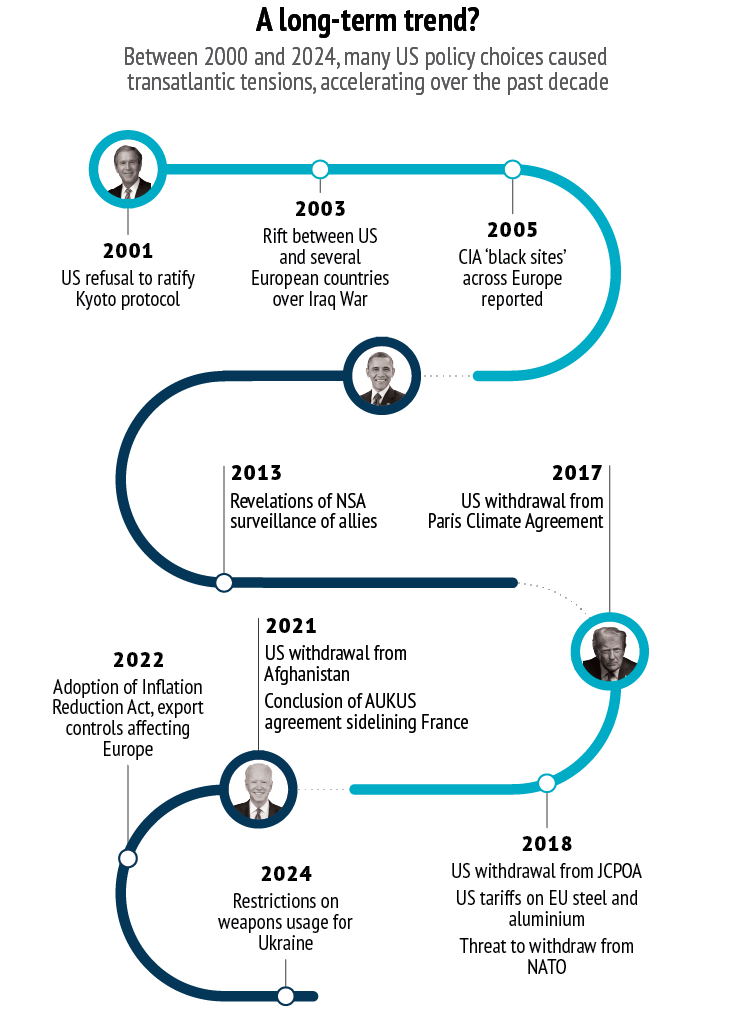
Episodes of tension in transatlantic relations are not new. There are many examples in the post-war period – from rifts over the Vietnam war, to the cruise missile crisis, to the Iraq war and the Snowden spying revelations, culminating in the major trade clashes during Trump’s first term. While the Biden administration was keen to restore the transatlantic partnership overall, tensions still emerged on military agreements (AUKUS), subsidies to industry (the Inflation Reduction Act) and the extent of support to Ukraine.
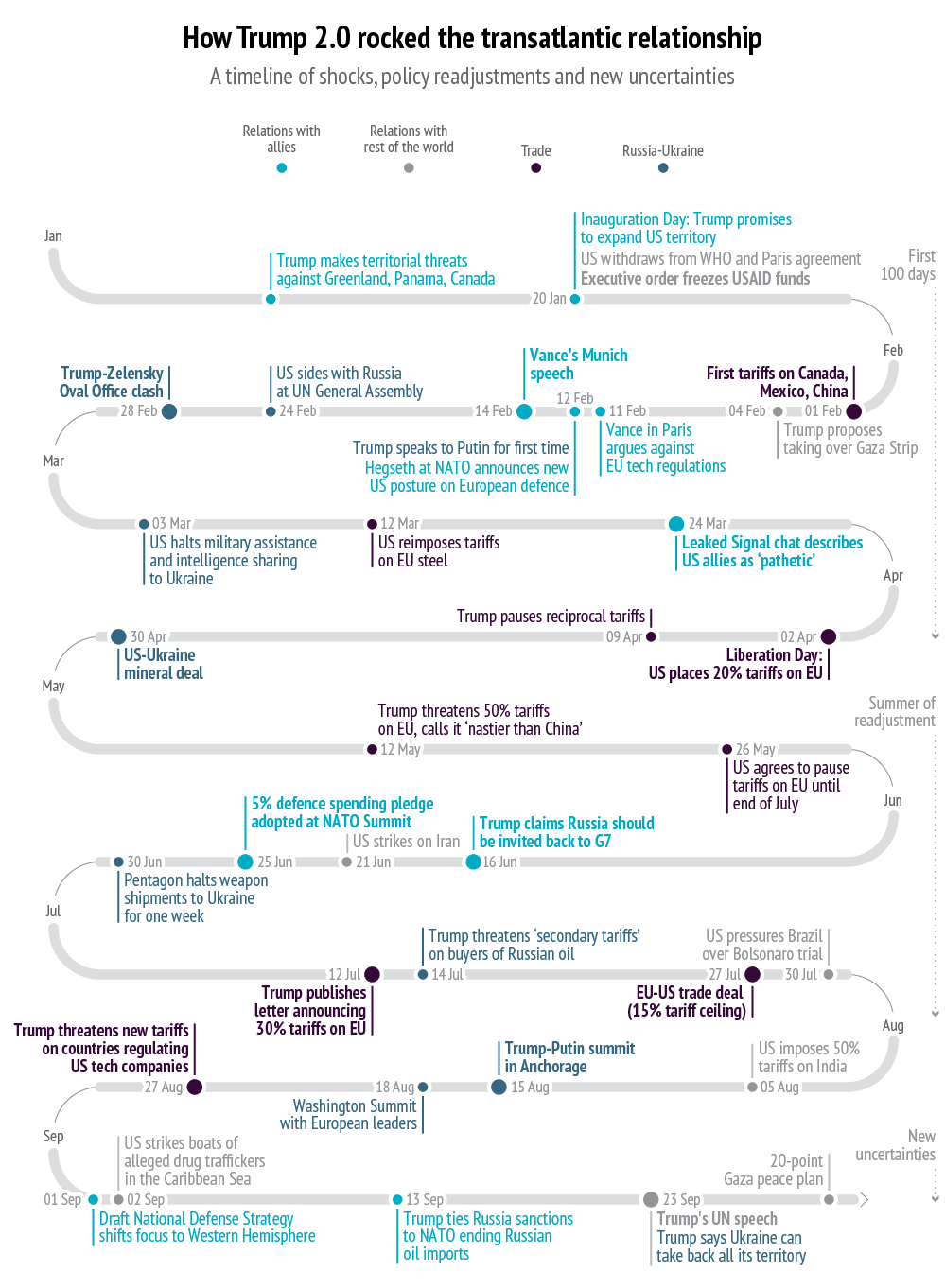
However, what has unfolded in 2025 goes several steps further, both in qualitative and quantitative terms. A glance at the year’s timeline (see page 4) reveals the scale of the disruption the second Tump administration has unleashed across trade, alliances, and the global order. The first 100 days were particularly disruptive, both in rhetoric and policy, giving the impression that the US was targeting its own allies. The summer of 2025 was slightly more constructive, with Washington and Europe striking agreements on NATO, Ukraine and trade. However, relations are not back to how they were prior to Trump 2.0. The new administration’s actions, wittingly or not, have undermined the foundations of transatlantic trust.
The first 100 days were particularly disruptive, both in rhetoric and policy, giving the impression that the US was going after its very allies.
The summer of 2025 was slightly more constructive, with Washington and Europe striking agreements on NATO, Ukraine and trade.
However, relations are not back to how they were prior to Trump 2.0. The new administration’s actions, wittingly or not, have undermined the foundations of transatlantic trust.
Trusted partners tend to share a vision of the world, built on common interests and values. They work together to accomplish shared goals, consulting each other on the steps to take, and having a clear understanding of what the partner will do next (2). They include formats and institutions for dispute resolution, so that temporary tensions do not end up destroying trust in the long run (3). The transatlantic relationship used to display all of these elements.
However, under Trump 2.0 these features are all being unravelled. This is most visible in three areas:
From common values to hostility: For 80 years, American foreign policy objectives included support for the legitimacy, integration and security of European democracies (4). Trump questioned this commitment during his first term. During his second term, he has taken additional steps. Not only is the US seeking to rebalance away from Europe – an established trend in US foreign policy that predates Trump, but which has been accelerated by the new White House (5). This administration has also displayed elements of active hostility against the European project. Trump has described the EU as a globalist entity that aims to ‘screw’ the US while freeriding on American protection (6). He has refused to rule out the use of force to annex Greenland, the territory of an EU Member State and NATO ally. At the Munich Security Conference, Vice-President Vance called attempts to curb disinformation a bigger threat to Europe than Russia and China. In May, the State Department published a memo accusing Europe of carrying out an ‘aggressive campaign against Western civilization itself’ (7). In August, the State Department instructed US embassies in Europe to actively counter EU regulations on digital services (8).
Careful diplomatic action from European heads of state persuaded the president to veer away from some of these extremes. He changed his rhetoric on NATO, declaring that the alliance ‘isn’t a rip-off’, after the allies pledged to spend 5% of GDP on defence. Yet elements of hostility to Europe are embedded in ideological programmes like Project 2025 (9), remain entrenched within Trump’s coalition, and continue to shape US foreign policy and its approach to Europe (10).
Trump’s volatility and unpredictability: Being able to predict partners’ likely behaviour is essential for planning purposes and for cooperation. But under Trump 2.0, transatlantic unpredictability has become the norm. The President has reversed policy decisions in a matter of days, if not hours, in ways that have been hard to predict.
The EU-US trade negotiations highlight this dynamic. Trump began the dispute with a 20% ‘reciprocal’ tariff across the board, which was taken down to 10% one week later after market turmoil. When an EU-US agreement appeared within reach, the president suddenly issued a ‘letter’ announcing levies of 30%, once again blindsiding EU negotiators. The 15% tariff ceiling agreement was hailed in Brussels as ‘the best possible deal given the circumstances’ (11) – as the EU avoided the 50% levies that India and Brazil are now facing. But as the general agreement is implemented, more issues will emerge which could lead Trump to reverse course again. For instance, since concluding the trade deal, the US has threatened more tariffs in response to EU tech regulation of American companies operating inside the EU.
Volatility is also evident in Trump’s Ukraine policy. Trump shifted from blaming Ukraine and blocking intelligence to Kyiv to reversing the Pentagon’s decision to halt weapon supplies and promising sanctions on Russia. These partial reversals have been taken as a sign that Trump’s extremes will give way to a more conventional administration, like in the first term (12). However, European countries fear that a single meeting could undo months of diplomatic engagement. For instance, Trump backtracked on the sanctions threat after the Alaska summit with Putin and the measures have never materialised. And the US only allows European countries to buy US weapons; it no longer donates any weapons to Ukraine.
Policy process: loyalty over competence? While there was unpredictability during Trump 1.0, checks and balances within the administration and the Republican party curbed the president’s most unconventional ideas. Now, those bulwarks are mostly gone. Trump is in full command of his party – and elected officials are unwilling to challenge him ahead of the midterms. ‘America First’ is not a doctrine: it essentially coincides with whatever Trump decides.
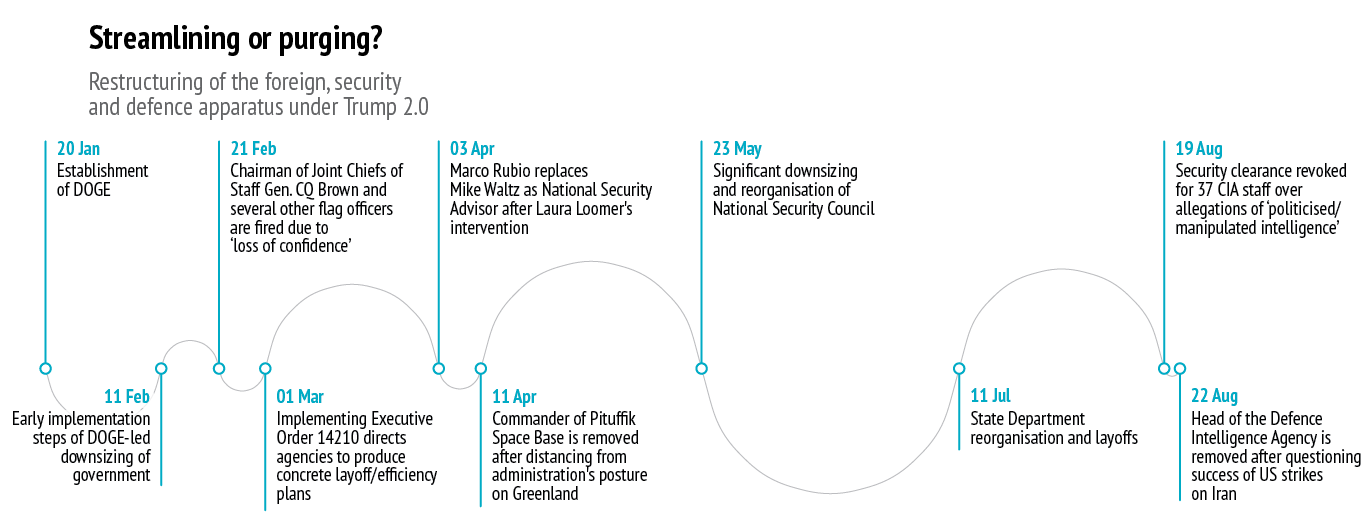
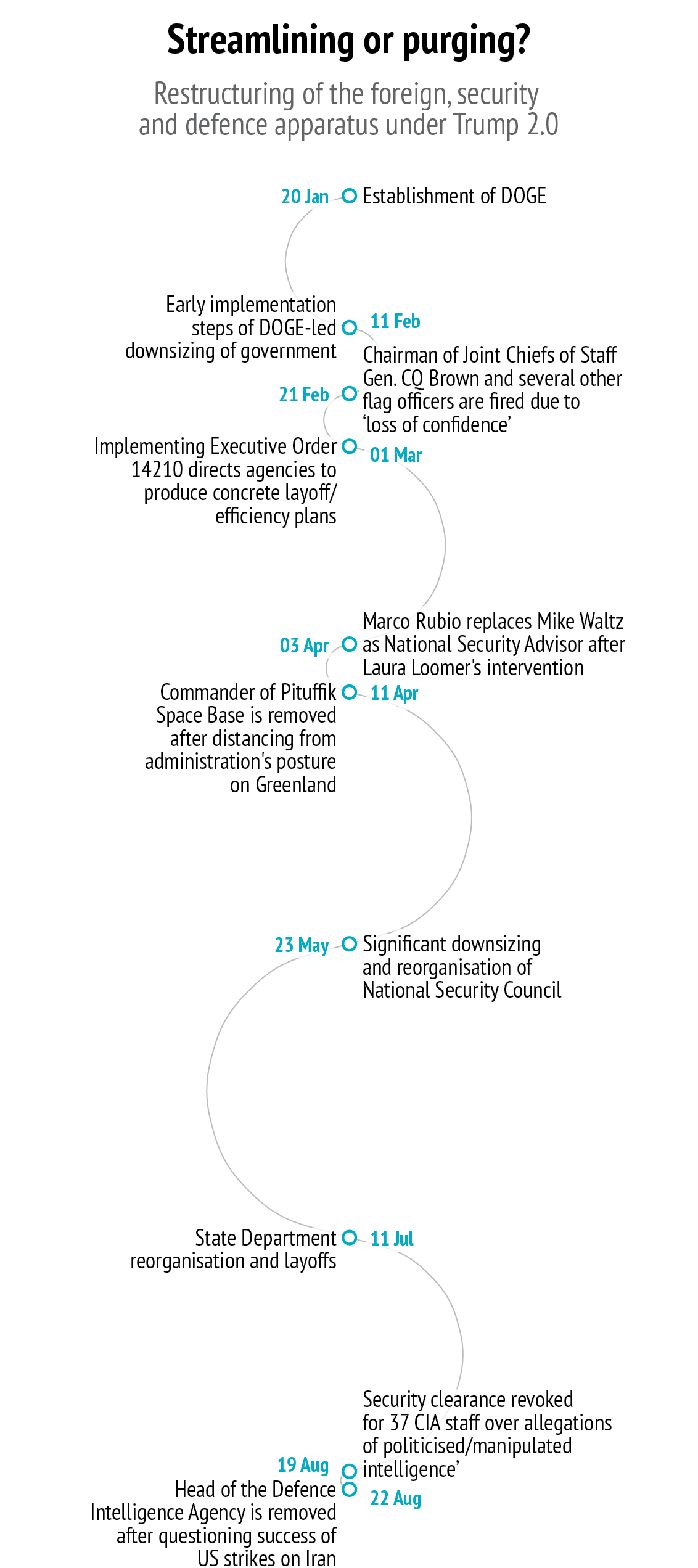
The policymaking process has also changed significantly. Groups that in the view of the president obstructed his work during the first term, like the National Security Council, have been sharply reduced in size, resulting in a messier inter-agency coordination process, and potentially hampering policy development (13). At the same time, officials who questioned the effectiveness of the administration’s policy – such as the strikes on Iran – or were associated with past probes into the 2016 election, have been removed or have had their security clearance revoked (14). These cuts are eroding the expertise held within the US government, and weakening incentives to present alternative or critical viewpoints.
All of the above – Trump’s own volatility, the premium on loyalty over expertise, and the presence of hostile elements – contribute to breaking trust. Europeans cannot be certain that the US will adhere to the new agreements made in the summer. It has become harder to predict and influence US policymaking through traditional channels. Instead, leaders have to go all the way to the president – e.g., at the hastily organised Washington Summit in August.
In 2016 many Europeans thought that Trump 1.0 was an historical exception: after the 2020 election, the relationship would return to normal – with episodes of tension, but institutions to manage them. This time, it is far harder to make that claim. Trump’s re-election shows the enduring appeal of his message to the American electorate. Most surveys show increasing scepticism by US citizens towards international institutions, alliances, and permanent American involvement abroad (15). The hostile elements who want to unravel the relationship with Europe will likely be a long-term feature of American politics, and Europe will need to learn to live with them. And the changes to the way the US government works – where loyalty is prized over competence – could be hard to undo. Hence, the erosion of transatlantic trust might be permanent.
The majority of European publics seem to understand this. According to a Pew Research Center survey, favourable European attitudes towards the US dropped by 12.9% between 2024 and 2025 (16). Many Europeans now regard the US as a ‘necessary partner’ rather than a trusted ally (17). Even more ominously, another survey found that Europeans consider Trump an ‘enemy of Europe’ (18). It is unlikely that these perceptions will change dramatically in the near future.
But Europe is not alone in experiencing this erosion of trust. Countries across the world – especially US allies – are grappling with the same factors and frustrations. Some are witnessing the weaponisation of tariffs for political purposes. Others have perceived abandonment by their main security provider, or even territorial threats. Many countries and populations that relied on US foreign aid will now have to make do without it. Some have already taken steps to adapt to an age of low trust in the US – with important lessons for Europe. An analysis of the demise of transatlantic trust would be incomplete if it ignored the international context and the experiences of other partners.
Of course, there are also people in Europe and beyond who have welcomed Trump’s new approach. At the time of writing, Trump’s unconventional diplomacy appears to have brought about a ceasefire in Gaza – a positive development. At the same time, illiberal and authoritarian actors see opportunities to strengthen ties with a Washington that is less concerned with combating autocracy. Populist forces regard Trump as the standard-bearer of their movement, and a catalyst for their own political ambitions. Traditional US adversaries like Russia and China have approached Trump 2.0 with cautious optimism, hoping to exploit weakening ties between the US and most of its traditional allies. While Trump 2.0’s volatility has also affected them – Iran, for instance, initially welcomed a less interventionist US approach but later suffered a US strike on its nuclear facilities – these actors ultimately stand to gain from the erosion of trust between America and its allies.
Exploring the erosion of trust across issues and regions
This Chaillot Paper explores how the erosion of trust has unfolded across different dimensions of the transatlantic relationship: what has changed? What strategic debates have emerged? How should Europe’s relationship with the US evolve in a low-trust environment? In the second half of the study, we ask how other actors across the world have coped with similar breaches of trust: did they experience the same feeling of broken trust as Europe? Did they see it coming, and were they more prepared? What should Europe learn from them, and how can it present itself as a useful partner in these uncertain times? We tackle these questions in 11 distinct chapters.
The issues: manageable differences or deep rifts?
The size of the trust deficit varies across different domains of the transatlantic relationship. In some areas, Europe and the US could continue working together to pursue aligned interests, but uncertainty and mistrust could also magnify existing differences, straining the relationship. In other areas, the misalignment between US and European objectives is bigger, making it even harder to find common ground moving forward – and US policy could even run counter to Europe’s interests.

Europeans have for decades trusted the US commitment to defend the continent. Now, Luigi Scazzieri argues, that belief is very much under question. European countries are therefore hedging against the threat of abandonment. In principle, a way forward could be found, with Europeans stepping up their commitments, and Washington providing some key assets for deterrence. However, the pace and manner of US disengagement from European security may still result in major deterrence gaps.

Support to Ukraine is another area where Europeans have sought to recalibrate their relationship with Washington. As Ondrej Ditrych suggests, while Europeans seek to keep Trump on their side, they must also manage Putin’s diplomatic overtures to the White House. And transatlantic tensions could also emerge in the post-war reconstruction of Ukraine, as the US and Europe might end up competing for resources.

On China policy, Tim Rühlig argues, transatlantic mistrust goes both ways: while Brussels is surprised by Trump’s not-so hawkish approach to Beijing, the US does not believe that Europeans are serious about tackling Chinese threats. This mutual lack of trust prevents the two sides from addressing what should be shared interests in countering China.

In the area of countering disinformation, the US has taken a U-turn from the approach of previous administrations. The US is dismantling its own counter-FIMI apparatus, while attacking those who block malign activities as enemies of free speech. As Leonardo De Agostini argues, this will worsen the information threat environment in Europe’s neighbourhood, empowering authoritarian actors. To safeguard against these threats, Brussels and national capitals must take the lead in countering disinformation.

Criticism of EU digital regulations is a key pillar of the alliance between Trump 2.0 and the ‘tech-industrial complex’, which Clotilde Bômont explores in her chapter. The EU must be clear-eyed about the risks this alliance poses for its digital sovereignty. However, the EU could also exploit the cracks emerging in the partnership between Trump and Big Tech, finding potential avenues for cooperation with the US government in selected areas.

Transatlantic cooperation on climate change and energy has suffered a serious hit under the new administration. Caspar Hobhouse argues that Trump’s climate denialism is making headway in Europe, weakening the EU’s willingness to pursue the energy transition. While new energy deals with Washington could serve to replace Russian fossil fuels, they also could keep Europe’s energy prices high and sustain external dependencies. He argues that the EU must not give up its leadership role in the global effort to fight climate change, working in concert with the rest of the world.
The regions: partners in need and models to learn
As mentioned above, Europe is not alone in experiencing a transatlantic rift. Countries across the world are also losing trust in the US. Some are re-evaluating their relationship now, while others had already begun to do so well before Trump’s second term. These countries are looking for trusted partnerships to compensate for the vacuum left by Washington. Should Europe fail to provide a concrete alternative, others will surely step in to fill the gap. At the same time, many of these countries can provide valuable lessons on dealing with the US in a climate of diminished trust.

The Americas, Giuseppe Spatafora argues, have been the laboratory of Trump 2.0’s foreign policy. Many of its closest allies and partners feel betrayed and under threat, while others will suffer from significant USAID cuts.

The closest US allies in East Asia, Japan and Korea in particular, are growing sceptical of American nuclear guarantees. As Lizza Bomassi notes in her chapter, the debate on developing a domestic nuclear deterrent has gained momentum, which may cause significant instability.

Neglect by Washington is likely to have a profound impact on the Western Balkans. A potential withdrawal from the region risks strengthening the cards of illiberal forces, writes Bojana Zorić. In all these three regions (Americas, Northeast Asia, and the Western Balkans), Europe has an opportunity to present itself as a trustworthy partner to those who have been most affected by the new US policy.

Other countries had lost their trust in the US well before 2025. American partners in the Gulf expected a reduction in US commitment since at least Trump 1.0. As Katarzyna Sidło claims, they have reacted by pursuing a hedging strategy, which has enabled them to navigate the changing US policy towards the region.

In Africa, Trump’s drastic cuts to USAID and withdrawal from multilateralism have only worsened what was already a low-trust relationship. Rossella Marangio argues that US-Africa relations will continue to be based on convenience – with African countries pursuing bilateral deals with Washington where possible, while also pushing back (e.g. in the case of South Africa) and strengthening their ties with other partners. While the EU might expect these actors to turn to Brussels to compensate for American unreliability, it should be aware that this will not happen automatically.
Advancing transatlantic relations under low trust
Europe faces a dilemma. On the one hand, the transatlantic relationship and cooperation with the US remain crucial. The challenges Europe faces have not gone away, and it needs to cooperate with the US where feasible. On the other hand, transatlantic mistrust will persist for a long time. There is no clear way of returning to a normal relationship. In some areas, the US may come to be seen less as a fully-fledged ally and more as a ‘necessary partner’ (19). In other areas, US policies may run counter to Europe’s interests, which will need to be defended.

The EU and its Member States must therefore develop a mixed toolbox. In the Conclusion, EUISS Director Steven Everts and Giuseppe Spatafora distil the lessons from this Chaillot Paper into concrete proposals. These include tactical steps to manage the relationship and avoid a fallout with Trump. They also entail a strategic mindset to strengthen Europe’s hand and its ability to defend its interests, if necessary without Washington. The mix between tactical and strategic moves will vary across policy domains. Both will be necessary to navigate transatlantic relations in a low-trust environment.
References
-
(1) The author would like to thank Alice Ekman for suggesting trust as the central theme of this Chaillot Paper.
-
(2) Nielsen, K.L. and Dimitrova, A., ‘Trump, trust and the transatlantic relationship’, Policy Studies, 2021.
-
(3) Hofmann, S., ‘Elastic relations: Looking to both sides of the Atlantic in the 2020 US presidential election year’, Journal of Common Market Studies, 2021.
-
(4) Jones, E., ‘Transatlantic rupture: Legitimacy, Integration and security’, Survival, Vol. 67, No. 2, March 2025.
-
(5) Spatafora, G., ‘The Trump card: What could US abandonment of Europe look like?’, Brief No.5, EUISS, February 2025.
-
(6) Euractiv, ‘EU was formed to “screw” US, Trump says in promising tariffs on cars’, 26 February 2025.
-
(7) US State Department, ‘The need for civilizational allies in Europe’, 27 May 2025.
-
(8) Humeyra, P., ‘Exclusive: Rubio orders US diplomats to launch lobbying blitz against Europe’s tech law’, Reuters, 7 August 2025.
-
(9) The Heritage Foundation, Mandate for Leadership–Project 2025, 2023.
-
(10) Belin, C., ‘MAGA goes global: Trump’s plan for Europe’, ECFR, May 2025; Bergmann, M., ‘The Transatlantic alliance in the age of Trump: The coming collisions’, CSIS, February 2025.
-
(11) Euronews, ‘“Best we could get”: Brussels defends EU-US trade deal amid mounting criticism’, 28 July 2025.
-
(12) Ashford, E., ‘Four explanatory models for Trump’s chaos’, Foreign Policy, 24 April 2025.
-
(13) ‘Trump, Rubio take aim at National Security Council’s “Deep State”’, Axios, 23 May 2025.
-
(14) ‘Donald Trump has purged one of the CIA’s most senior Russia analysts’, The Economist, 21 August 2025; ‘Pentagon fires intelligence agency chief after Iran attack assessment’, BBC News, 22 August 2025.
-
(15) Brogi, A., ‘Transatlantic relations after Trump: Mutual perceptions and strategy in historical perspective’, in Jervis, R. et al (eds.), Chaos Reconsidered: The liberal order and the future of international Politics, Columbis University Press, 2023.
-
(16) Wike, R., Poushter, J., Silver, L. and Fetterolf, J., ’U.S. image declines in many nations amid low confidence in Trump’, Pew Research Centre, 11 June 2025.
-
(17) Puglierin, J., Varvelli, A. and Zerka, P., ‘Transatlantic twilight: European public opinion and the long shadow of Trump’, ECFR, February 2025.
-
(18) Le Grand Continent, ‘Baromètre de l’opinion publique européenne : « Quelle défense pour l’Europe ?»’, 20 March 2025.
-
(19) Krastev, I. and Leonard, M., ‘Trump’s European revolution’, ECFR, June 2025.