Regardless of whether the ceasefire between the US and Iran holds, the war in the Middle East complicates European rearmament and support for Ukraine, while also further eroding confidence in the United States as a reliable guarantor of Europe's defence. To put their defence ramp-up on a firmer footing, Europeans should reduce exposure to US political volatility, industrial bottlenecks and the diversion of defence equipment during wartime.
Rearmament under strain
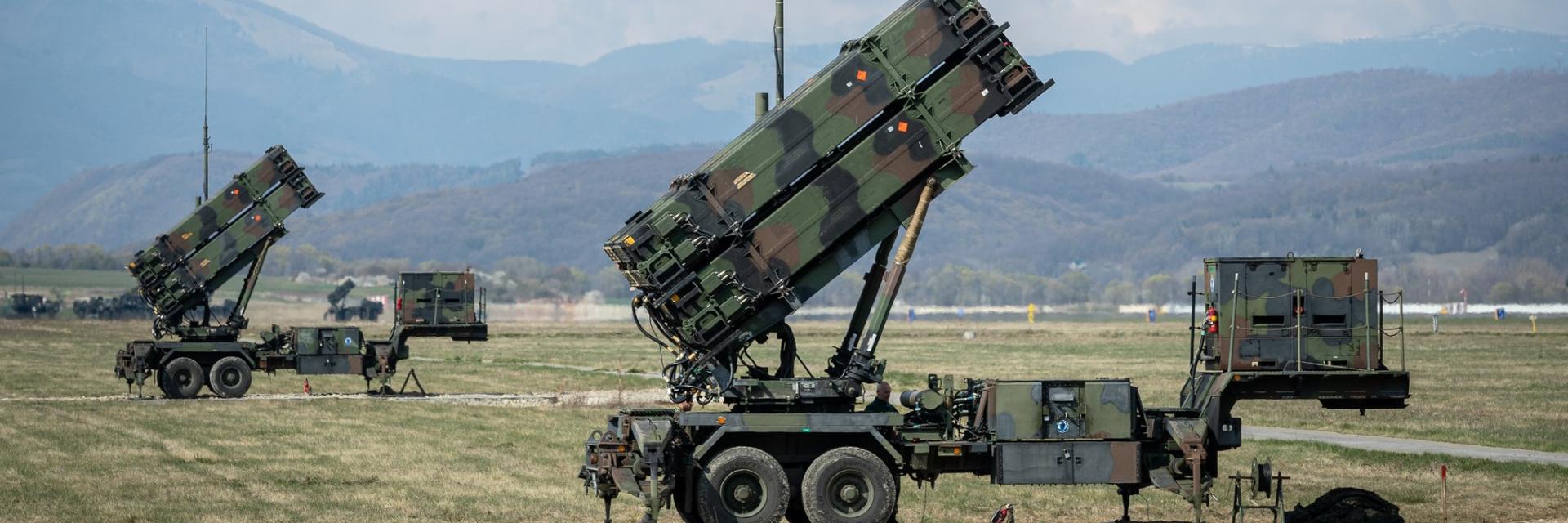
Despite grave doubts about Donald Trump’s commitment to Europe, Europeans have continued to lean heavily on Washington both for their own rearmament and for arms deliveries to Ukraine. The hope was that purchases from the US would help maintain transatlantic ties, while also providing critical equipment for which there are few alternatives in Europe, such as Patriot systems.
The US-Iran war has called this entire model into question. Politically, the war has raised new doubts about America’s commitment to European security and to Ukraine. Europeans’ unwillingness to participate in the US and Israeli military campaign has increased the Trump administration’s resentment towards NATO. If Trump acts on his pledge to ‘remember’ Europe’s ‘betrayal’, he could request a faster withdrawal of US personnel from key NATO posts, or reassess the US force posture in Europe.
Beyond the political level, the conflict in the Middle East puts in question America’s ability to deliver weapons to Europe and Ukraine in a timely fashion. The US has expended a significant share of its arsenal during the conflict. For example, replacing the more than 850 Tomahawk missiles fired would take about ten years based on the current production rate of around 85 units per year.
The US will likely prioritise replenishing its own arsenals – both for home defence and to ensure credible deterrence in the Indo-Pacific – over the needs of European allies and Ukraine. This shift is already underway: in March, Switzerland learned that its order of five Patriot systems would face a five-year delay. The Pentagon has also discussed redirecting assets earmarked for Ukraine to the Middle East.
The war will also make Europe’s defence ramp-up harder to sustain economically, due to lower growth and additional strain on government budgets. For some states, the conflict may also generate new operational costs, particularly through potential maritime security deployments to protect shipping in the Gulf.
These political, technical, and economic pressures will deepen Europe’s window of vulnerability. Ukraine may receive less support, and more slowly, while European countries will struggle to rapidly strengthen their own capabilities. The result is a wider window in which Russia could judge that the balance of risk has shifted in favour of further aggression.
Strengthening the foundations of Europe’s rearmament
Europeans need to close this window of vulnerability as quickly as possible. While there is no easy solution, a three-pronged approach would help strengthen Europe’s defence ramp-up.
First, Europeans need to redouble investment in their own systems in order to reduce their dependence on external supply in key capability areas. In principle, Europe can replace US systems both for air defence and long-range strike with domestic alternatives. SAMP/T is Europe’s closest equivalent to Patriot for long-range air and missile defence, while IRIS-T can cover the medium range. For long-range strikes, Europeans possess systems such as Scalp/Storm Shadow and Taurus.
The challenge is that these systems have historically been produced in low volumes. There has been some progress in recent years. For example, France and the UK have placed orders for Scalp/Storm Shadow, and Germany is planning to procure new Taurus missiles. However, larger orders are needed to expand production and establish credible stockpiles.
Coordinated purchases would help deconflict and aggregate demand, thereby lowering costs. For example, Bulgaria, Estonia, Latvia and Slovenia have jointly placed orders for Diehl IRIS-T SLM through the German-led European Sky Shield Initiative. The aim should be to build clusters of countries using interoperable systems across different layers of defence. Europeans should place particular emphasis on developing low-cost interceptors against drones. There are already promising initiatives in this area: for example, Frankenburg Technologies is partnering with Poland’s PGZ to manufacture up to 10,000 low-cost anti-drone missiles per year in Poland.
Second, Europeans need to work more closely with Ukraine. The first priority is to ensure that Ukraine can produce what it needs by giving the country access to sufficient and predictable funding. Direct support to Ukraine’s defence industry remains the most efficient way for Europeans to strengthen its war effort. The aim should not only be to buy more weapons for Ukraine, but also to integrate Ukraine more deeply into the wider European defence industrial base, thereby harnessing its expertise and innovation potential.
Encouraging partnerships between EU firms and their Ukrainian counterparts is an important part of that effort. A notable example is the localisation of production of components for the Ukrainian Flamingo missile in Denmark. Current efforts focus on producing weapons in Europe for Ukraine, but over time the focus could shift to producing in Europe directly for European armed forces. Europeans should actively promote such partnerships through dedicated networks and funding. The EU is already playing a significant role through the EU–Ukraine Task Force on Defence Industrial Cooperation, which aims to identify concrete collaboration opportunities and support common procurement. Initiatives to connect European and Ukrainian firms, such as BraveTech EU, can also help to tap into Ukraine’s expertise.
Third, many European countries have already placed large orders for US-origin air defence and long-range strike systems, creating a degree of path dependence. Because some reliance on US systems in these areas and beyond will remain unavoidable for the foreseeable future, Europeans should seek to mitigate the associated risks. One way to do so is by encouraging US companies to set up production lines on European soil. A case in point is the Raytheon-MBDA Patriot production facility in Germany, supported by European orders for up to 1,000 PAC-2 missiles to strengthen regional inventories. While this may not be a feasible approach for existing contracts, it should be explored for future ones. Anchoring more production, maintenance and sustainment in Europe would help Europeans hedge against supply disruption when buying from the US.