Image
The EUISS is an agency of the European Union

Although it deploys no ground troops in Ukraine, Belarus continues to undermine European security by enabling Russsia’s war of aggression. Ukraine is obliged to divert forces to secure its northern border with Belarus. Belarus hosts combat support systems such as drone control stations; its civilian infrastructure is used to map Russian drone trajectories; it provides training for Russian forces; and its defence industry, operating through sanctions evasion networks involving entities in Russia, China and the West, feeds Russia’s war effort by supplying military hardware and ammunition. Belarusian enterprises are key providers of launch vehicles for Topol-M, Yars or Iskander missile systems, services to the Russian air fleet, sighting and guidance systems, and microchips – including those produced by the now sanctioned company Integral. They may have supplied equipment worth more than €1 billion in the first three years of the full-scale war alone(1).
Aleksandr Lukashenka is eager to avoid being seen as a belligerent on a par with Russia. However, his room for manoeuvre is limited. The regime’s consolidation following the post-election crisis in 2020 has relied heavily on the Kremlin’s support and protection. As a result, Lukashenka’s former hedging strategy, which periodically involved engagement with the EU, has collapsed. Even a ‘grand bargain’ with the Trump administration, now being floated in some circles, would not restore the regime’s autonomy vis-à-vis Russia which continues to tighten its grip over the country. Although integration notionally proceeds through 31 sectoral roadmaps, it has advanced furthest in the military domain, driven by Minsk’s deepening economic dependence on Moscow(2).
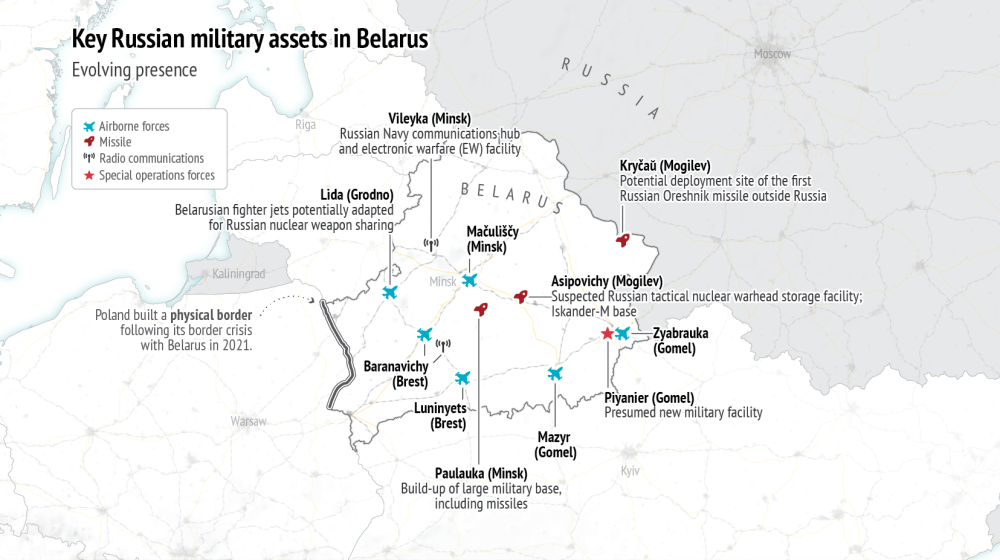
The military integration of Russia and Belarus under the framework of the Union State, enacted through the Regional Grouping of Forces as part ofRussia’s Moscow Military District, poses a distinct threat to the EU. Belarus is turning into a potential operational platform for a future Russian war against the EU. Although Russia’s military presence in Belarus is currently limited to around 2 100 troops, recent agreements have consolidated its basing rights(3). The agreement on joint combat training centres ratified in December 2023 and the provision regarding the presence of military formations in Article 5 of the Treaty on Security Guarantees, provide a legal basis for the future deployment of Russian troops in Belarus, while the regime is considering allowing foreign nationals to serve in its armed forces. Military sites and logistical infrastructure are being developed in parallel (see map below). Zapad 2025, the most recent major joint military exercise, conducted in September 2025, was relatively modest and featured a smaller nuclear component than previous iterations(4). But it underscored Belarus’s subordinate role in Russia’s military planning(5). The threat that Belarus poses is amplified by geography: the country’s flat terrain facilitates rapid troop movements, while its proximity to the Suwałki Corridor gives it strategic importance for the collective defence of the Baltic states.
These developments also pose a threat to Ukraine. Kyiv came under attack launched from Belarusian territory at the outset of the full-scale war, and it now faces the prospect of escalation along its northern border as Russia seeks to weaken Ukraine’s defensive posture while pursuing its offensive campaign in the Donbas. At the same time, deepening integration threatens Belarus’s sovereignty and even national identity as Russia increasingly promotes the ideological principles of the Russkiy mir doctrine in Belarusian society and culture.
Moreover, Belarus already serves as a platform for Russia’s psychological warfare against the EU. Russia’s tactical nuclear weapons and dual delivery systems are central to Moscow’s strategy of intimidation. The scale of the deployment remains unclear, particularly in the case of Iskander-M missiles and Su-25 and Su-30 bombers reportedly adapted for nuclear missions, as well as the Oreshnik missile system, despite the nuclear-sharing agreement signed in 2023 and recurrent statements by both Lukashenka and Vladimir Putin. There is greater certainty about the presence of Iskander-M systems and the storage of related warheads at the Asipovichi military base(6). The much-heralded deployment of Oreshnik missiles, meanwhile, appears to be limited to the designation of combat patrol areas around the Krichev-6 facility in Mogilev oblast.
Oreshnik illustrates the role these deployments play in Russia’s psychological warfare. The missile system is not yet in serial production and its integration with the MZKT-79291 launcher chassis, a key component that would give it full mobility(7), has not been confirmed. The missile is a serious concern for Europeans as an intermediate-range ballistic system with significant escalatory potential operating in a continent where no arms control regime has replaced the Intermediate-Range Nuclear Forces (INF) treaty. Fast and mobile (once integrated with a mobile launcher), Oreshnik is not intended for deployment near a hostile border where Russia already fields Iskander and Kalibr systems. The attention Oreshnik has attracted in Western media has magnified the impact of its largely performative deployment. Its purpose is less to strengthen Russian deterrence, as Moscow claims, than to enhance the effectiveness of Russian coercive diplomacy by reinforcing the Kremlin’s increasingly frequent nuclear threats, and to constrain the EU’s response options in a future limited war scenario. Nuclear use by Russia should not be ruled out. However, the heightened readiness of nuclear forces deployed in Belarus, demonstrated during the last joint exercise held in May 2026, still serves primarily as a tool of intimidation(8).
Like military integration in the conventional domain, these deployments – over which the regime does not exercise control – do not deliver more security for Belarus but instead contribute to its further vassalisation. Contrary to Lukashenka’s claim that nuclear weapons protect Belarus from externally orchestrated regime change and safeguard the country’s independence, their presence is undermining both.
Russia is likely to continue its creeping penetration of Belarus. Direct annexation, whether to advance Putin’s imperial project or to remove the risks of Minsk deviating from Moscow’s script, is unlikely, even in the event of a sustained cessation of hostilities in Ukraine. The Kremlin appears content with the current balance of benefits and costs associated with Belarus’s subordinate status. It would also likely view an expanded border with NATO as more of a liability than an asset. Unless Moscow concludes that Western efforts to draw Belarus out of Russia’s orbit pose a clear and imminent threat, it is therefore unlikely to seek to dramatically alter the status quo.
Even so, Belarus is likely to play a growing role as a launchpad from which Russia can exert pressure through hybrid warfare against the EU.Regardless of Minsk’s preferences, in the baseline scenario Belarus is primed to play a key role in Russia’s multidomain escalation strategy. Ongoing military penetration is creating the conditions for the redeployment of Russian assets once the war against Ukraine settles into a frozen conflict. Areas surrounding the line of contact there will remain heavily militarised. Belarus, however, offers a natural destination for the partial redeployment of Russian kontraktniki (contract soldiers). Stationing some of these forces in Belarus would allow Moscow to maintain a military presence in the wider Ukrainian theatre while increasing pressure on the EU, forcing Member States to adapt their defence planning, while averting the political and social costs of their demobilisation at home. Soviet-era military infrastructure would help absorb the costs of redeploying these troops, and could turn Belarus into a staging ground for a future Russian military attack against the EU.
A wildcard could, however, disrupt this baseline scenario in the form of an escalation of Russia’s war of aggression against Ukraine that directly implicates Belarus. There is currently no evidence that the Lukashenka regime is preparing to take part in any offensive operations. But the use of Belarusian territory as a launchpad for Russian hostile activities could still prompt retaliatory strikes by Ukraine. The regime in Minsk is keen to avoid such a scenario, as it would carry a significant risk of upsetting the current fragile equilibrium. The EU can exploit this vulnerability to alter a trajectory that is steadily undermining European security.
Although the Lukashenka regime’s room for manoeuvre has narrowed, prudent and targeted engagement with it can still shape certain outcomes in ways that serve the EU’s interests.
Any adjustment of the EU’s approach towards Belarus must not simply restore Lukashenka’s room for manoeuvre in exchange for limited and temporary humanitarian concessions. For a dictatorial regime, political prisoners are an effectively unlimited resource. Moreover, giving Lukashenka greater latitude would likely reinforce rather than weaken authoritarian consolidation. Although tensions exist between the economic bloc of technocrats and the siloviki, the latter’s position remains secure and uncontested. It would also indirectly aid Russia’s military reconstitution without advancing the EU’s overarching objective, which differs from that of the Trump administration: a future free and independent Belarus that does not pose a threat to European security(9).
Nor should the EU demand what the regime cannot realistically deliver at present: a complete break with Russia. What the regime can do is limit domestic repression, refrain from hostile actions of its own – something that should be a precondition for any engagement – and credibly resist involvement in any further escalation of Russia’s war in Ukraine or in Russian hybrid campaigns targeting the EU. Such a more geopolitically detached stance would be supported by domestic preferences and concerns about Russia’s growing influence in Belarus and the risk of deeper entanglement in its war. The EU should seek to leverage these concerns and insist on practical confidence-building and risk-management measures, including more extensive exchanges of military information.
The EU’s debate on Belarus policy should move beyond the current engagement-or-isolation paradigm towards a strategy that combines increased pressure with a clearly defined pathway towards sanctions relief. In practical terms, increased sanctions pressure should be accompanied by clear signals about what steps the regime needs to take for restrictions to be eased to their current level or below. The EU should coordinate this approach closely with Ukraine. Any potential easing of restrictions, including allowing potash exports by Belarus’s state-owned producer Belaruskali to transit through the EU, must be strictly conditional, and subject to robust verification and snapback mechanisms. Safeguards are also needed to ensure that sanctions relief does not indirectly facilitate Russia’s military reconstitution and hence magnify the threat Russia poses to the EU.
In addition, the EU should increase its support for democratic forces and civil society. Any future political change capable of extricating Belarus from Moscow’s embrace and permanently reducing the threat that the country currently poses to the EU will depend not on a single grand bargain with the regime but on the gradual rebuilding and expansion of the political and civic space in Belarus.
The process will also need to be protected from Russia’s efforts to derail it. This will require both constraining Russia’s ability to interfere and including Belarus in any future discussions with Russia on a European security architecture. Such discussions could cover force deployment limits and military transparency measures, which Minsk appears to be ready to consider in principle, as a means of managing risks along Europe’s extended frontline with Russia. Despite Russian infringement of its sovereignty, Belarus should be treated as an independent actor in these discussions, helping to create the conditions for that status to become a reality in the future.
In parallel, the EU needs to strengthen its capacity for defence, deterrence and escalation management across the full spectrum of threats emanating from Belarus. These range from coercion and intimidation – including tools of psychological warfare like Oreshnik – to the use of Belarusian territory as a platform for Russian military aggression against the EU. EU-wide efforts should complement initiatives already pursued by neighbouring states, exemplified by Poland’s measures to counter drone incursions and weaponised migration.
*The author wishes to thank Josef Mayr, EUISS trainee, for his invaluable research assistance.
1. Belarusian Investigative Center, 7 May 2026.
2. Belarus depends on Russia for market access, 95% of its fuel and energy imports and fiscal stability sustained by repeated debt relief. Expert View, Beleconomy, December 2025; Shraibman, A., ‘How to help Belarus preserve its sovereignty and democratic resilience’, GMF, January 2026.
3. iSANS, ‘Review of military activity in Belarus’, February 2026.
4. Rosa-Hernández, G. and Eveleth, D., ‘The “Zapad” exercise and how Lukashenko learned to love the Bomb’, Bulletin of the Atomic Scientists, 6 November 2025.
5. Skorupa, K. and Muzyka, K., ‘Zapad 2025 in Belarus: Structure, conduct, implications’, Rochan Consulting, October 2025.
6. Rosa-Hernandez, G., Eveleth, D. and Schwartz, P., When Nuclear Weapons Return to Belarus: Evolving concepts in Russian escalation management strategy, CNA, Arlington, October 2025.
7. The two confirmed launches of Oreshnik from Russia’s Kapustin Yar base that targeted Ukraine were thus more experimental.
8. Muzyka, K., ‘Evolution of Belarusian nuclear-related exercise activity between 2024 and 2026’, Rochan Consulting, 25 May 2026.
9. Council of the European Union. ’Council Conclusions on Belarus’, 19 February 2024.