After three decades of Alexander Lukashenka’s rule, Belarus remains trapped between a ruthless dictatorship on the one hand, and Moscow’s increasingly suffocating embrace on the other. The EU must reinforce its commitment to the vision of a free, democratic, sovereign and independent Belarus with a clear path to EU membership(1). It also needs to make Belarus a part of the conversation on the future of security in Europe as efforts to end the fighting in Ukraine take shape.
This Brief analyses recent domestic and geopolitical trends related to Belarus before proposing how the EU should recalibrate its policies in support of the democratic opposition, and vis-à-vis the regime.
The Lukashenka regime has historically survived crises through a calculated strategy of pragmatic balancing. However, that approach collapsed following the August 2020 presidential election. The regime responded with unprecedented brutality to the democratic mobilisation that began to pose a direct threat to its grip on power when Svetlana Tsikhanouskaya won the popular vote. More than 30 000 people were arrested. At least 100 000 fled the country to escape the deepening repression and intimidation(2).
Against this backdrop, the sham presidential election that took place on 26 January 2025 handed Lukashenka a record 86.82% of the vote and a seventh presidential term(3). As in previous elections, the regime tried to project a ‘human face’ ahead of the vote. In 2024, it released around 200 political prisoners and circulated footage of the jailed opposition politician Viktor Babaryka and RFE/RL journalist Ihar Losik after almost two years of holding them in detention incommunicado(4). Yet politically motivated arrests, trials and other forms of persecution meanwhile continue. More than 1 250 political prisoners remain unjustly detained while four political prisoners died in custody in 2024(5).
What is changing, however, is the geopolitical context. Moscow’s increased foothold in Belarus presents growing security challenges for the EU, and a frozen conflict in Ukraine could further exacerbate those risks. However, this would also reshape the relationship between Moscow and Minsk – an evolving dynamic which the EU should closely monitor and strategically exploit.
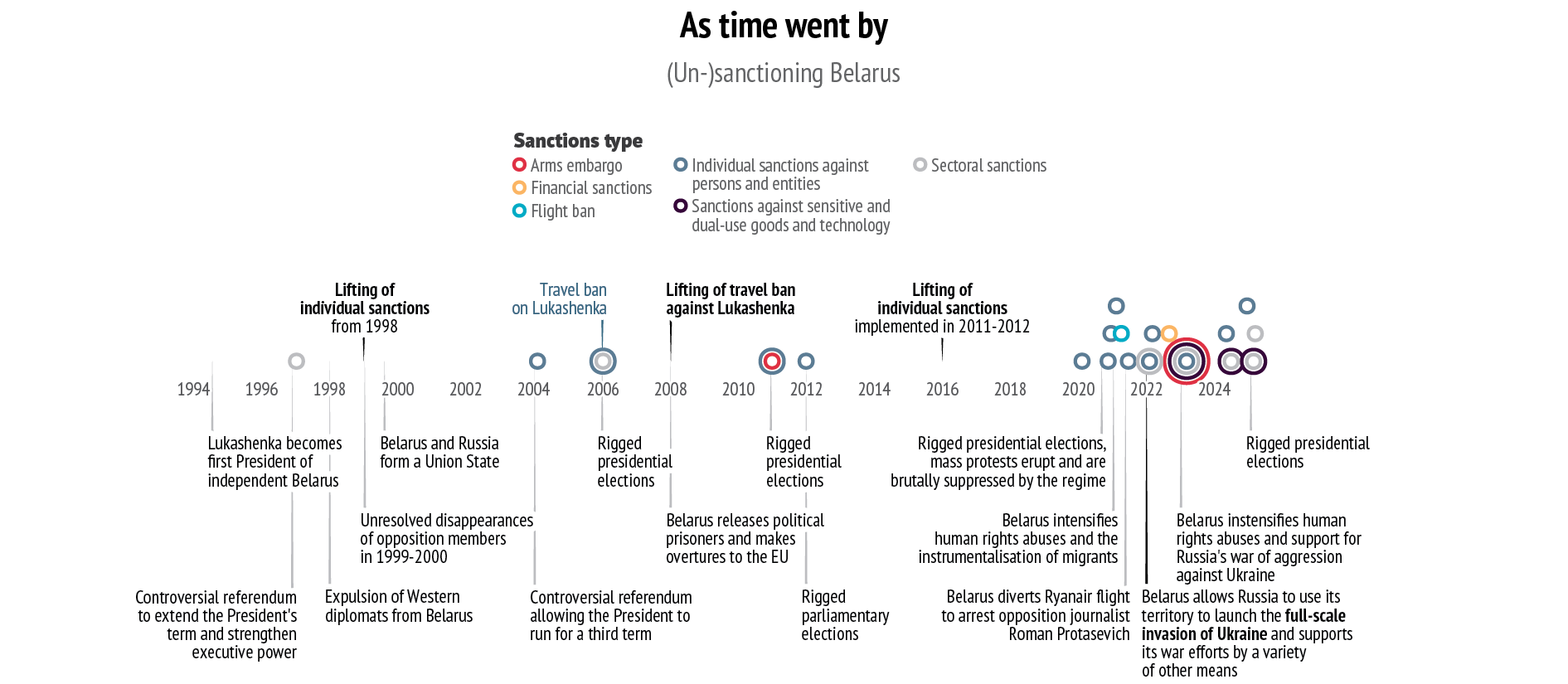
NB: Individual sanctions against persons and entities include asset freezes and travel bans.
Russia’s tightening grip
To ensure the survival of his regime amid the 2020 election crisis, Lukashenka moved closer to Russia. Moscow helped to stabilise his rule, including by a tacit threat of military intervention that prevented defections within the ruling apparatus. In return, Lukashenka had to accept tighter Russian control and comply more with Moscow’s wishes.
Since 2021, Belarus has weaponised irregular migration as a tool of hybrid warfare against the EU’s external borders. Over 52 000 people attempted to cross illegally into Poland, Lithuania and Latvia that year. In 2024, the number remained significant at 36 030(6).
In 2021, Belarus also suspended its participation in the EU’s Eastern Partnership and started allowing greater Russian military presence in the country. In 2022, it became complicit in Russia’s full-scale invasion of Ukraine. Under the cover of the ‘Union Resolve’ exercise, some 30 000 Russian troops moved into Belarus, later engaging in the (ultimately unsuccessful) operation to capture Kyiv. Although Belarusian armed forces have not been directly involved in Russia’s armed aggression, Belarus has facilitated it in various other ways. It has served as a logistical base and a ‘military warehouse’ for storing and repairing equipment, transporting personnel and firing ballistic missiles while allowing overflights by Russian warplanes and drones. Belarus has also supplied Russia with military equipment including ammunition, T-72 tanks, IFVs, trucks and helicopters. Finally, it has also played a role in helping Russia circumvent Western sanctions, thereby aiding Russia’s weapons production. One example is the delivery of microchips used in Russian missiles by the Belarusian company Integral – which the EU finally sanctioned in February 2025.
The actual presence of Russian military forces in Belarus is currently estimated at no more than 2 000 troops. The Wagner paramilitaries, whom Lukashenka invited in 2023, hoping – ultimately in vain – that they would train his forces as well as provide useful contacts in Africa, are now also gone. Nonetheless, Ukraine still needs to commit manpower and resources for reconnaissance and fortifications to protect its northern border in view of Belarus’s role as a past and potential future launchpad for armed invasion. This frustrates Kyiv’s defensive efforts elsewhere. Beyond troops or other weapons systems, and with significant implications for broader European security, nuclear warheads for Russia’s Iskander-M missiles (deployed earlier) and nuclear aerial bombs for Su-25 and Su-30 aircraft were relocated to Belarus in 2023(7).
This military cooperation goes hand-in-hand with deeper integration within the framework of the Union State, facilitated through a series of ‘roadmaps’(8) and the signing of a package of ten agreements, including one extending security guarantees, on the State’s twenty-fifth anniversary in December 2024. While the provisions in these agreements are largely symbolic, they ultimately provide Moscow with greater leverage to interfere in Belarusian affairs – for example through a formal authorisation to intervene in the event of a crisis(9).
This integration does not (yet) amount to de facto annexation. Russia’s tightening grip is reinforced, however, by Belarus’s growing economic dependence. Belarusian exports to Russia now stand at 70% (an increase of over 20% compared to 2021)(10). Moreover, Russia plays a crucial role in facilitating exports of Belarusian goods to third countries – including potash shipments to China and other markets.
While purges in the regime apparatus have helped cement Belarus’s alignment with Russia, Lukashenka has at the same time sought to hedge against Moscow’s growing influence while offsetting the economic and symbolic costs of isolation from the West. The regime’s deepening relations with China, with whom it has enjoyed an ‘all-weather and comprehensive strategic partnership’ since 2022, merit special attention in this context. China is Belarus’s second-largest trading partner, with exports surging by 77% in 2023(11). Minsk has been hoping to attract more Chinese capital through the Вялікі камень (Great Stone) industrial park project. Military cooperation has also expanded, including the development of the Polonez multiple launch rocket system and a bilateral military exercise staged in Belarus in July 2024. Relatively frequent high-level meetings – there have been at least 13 between Lukashenka and Xi to date – underscore Belarus’s efforts to maintain international ties. Its accession to the Shanghai Cooperation Organisation (SCO) in July 2024 and designation as a BRICS ‘partner country’ furthermore seek to project an image of Belarus as a respected partner on the international stage, despite its pariah status in Europe.
But the partnership with China currently has clear limits, Lukashenka’s persistent attempts to cultivate it notwithstanding(12). Offers to privatise Belarusian companies to attract Chinese capital have so far come to nought, as Beijing has consistently preferred to provide tied loans rather than direct investment. Nor has Belarus’s parallel reaching out to the Gulf countries, India, Pakistan, Africa or North Korea been effective in offsetting Russia’s growing influence. With Europe’s doors shut, these attempts at geopolitical diversification are unlikely to significantly alter Belarus’s dependence on Moscow.
More EU engagement
The crackdown on the democratic protest movement in 2020 abruptly ended a rapprochement with the EU that had begun five years earlier. In response, the EU scaled down its relations with the regime, reimposed and introduced new sanctions, and redirected its assistance towards civil society and independent media. It also strengthened its support for victims of repression and human rights defenders, worked to protect and preserve Belarusian cultural heritage, and provided assistance to SMEs in exile. The EU further pledged its readiness to support a peaceful democratic transition through a €3 billion investment package.
Keeping the vision of a future free and independent Belarus alive is an important normative commitment. Belarus’s future is, however, also of increasing concern for European security. How can the EU more effectively address both of these challenges?
First, the EU should continue to support the United Transitional Cabinet (UTC) and the Coordination Council as the legitimate representatives of the Belarusian people. It should provide financial assistance and help develop comprehensive and viable structural reform plans for a future democratic Belarus. The EU could also invite the opposition to focus more on the domestic agenda and effectively communicate its vision, placing greater emphasis on education, healthcare and social policies. In addition to lending full support to human rights defenders, the EU should also back the UTC’s efforts to foster (virtual) connections between the opposition in exile and people at home. Moreover, in its own communication, the EU must clearly convey that it will welcome a free and democratic Belarus as a future member.
Second, the EU should anticipate and capitalise on new dynamics in Russia-Belarus relations that may emerge following a potential deal to freeze the war in Ukraine – a scenario that would weaken Minsk’s position vis-à-vis Moscow and may expose it to intensified efforts by the Kremlin to undermine its sovereignty. The EU should take advantage of Lukashenka’s fears of being reduced to Russia’s regional gubernator, as well as the growing realisation among regime apparatchiks that the current system is unsustainable in the long run. Brussels should maintain its hardline stance, preserving and even further expanding sanctions. In parallel, selective engagement with elements of the regime should remain an option. This approach would be based on the premise that steps such as the release and non-harassment of political prisoners, dialogue with the democratic opposition, and an end to hybrid attacks could pave the way for suspending certain sanctions and even resuming sectoral cooperation and assistance. This new conditional approach should orient the process towards a negotiated transition in the future. The EU should take note of the Trump administration’s steps towards rapprochement with the Lukashenka regime. But it should use its own leverage to demand real, sustained and measurable progress towards liberalisation – going beyond the mere release of political prisoners.
Moscow will resist any attempts to reduce its control over Belarus. Any real democratic transition in Belarus remains contingent either on a regime change in Russia, or the latter’s diminished capacity to interfere in Belarusian affairs. It is also closely tied to the outcome of the peace process in Ukraine. The EU should therefore seek the best possible deal for Ukraine while, to the extent possible, coordinating with the US to create disincentives for future Russian interference in Belarusian politics. It should also prepare for a possible scenario in which Russia’s efforts to erase Belarusian sovereignty and national identity by force lead to a violent rupture.
Third, in the meantime the EU should raise the issue of Russia’s military presence in Belarus with Moscow during any future discussions about European security – responding to the Kremlin’s manifold demands with a list of its own. The potential Oreshnik deployments alluded to by Putin and Lukashenka are a red herring here: forward deployment of fast intermediate-range ballistic missiles (IRBMs) would make little military or strategic sense for Russia. The EU should instead insist on the withdrawal of Russia’s deployed nuclear weapons and Iskander-M missiles from Belarus. Furthermore, the EU should seek assurances that Russia will not redeploy land troops from the Ukrainian battlefield to Belarus, where they could heighten the threat to the Suwalki Gap. Finally, it should push for restrictions and increased transparency regarding all exercises conducted on Belarusian territory – including the upcoming Zapad-2025 in September – to mitigate the risks of them being utilised as a prelude to future aggression.
References
* The author would like to thank Carole-Louise Ashby, EUISS trainee, for her invaluable research assistance.
-
Council Conclusions on Belarus, 6737/24, 19 February 2024; see also Council Conclusions on Belarus, 11661/20, 12 October 2020.
-
See, for example, Report of the United Nations High Commissioner for Human Rights, A/HRC/55/61, 15 March 2024 (https://www.ohchr.org/en/documents/country-reports/ahrc5561-situation-human-rights-belarus-run-2020-presidential-election) In April 2024, the UN Human Rights Council established a group of independent experts to investigate international crimes committed by the Belarusian authorities.
-
‘Belarus’s Central Election Commission declares Lukashenko winner of presidential election’, Radio Svoboda, 27 January 2025 (https://www.svoboda.org/a/tsik-belarusi-obyavil-lukashenko-pobeditelem-…
-
At least 8 other political prisoners including Siarhei Tsikhanouski, Sviatlana Tsikhanouskaya’s husband, remain incommunicado in what constitutes enforced disappearance under international law and potentially also a crime against humanity.
-
European Parliament, ‘Resolution 2024/3014(RSP) on the need to address the continued oppression and fake elections in Belarus’, 22 January 2025 (https://www.europarl.europa.eu/doceo/document/TA-10-2025-0002_EN.html
-
A calculation drawing on data from Deutsche Welle, Statista, and Latvia and Lithuania border guard services. See also Ashurkevich, T., ‘Inside Belarus’ secret program to undermine the EU’, Politico, 22 January 2025 (https://www.politico.eu/article/alexander-lukashenko-belarus-secret-pro…
-
Belarus was the first state to voluntarily give up nuclear weapons in the 1990s. Days into Russia’s full-scale invasion of Ukraine, a sham referendum took place after which a clause binding Belarus to remain a non-nuclear and neutral state was removed.
-
Huterer, M. and Sahm, A., ‘Belarus: Sovereignty under threat’, SWP Comment, 12 June 2024 (https://www.swp-berlin.org/10.18449/2024C22/
-
Klisiński, K. and Zochowski, P., ‘Security above all: A revised Belarus-Russia alliance’, OSW, 9 December 2024 (https://www.osw.waw.pl/en/publikacje/analyses/2024-12-09/security-above…
-
Klysinski, K., ’Towards a dependence with no alternative: Russia’s increased role in the Belarussian economy’, OSW, 18 August 2023 (https://www.osw.waw.pl/en/publikacje/osw-commentary/2023-08-18/towards-…
-
Zahid, M., ‘Decoding China’s foreign policy approach toward Belarus’, The Diplomat, 14 December 2023 (https://thediplomat.com/2023/12/decoding-chinas-foreign-policy-approach…)
-
Lukashenka first travelled to China as president in 1995. The progressive development of the relationship between the two countries that followed entailed elevating its status in Beijing’s formal nomenclature, Belarus’s deeper engagement in the SCO (advancing from a dialogue partner to observer to member), but also, for example, Minsk’s adopting the PRC’s line on Taiwan.