Summary
- Africa’s digital transformation is accelerating, creating opportunities for growth, regional integration and innovation, but also vulnerabilities in infrastructure, data governance and cybersecurity. As China, the US, South Korea and India compete to shape Africa’s digital markets, African governments are pursuing greater strategic autonomy, supplier diversification and local value creation, giving momentum to closer EU-Africa digital cooperation.
- EU and African priorities are converging across trusted connectivity, data governance, AI, cybersecurity, digital public infrastructure and skills. Although cooperation frameworks already exist, their success will depend on financing, implementation, local ownership and the ability to deliver credible alternatives to other external partners.
- Ghana and Kenya illustrate complementary partnership models, demonstrating how future EU-Africa digital cooperation should integrate security, infrastructure, markets and governance within a coherent, African-led framework.

- This Brief is part of the Africa Next series, dedicated to examining forward-looking themes and policies crucial for the Africa-EU partnership.
Africa’s digital transformation has become a strategic issue for governments across the continent and the EU alike. Between 2019 and 2024, the proportion of individuals using the internet increased by 37%(1), while Africa’s digital transformation market, valued at USD 30.24 billion in 2025, is projected to grow to USD 72.23 billion by 2031(2). Nevertheless, the continent still faces the world’s largest connectivity gap. In 2025, only 36% of Africa’s population had internet access, compared with 74% globally(3), with connectivity remaining primarily mobile-led.
While Africa’s digitalisation opens major economic, societal and political opportunities, it also exposes countries to external dependencies, cybersecurity risks and information manipulation. These vulnerabilities mirror European concerns over trusted infrastructure, secure digital services and democratic resilience, creating room for deeper Africa-EU cooperation as interests converge. Building Africa-EU digital partnerships, however, requires translating shared ambitions into practical capabilities that reflect Africa’s diverse digital realities and deliver mutual benefits.
Converging interests
In its 2025 International Digital Strategy, the EU presents external digital cooperation as a way to diversify its partnerships, promote an open and rights-based digital model, and strengthen its autonomy and leverage in global technological competition. The Strategy identifies infrastructure, AI, cybersecurity, governance, digital identity, digital public services and platform regulation as key areas for cooperation. Africa is therefore a partner of growing importance for the EU’s digital agenda. It is a rapidly expanding market, a potential partner in multilateral forums on digital governance and standard-setting, a source of innovation and talent, and an arena of geopolitical competition across the technological stack.
This convergence with European priorities is rooted in Africa’s own agenda. Digital transformation can support public services, economic development and the implementation of the African Continental Free Trade Area (AfCFTA) through digital payments, e-commerce and cross-border services. African governments and regional institutions have therefore placed the digital transition at the centre of economic transformation and political agency. In its Digital Transformation Strategy, the African Union (AU) frames the transition as a driver of inclusive growth, job creation and regulatory harmonisation, and as a means of strengthening Africa’s participation in the global digital economy as a producer and ‘not merely a consumer’(4). The AU’s ambition for a secure African Digital Single Market by 2030 reflects broader efforts to integrate national digital strategies within a continental framework.
At the same time, Africa’s digital transformation raises questions about control and dependencies: who finances, builds and maintains infrastructure; where data is stored and processed; which technical standards govern digital markets; and whether public services and information systems can be protected against cyber threats and manipulation. Despite the growth of African enterprises, the continent remains heavily reliant on foreign providers and investment. China, in particular, is a major provider of telecommunications infrastructure and network equipment through its Digital Silk Road initiatives, despite growing public concerns over the adoption of Chinese-style surveillance methods and the transfer of data to China(5). In 2024, Chinese vendors Transsion, Huawei and Xiaomi accounted for a combined 38% of Africa’s mobile phone market, compared with 34% for Samsung (South Korea) and 15% for Apple (US)(6). US companies dominate operating systems, platforms, cloud and software ecosystems, with Android, Windows and iOS alone accounting for 94% of the operating system market in 2024(7). However, concerns about data management have led Ghana, Zambia and Zimbabwe to decline recent health deals proposed by the US(8). In this context, Europe retains a modest but still significant foothold in Africa’s internet and telecommunications services. The Vodacom Group (a UK Vodafone subsidiary) and France’s Orange hold 16% and 12% of the African market respectively, alongside South Africa’s MTN (23%) and India’s Airtel (11%)(9).
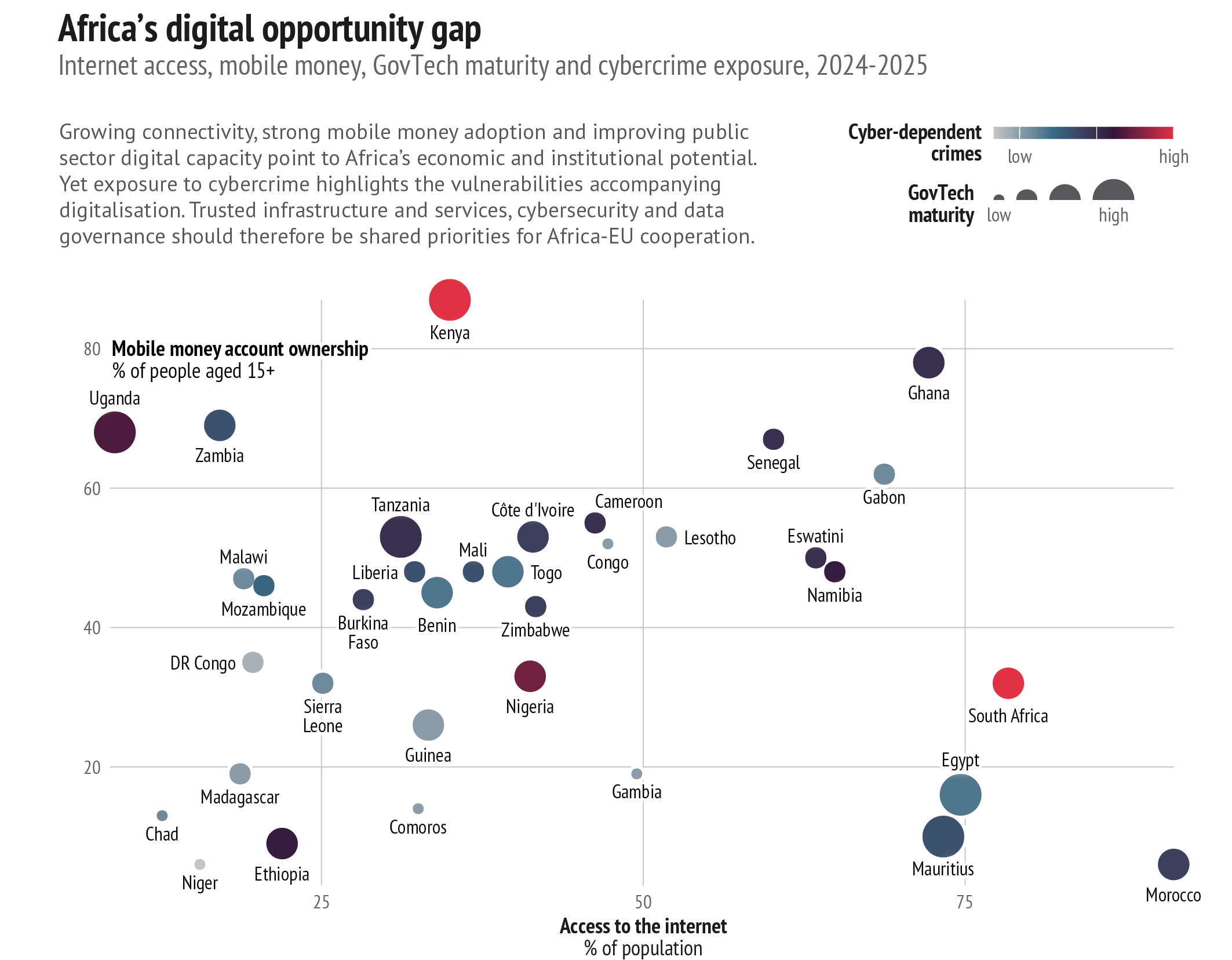
Data: ENACT, Organised Crime Index, 2025; ITU, Data Hub, 2026; World Bank Group, GovTech Maturity Index (GTMI) Data Dashboard, 2026; World Bank Group, Global Findex Index, 2025
Cybercrime exposure assesses the value and reach of organised cyber-dependent crime, including malware, hacking, DDoS, ransomware and cryptocurrency fraud.
GovTech maturity is based on the World Bank index assessing digital transformation and capacity in the public sector, including government systems, online services, citizen engagement and enabling frameworks.
Although the EU cannot match the scale of Chinese financing or US digital platforms, it can position itself as a partner for diversification(10). Its added value lies in combining investment, regulatory cooperation, skills development and trusted connectivity. This logic underpins EU initiatives such as the Global Gateway, the AU-EU D4D Hub, cooperation with Smart Africa and the 2025 International Digital Strategy. Connectivity, for instance, is strengthened through infrastructure projects such as the Medusa submarine cable, connecting the two shores of the Mediterranean, or continental fibre network deployments. Nonetheless, to be considered viable alternatives to competing external initiatives, EU-backed projects and services need to be affordable, resilient, interoperable and supported by local skills and maintenance capacities. European experience on data protection can complement African efforts to develop interoperable rules and frameworks for cross-border data flows – crucial to AI development, digital trade and cloud architectures. Overly restrictive data localisation approaches could fragment African markets(11) and undermine the digital integration that the AfCFTA seeks to advance.
Local data storage and processing remain crucial for Africa’s digital sovereignty. African stakeholders are calling for greater investment in data centres and ‘AI factories’(12), mirroring similar initiatives in Europe. Africa accounts for a fifth of the world’s population but generates less than 1% of global data. Expanding data centre capacity would help retain economic value on the continent while strengthening technological capabilities. This also offers the EU an opportunity to promote sustainable and inclusive digital solutions by linking investment in data infrastructure with energy efficiency, skills development, research cooperation and governance standards.
Digital public infrastructure, cybersecurity and information integrity are also areas of shared concern. As e-government, digital identity, payment and public service platforms expand, they create new opportunities for inclusion and efficiency, but also new vulnerabilities to cybercrime, fraud and disruption. In 2025, digitally enabled crimes ‘accounted for over 30% of reported crimes in West and East Africa’(13). Africa-EU cooperation should therefore also enhance collaboration between law-enforcement and cybersecurity authorities, and facilitate the exchange of information and good practices.
Ghana and Kenya: Two approaches
Ghana and Kenya are among the African states that have most actively embraced the digital transformation agenda and aspire to become regional digital hubs. They illustrate two different pathways for Africa-EU digital cooperation. Ghana represents a security governance model, in which digital issues are linked to cyber resilience, hybrid threats, information integrity and regional stability. Kenya exemplifies an economic infrastructure model, in which digital cooperation is tied to connectivity, data flows, digital public infrastructure, AI and innovation ecosystems.
Ghana stands out for the maturity of its cyber governance agenda and its role in West African security. It has developed information and communication technology (ICT) policies since 2003 and its 2024 Digital Economy Policy and Strategy places particular emphasis on narrowing rural-urban gaps, strengthening cybersecurity and expanding the digital economy beyond its estimated 4% contribution to GDP in 2022(14). The country ranked in the top tier of the 2024 ITU Global Cybersecurity Index, with a score of 99.27%, placing it among the strongest performers on the continent(15) and positioning it as an important EU partner in this field. The 2026 EU-Ghana Security and Defence Partnership also confirms mutual interest in cooperation on cyber issues, hybrid threats and foreign and domestic information manipulation. This makes Ghana a potential West African anchor for cooperation on cyber resilience and information integrity.
Kenya illustrates a different dimension of the Africa-EU digital agenda, shaped by Nairobi’s role as a regional innovation hub, and by a national strategy focused on connectivity, digital public services, entrepreneurship and data-driven growth(16). In March 2026, Kenya became the first African country to launch a Digital Dialogue with the EU, focusing on telecommunications and networks, AI innovation ecosystems, e-governance and digital public infrastructure. It has also opened discussions on expanding Kenya’s aerial fibre network, extending the Blue Raman submarine cable and connecting European AI factories with Kenyan firms and research institutions. Cybersecurity underpins this wider economic and infrastructure agenda, with the EU-funded Kenya Cyber Resilience project aiming to strengthen incident response capacities and public awareness.
The EU’s engagement in Ghana and Kenya combines security, governance, infrastructure and markets, but remains dependent on national priorities. The cooperation also exposes gaps which need to be addressed in future partnerships, as financing remains complex, private sector scale and delivery capabilities are uneven, local cloud and AI compute capacity are still limited, and regional spillover effects are slow to emerge.
Delivering cooperation
The partnership with Africa is becoming central in determining whether the EU can be a credible digital partner. It needs to be able to promote standards, mobilise investment, support implementation, deepen cooperation with local institutions and engage private actors on both sides.
Africa already possesses the foundations for a more integrated digital market through the AU Digital Transformation Strategy, the AU Data Policy Framework, the AfCFTA and implementation platforms such as Smart Africa. The EU should continue building on these African-led frameworks rather than creating parallel initiatives, with a focus on regulatory interoperability, regional digital corridors and shared infrastructure. Data governance is a priority, as compatible rules on data protection, cybersecurity and trusted cross-border data flows would help expand continental digital markets and strengthen African countries’ position vis-à-vis external providers. Data and compute infrastructure should also become a flagship area of cooperation, as growing demand for local data centres and ‘AI factories’ opens space for European investment and expertise in a fast-growing market. This agenda will only be credible if the EU and the AU better integrate European and African companies into digital diplomacy and facilitate their engagement with national and regional digital ecosystems. Joint ventures, research partnerships and access to credit for African digital firms are essential conditions for creating mutually beneficial opportunities.
Scaling up the Africa-EU partnership on digital transformation will also require a clearer political narrative and stronger institutional coordination to bring scattered initiatives together into a visible and coherent partnership that benefits both continents. This would allow the EU to connect investment, experience in regional integration and regulatory expertise in support of secure, inclusive and locally grounded digital transformation.
References
1. Based on International Telecommunication Union (ITU) Data Hub, Individuals using the internet.
2. Mordor Intelligence, ‘Africa Digital Transformation Market Size & Share Analysis: Growth Trends and Forecast (2026–2031)’.
3. ITU, ‘Measuring digital development: Facts and Figures 2025’, ITU, Geneva, 2025.
4. African Union, ‘The Digital Transformation Strategy for Africa (2020-2030)’, 2020.
5. Soulé, F., ‘Navigating Africa’s digital partnerships in a context of global rivalry’, Centre for International Governance Innovation, Policy Brief No. 180, October 2023, pp. 4-5.
6. Allen, N., ‘Demystifying external actor influence in Africa’s technology sector’, Africa Center for Strategic Studies, 13 November 2024.
7. Ibid.
8. Acquah, E., ‘Ghana becomes the latest African country to reject a US health deal, citing data sharing concerns’, AP News, 2 May 2026.
9. ‘Demystifying external actor influence in Africa’s technology sector’, op. cit.
10. Bômont, C. and von der Brelie, F., ‘Autonomy through partnerships: Charting the EU’s global digital engagement’, EUISS Analysis, 27 July 2026.
11. African Center for Economic Transformation, ‘Great opportunities lie ahead for data governance in Africa. So do great challenges’, 29 September 2023.
12. UNECA, ‘Africa pushes for data sovereignty and digital independence’, Africa Renewal, 11 May 2026.
13. ENACT, Africa Organised Crime Index 2025 .
14. Ministry of Communications and Digitalisation (Ghana), Ghana Digital Economic Policy and Strategy 2024.
15. Ghana Cyber Security Authority, ‘Ghana ranked Tier 1, a role-modelling country globally’, 12 September 2024.
16. Ministry of Information, Communications and the Digital Economy (Kenya), Kenya National Digital Master Plan 2022–2032, Government of Kenya, Nairobi, 2022.