Summary
- The EU and NATO are the leading organisations responsible for Europe’s security and defence. Their cooperation, which began in the 1990s, has deepened since 2022 in light of growing security threats to Europe. Most cooperation takes place at staff level.
- Structural limits – like different membership and concerns over duplication – constrain the political ambition of the relationship. The transatlantic tensions brought about by Trump 2.0 have added new challenges to EU-NATO ties.
- The EU and its Member States should seek to reinforce EU-NATO relations and align cooperation where possible, while hedging against transatlantic uncertainty and its impact on the functioning of the Alliance.
The EU and NATO are often called ‘essential’ or ‘indispensable’ partners(1). The two institutions share 23 member states, face the same security challenges and would play key roles in the event of an attack on European territory. Their partnership has deepened in recent years, especially since Russia launched its full-scale invasion of Ukraine. As Europeans seek to assume greater responsibility for defending the continent, cooperation has become even more urgent.
At the same time, enduring obstacles like differences in membership have limited cooperation, leaving the relationship largely confined to the technical level and producing uneven progress across policy areas. Recurrent transatlantic tensions since Trump’s return to the White House – such as the crisis over Greenland in January 2026 – also cloud the partnership’s future.
This Brief reviews the state of EU–NATO relations. It examines the areas of positive cooperation and analyses both longstanding and emerging frictions. Moving the partnership forward would benefit European security, but the EU and Member States must also prepare for a future in which transatlantic tensions make the relationship increasingly difficult.
A technical partnership
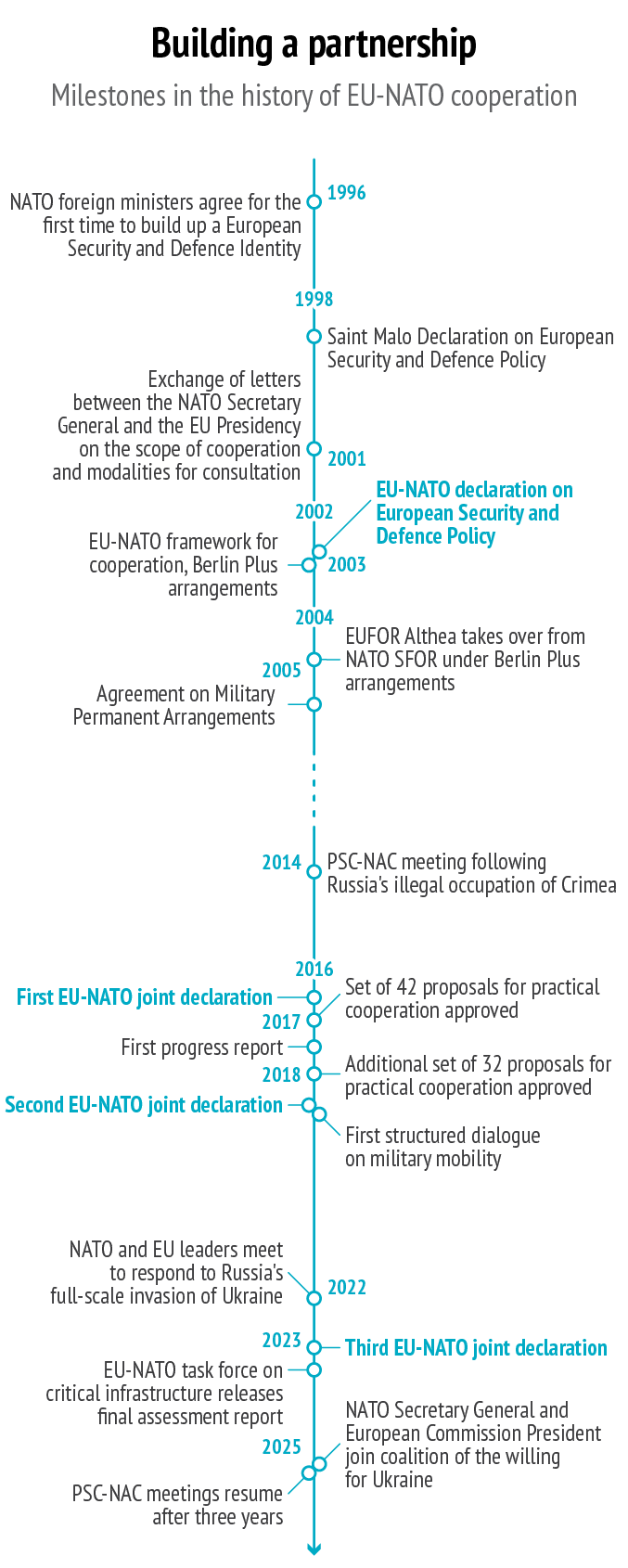
The EU–NATO partnership began to take shape after the Cold War, as the EU’s role in security gradually expanded. However, differences in membership, as reflected in the dispute between Türkiye and Cyprus, and objections by non-EU NATO members over perceived EU encroachment into areas traditionally associated with NATO, have limited the depth of cooperation. Joint sessions between the Political and Security Committee and the North Atlantic Council (PSC–NAC) resumed in 2025 after a three-year hiatus, but remain largely formal.
Instead, the main driver of the relationship is staff-to-staff cooperation. EU and NATO staff cooperate across 74 practical areas, reviewed in annual progress reports, and coordinated by the EU-NATO Steering Group. Between 2016 and 2025, the two organisations held 325 cross-briefings in various committees and working groups(2). This continuous information exchange has value in itself: it enables members of both organisations to be aware of each other’s plans, objectives and concerns. It facilitates the alignment of positions and fosters inter-institutional learning. In seven areas that are deemed of particular importance, the EU and NATO have established structured dialogues(3).
Cooperation between staff goes all the way to senior leadership, which seeks to show alignment and complementarity between the two institutions. At their confirmation hearings, EU Commissioners pledged to support Member States in developing ‘the capabilities and resources needed for the implementation of NATO military deterrence and defence plans’(4). Shortly after taking office, NATO Secretary General Mark Rutte released a set of NATO standardisation agreements to the European Commission and the EEAS, responding to EU requests for greater information sharing to align capability planning efforts.
Cooperation is particularly advanced in the areas of hybrid threats, which bridge military and civilian domains. Exchanges between EU and NATO intelligence services, and the Hybrid Centre of Excellence – recently affected by the US withdrawal from participation – have helped EU and NATO countries develop shared situational awareness on hybrid threats.
In response to Russian attacks on Europe’s physical and digital networks, the EU and NATO set up a joint task force to protect critical infrastructure and established a plan for rapid and coordinated response to future acts of sabotage. In early 2025, following sabotage of undersea cables in the Baltic Sea, NATO launched the Baltic Sentry mission to deter future attempts, while the EU adopted an Action Plan on Cable Security to speed up repair, increase redundancies and enforce sanctions.
On the operational level, the ‘Berlin Plus’ arrangements allow the EEAS to use NATO assets and infrastructure for CSDP missions and crisis management operations. However, EUFOR Althea is the only operation under this framework: it is run from NATO HQ in Sarajevo and commanded by the Deputy SACEUR. NATO and the EU also run operations across the European neighbourhood, sometimes in the same regions – such as Operation IRINI and Operation Sea Guardian in the Mediterranean, or EULEX and KFOR in Kosovo – although the absence of operational agreements limits cooperation.
Support for Ukraine has become a central focus of EU–NATO cooperation. EU and NATO leaders are among Kyiv’s staunchest advocates. Staff from the EUMAM training mission and from NATO Support and Training for Ukraine (NSATU) frequently carry out joint training activities for Ukrainian soldiers. Both institutions have opened offices in Kyiv.
Finally, the EU and NATO have increasingly focused on strengthening Europe’s defence capabilities. The Commission’s Readiness 2030 initiative and the activation of the national escape clause signalled support for higher defence spending, which in turn helped Member States agree to the 5% defence spending pledge at the 2025 NATO Summit. The EU has also sought to deepen cooperation with European NATO Allies, signing security and defence partnerships with Norway, the UK and Canada.
Between old and new rifts
Despite the many shared threats, the EU and NATO face several obstacles to cooperation. As mentioned above, disputes between Member States have restricted the sharing of classified information between the two institutions and blocked formal joint planning. NATO does not grant EU staff access to classified components of the NATO defence planning process. This hinders EU-NATO cooperation in developing specific capabilities, despite some rare examples such as the multi-role transport tanker.
A second enduring tension concerns the development of a ‘European pillar’ within NATO, partly because there is no agreement on its meaning or objective. While some consider it an effort to rebalance the Alliance by assigning more responsibilities to Europeans, others view it as the development of alternative EU structures or as a special European caucus within NATO. This raises concerns about duplication and discrimination against non-EU Allies.
These worries affect other areas of cooperation. For instance, although NATO welcomed the EU’s military mobility package of November 2025 as a crucial step towards enabling NATO forces, it also shared concerns that only certain procedures will be extended to non-EU NATO Allies. And while the EU’s funding instruments enable European countries to spend more on defence, the US and other countries fear being excluded. In February 2026, the Trump administration criticised the EU’s plan to include a European preference in defence procurement rules(5). This dates back to Madeleine Albright’s ‘3-D’ speech in 1999.
Trump’s return to office and the new US posture towards Europe have generated fresh tensions – across the Atlantic, among Europeans and between the EU and NATO. Trump has repeatedly cast doubt on the US commitment to Article 5, asking whether European Allies would defend the US if required. In January 2026, Washington increased pressure on Denmark to cede control of Greenland, threatening tariffs against Copenhagen and other European partners. During the crisis, the EU threatened to deploy its Anti-Coercion Instrument against the US, while NATO sought to address some of Trump’s concerns through Operation Arctic Sentry. Although Trump ultimately withdrew his threats, the episode intensified debate in Europe about contingency planning in the event of a crisis or paralysis within the Alliance.
One position is that if Europeans meet their defence spending and capability targets, they can rebalance the Alliance while preserving the transatlantic bond. Proponents of this view point out that US criticism of Allied free-riding declined after the Hague Summit. US officials claim that they want to maintain a role in a ‘NATO 3.0’ in which Europeans take the lead, as reflected in the recent reshuffling of NATO command posts(6). On the defence industrial front, the US wants to retain its prominent role in the European market – and wants the Alliance to champion transatlantic defence industrial ties.
The other position contends that recent tensions and hostile rhetoric call for reducing dependencies on the US in critical capability areas, from airlift and intelligence, surveillance and reconnaissance to command and control and digital platforms. This view aligns more closely with the EU’s approach. Although Member States retain sovereignty over what to buy and from where, the Readiness 2030 initiative aims to promote intra-European defence industrial collaboration as a necessary step to achieve European-led conventional deterrence. While key partners such as the UK, Norway and Ukraine may participate to varying degrees, European reliance on the US defence industry must be reduced.
Some have gone further, advocating for a European rapid reaction force to replace the US contingent, and for developing command structures to implement Article 42.7 as an alternative to NATO’s Article 5. This reflects the growing uncertainty within Europe about US commitments – and increasingly dominates EU-NATO exchanges. In late January 2026, Rutte told the European Parliament: ‘If anyone thinks … that the European Union, or Europe as a whole, can defend itself without the US, keep on dreaming’(7). Several European leaders pushed back against this statement. This spat underlines the growing divergence between the EU and NATO over the future US role in Europe’s defence architecture. This tension is likely to persist, if not intensify, in the years ahead.
The Trump administration has also called for NATO to focus exclusively on European deterrence. It has reversed its support for NATO’s engagement with Indo-Pacific partners, and is reportedly calling for operations in the neighbourhood, such as KFOR and the NATO advisory mission in Iraq, to be scaled back(8). This will not just make cooperation with EU missions harder. It may also increase instability in the EU’s neighbourhood and weaken links between theatres.
Finally, although the two institutions both support Ukraine, their different instruments could at times clash. A major point of disagreement, for instance, was on whether the EU’s €90 billion loan for Ukraine should be used to purchase US weapons under NATO’s Prioritised Ukraine Requirement List (PURL), or if it should be spent on European kit. And the path towards Ukraine’s integration into Western structures may become increasingly asymmetric: while Ukraine’s accession to the EU continues, the US has ruled out NATO membership.
The bumpy road ahead
Since the EU and NATO are the central institutions for European security, closer cooperation between them remains desirable. However, differences in membership, mandate and outlook will endure, and will continue to limit deeper integration. European defence cooperation will likely proceed through small formats outside the two organisations(9).
Considering these obstacles, what can EU and NATO staff do to align efforts and expand practical coordination? Broadening structured dialogues, improving information exchange where possible, enhancing institutional awareness and conducting joint exercises could help sustain coordination between the two organisations. The leadership should continue to signal unity of intent, ensure complementarity of instruments and strengthen rapid coordination mechanisms. However, as transatlantic tensions increasingly affect the EU-NATO debate, this cooperation may become harder to achieve.
The EU should continue to support Member States in developing the necessary capabilities to defend the continent. Plan A remains to use these capabilities as part of NATO’s deterrent posture. But Europeans must also prepare for scenarios in which key NATO components – above all the US backbone – are unavailable. In that context, continuing the integration of Ukraine into Europe’s defence architecture and providing credible security guarantees to Kyiv becomes even more important.
The EU should also build on its strengths: countering hybrid threats, boosting societal resilience and preparedness, and advancing military mobility. These are not just the most positive areas of cooperation with NATO. They also enhance Europe’s deterrence regardless of the Alliance’s trajectory.
Finally, the EU should be ready to step up where NATO scales back. If NATO reduces its presence in the neighbourhood, the Union should strengthen its stabilising role and expand CSDP missions’ ability to operate independently of NATO structures. Lastly, Europeans should not shy away from engaging with other theatres such as the Middle East and the Indo-Pacific where security dynamics are interconnected.
References
1. Lindström, G. and Tardy, T. (eds), The EU and NATO: The essential partners, EUISS, 2019.
2. Council of the European Union, Tenth progress report on the implementation of the common set of proposals endorsed by EU and NATO Councils, 8 May 2025, p.3.
3. Resilience; military mobility; climate change, security and defence; emerging and disruptive technologies; space; cyber; and defence industry.
4. European Parliament, ‘Verbatim report of proceedings – Hearing of Andrius Kubilius’, 6 November 2024, p. 6.
5. Puzder, A., and Whitaker, M., ‘Why US-EU defense industrial cooperation matters more than ever’, Politico Europe, 23 February 2026.
6. ‘Remarks by Under Secretary of War for Policy Elbridge Colby at the NATO Defense Ministerial (as prepared)’, US Department of War, 12 February 2026.
7. ‘Remarks by NATO Secretary General Mark Rutte at the meeting of the European Parliament’s Committee on Security and Defence’, NATO, 26 January 2026.
8. Jack, V., ‘US presses NATO reset, cut foreign missions as allies weigh peacekeeping in Iraq and Kosovo’, Politico, 19 February 2026.
9. Scazzieri, L., ‘The power of the few: How clusters can strengthen European defence’, Brief no. 3, EUISS, 20 February 2026.