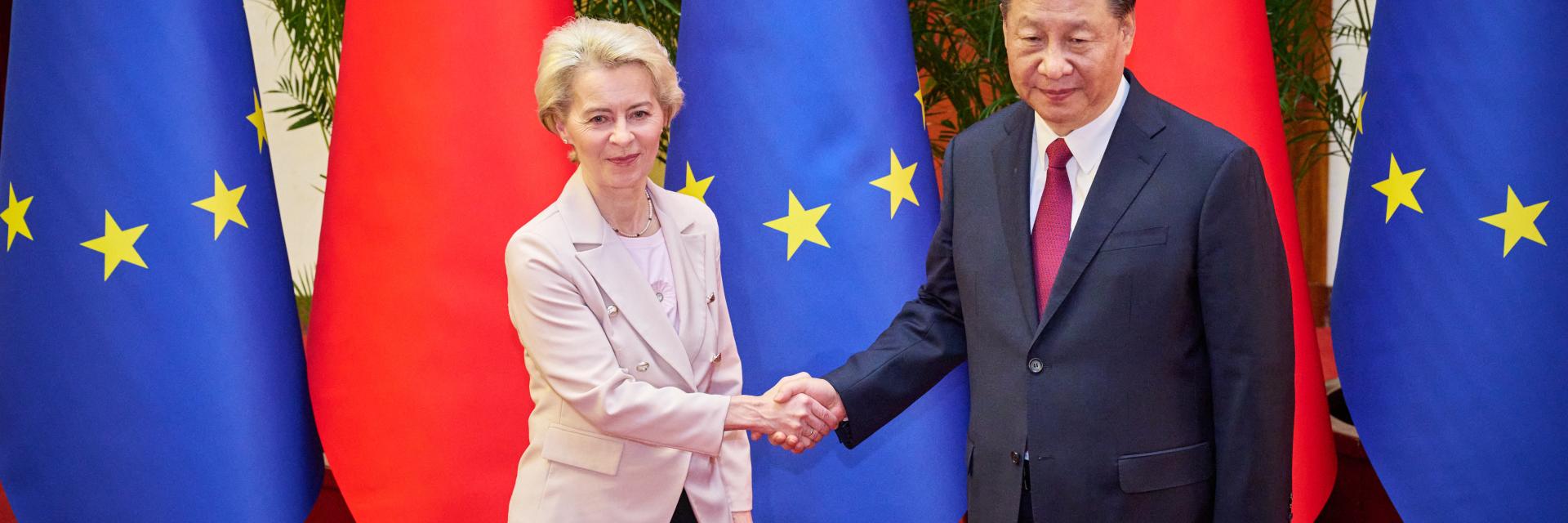
To what extent is China ready to respond to the EU's demands on market access, overcapacity, rare earths or Ukraine? Preparations for the EU-China summit to be held later this month in Beijing are proving difficult. China appears unwilling to make significant concessions. This is due not only to specific factors related to each of these issues, but also to broader, geostrategic considerations. Clearly Beijing does not see the EU as a priority partner – even less so today than in the past.
Wooing the Global South
Against a backdrop of renewed tensions between Europe and the United States, Beijing launched a new charm offensive towards the EU – and particularly certain Member States – during the first half of 2025. However, this offensive has remained largely superficial and does not compare to China's more vigorous diplomatic engagement with countries which it broadly categorises as the 'Global South' – a large and diverse group of non-Western countries.
In April, one month after he declined an invitation to visit Brussels for a summit marking the 50th anniversary of EU-China diplomatic ties, Xi Jinping toured Southeast Asia (visiting Vietnam, Cambodia and Malaysia), where he sought to galvanise support against US tariffs and promoted China as the engine of 'regional economic integration' under the old banner of the 'Belt and Road Initiative'. In May, during the fourth ministerial meeting of the China-Community of Latin American and Caribbean States (CELAC) Forum held in Beijing, Xi announced a credit line of RMB 66 billion (approximately €8.3 billion) to support development in Latin American and Caribbean countries. In June, China announced a new economic pact with Africa that will eliminate all tariffs on the 53 African states with which it maintains diplomatic relations. At the same time, China has continued to deepen its rapprochement with Russia, not only in economic and diplomatic terms but also in the field of security, as clearly reflected in the bilateral statements released during Xi's state visit to Russia in early May.
China perceives the countries of the so-called 'Global South' as natural, priority partners in its effort to build a coalition against what it sees as the illegitimate hegemony of the West
What has changed in recent years is that China now aims to build a coalition of countries – a 'circle of friends', as Xi has described it since 2018 – that would ultimately outnumber and marginalise Western countries. As part of this long-term strategy, China perceives the countries of the so-called 'Global South' as natural, priority partners in its effort to build a coalition against what it sees as the illegitimate hegemony of the West, and first and foremost the US. The EU is seen as neither a natural nor as a priority partner, even though it remains a very important market for China. For instance, Beijing's flagship 'initiatives' – the Global Development Initiative, the Global Security Initiative and the Global Civilization Initiative – are all primarily directed towards the 'Global South' countries, not Europe. Europe may still be seen as a potentially useful actor in the coalition-building process – especially when transatlantic divergences arise. However, even in this context, its 'usefulness' tends to play out first and foremost at the level of individual Member States, which are themselves seen, in any case, as secondary targets of China's great coalition-building strategy.
China's new foreign policy priorities resemble an updated, 2.0 version of Mao's 'Three Worlds' theory (三个世界的理论), first articulated in 1973-1974. At the time, Mao categorised the world into three parts and hoped to create a 'Third World' coalition of states to counter the dominance of the US and Soviet Union in global politics. This broad group of countries (including most of Asia, Africa, Latin America and the Caribbean) was then perceived by Beijing as a natural coalition of partners. In contrast, 'Second World' countries (primarily Canada, Japan, and European countries) were not seen as natural partners, but still considered as potentially useful in creating a larger, united front against the main enemies: the 'First World' superpowers, the Soviet Union and the US, during the Cold War era.
The Communist Party of China's foreign policy worldview is once again taking shape along historical lines of global division
Today, China once again sees European countries as potentially useful, but certainly not as priority partners. Ultimately, from Beijing's perspective, they are still fundamentally part of 'the West' – a term frequently used, and in a strongly pejorative sense, in China's foreign policy discourse. The Communist Party of China's foreign policy worldview is once again taking shape along historical lines of global division, with updated geographical framing and terminology. As of mid-2023, Beijing has not only officially adopted the term 'Global South' in its diplomatic vocabulary[1], but has also fully integrated it into its foreign policy strategy. Since then, China has consistently advocated for the ‘collective rise of the Global South’, as Xi Jinping reaffirmed at the BRICS Plus dialogue in Russia in October 2024.
A long game
The EU would benefit from a clear-eyed understanding of how China compartmentalises the world today in its foreign policy strategy. This awareness is particularly important at times of bilateral negotiations, such as those leading up to the EU-China summit, but also in multilateral settings. The policy consequences of Europe being relegated to the second division in China's foreign policy agenda are profound: China devotes noticeably less time and effort to addressing European concerns than it did during the Hu Jintao era, and is also increasingly sidelining Europe in multilateral forums.
China's substantial investment in international institutions and forums is part of a broader strategy to use these platforms to advance its coalition-building efforts with 'Global South' countries. This approach will once again be on display in autumn 2025, at the 80th Session of the UN General Assembly in New York, as well as the upcoming summit of the Shanghai Cooperation Organization (SCO) to be held in China, and at the G20 Summit that will take place in South Africa in November. For more than two decades, China has used widespread dissatisfaction with the current international order as an opportunity to accelerate global governance reform under its leadership. Beijing has sought to accelerate this process even further since Donald Trump's return to power. Premier Li Qiang's once again referred to the 'urgency to reform the global governance system' in a speech delivered earlier this month at the BRICS Summit in Brazil.
The policy consequences of Europe being relegated to the second division in China's foreign policy agenda are profound
It is in Europe's interest to take China's global governance ambitions and coalition-building strategy seriously, because it is a long-term game designed to yield strategic advantages over the coming decades. This means that Beijing is unlikely to reconsider Europe as a priority partner anytime soon, nor to refrain from openly criticising its positions and actions. At the heart of China's strategy lies a confrontational propaganda campaign aimed at convincing a growing number of 'Global South' countries that the 'West' – first and foremost the US under Donald Trump, but also its European allies – is the main troublemaker and 'root cause' of all international wars and crises, from Ukraine to the Middle East. This sweeping accusatory discourse clearly converges with that of Russia, Iran and other countries which share an openly anti-Western stance.
Europe needs to be ready therefore to counter both China's alternative coalition-building efforts and its antagonistic discourse, as they are closely intertwined. It should bear in mind that behind China's wooing of the 'Global South', there is a clear and comprehensive plan to alter the global balance of power. Mao's 'Three Worlds Theory' is re-emerging, in a new form, and as transatlantic tensions intensify, an alternative coalition of countries – one that pointedly excludes Europe and the US – is steadily taking shape.