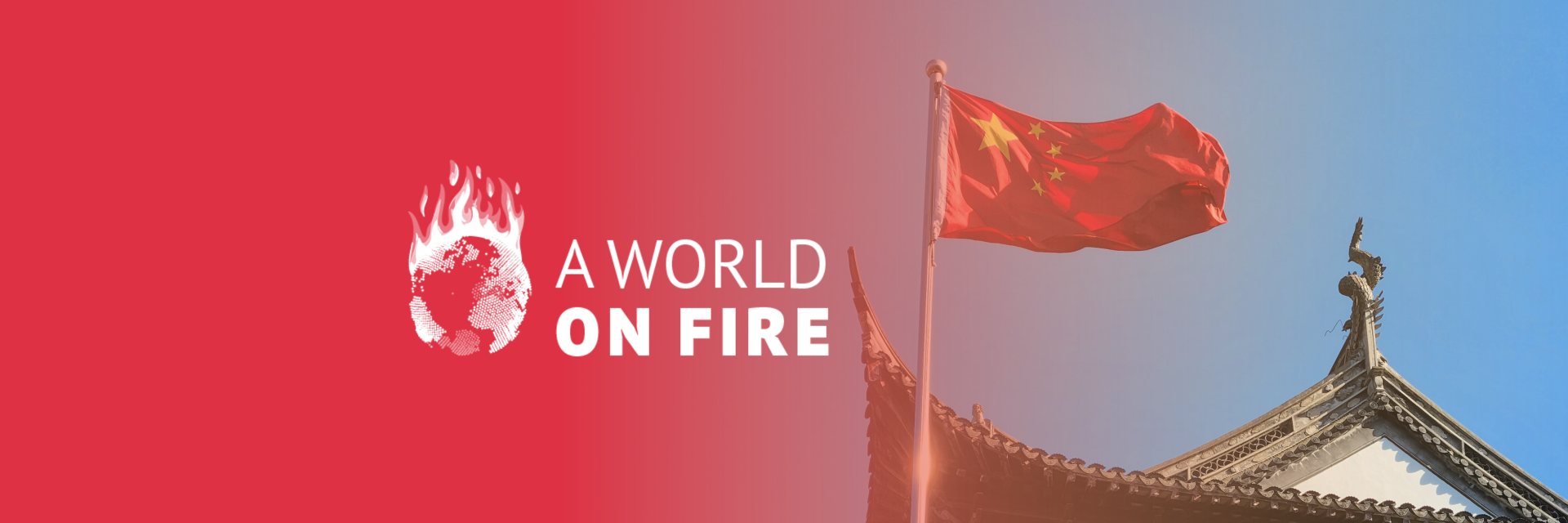
There is a dangerous idea going around Europe: that we have to quickly align with China because of the Trump tornado. This is sometimes called the 'China option' by strategists, who see the world mainly as billiard balls that react to each other, in an eternal search for the balance of power.
Because the United States under Trump is treating Europe in a hostile manner and seeking a rapprochement with Russia, Europe should strengthen ties with China. The Chinese, this group says, are not democrats but believe in a minimum of international rules of the game and free trade – unlike Trump. According to this reading, Europe allowed itself to be swept along by President Biden in a Cold War-like crusade against China. Now that Trump is treating us so badly, it is time to pursue a more pro-Chinese course, which would better serve European interests. Moreover, Europe cannot afford to have a bad relationship with Trump, Putin and Xi all at the same time.
Since Trump's return, something has indeed shifted in the attitude of European leaders towards China. That is why these days we hear less from Ursula von der Leyen, the President of the European Commission, about de-risking, and more about plans for a new EU-China summit in July. Hence the procession of government leaders to Beijing. Last week it was the turn of Spanish Prime Minister Pedro Sánchez. He openly advocated for a better balance in EU-China relations, through more intensive trade and investment, precisely in view of the tense relations between the US and the EU.
It may seem logical to let Trump's whims push Europe closer to China, but that would be a mistake and politically unwise. In terms of the aforementioned billiard game: the fact that the relative distance between the US and Europe under Trump is increasing does not yet mean that the absolute distance between Europe and China has been reduced.
We have to go back to the basics of the relationship between the EU and China. Everyone knows how difficult it is to keep the 27 EU countries together on a subject like China. Since 2019, the EU has managed this challenge quite successfully by framing its relationship with China through a threefold approach: treating Beijing as a partner in certain areas (think climate or financial stability), as an economic competitor and as a systemic rival that promotes its authoritarian model worldwide.
In recent years it has become clear that the balance has shifted and that the last two aspects have prevailed. This was mainly because China changed internally, with an increasing concentration of power around Xi, and because China was externally more assertive, if not more aggressive. In Brussels and the capitals, you heard more and more how difficult it was to still influence China's choices. There was dialogue about anything and everything, but the effect, in the sense of policy adjustments or actual cooperation, was difficult to see.
As a result, the number of disagreements increased to an impressive laundry list. Europe complained about Chinese support to Russia in the war against Ukraine and repeatedly said that this seriously burdened relations with the EU. China responded with vague language that it was neutral and used platitudes about the importance of territorial integrity. Meanwhile, exports of dual-use goods, which are used for both civilian and military purposes, increased, allowing Moscow to sustaine its aggression, at least in part.
Then the economy: despite pleas for fairer access for European companies to the Chinese market, the EU trade deficit with China in 2024 rose to more than €300 billion – €10 billion more than the US trade deficit with China, which Trump is so furious about. In addition, we see more and more examples of subsidies and dumping, economic coercion and the strategic use of export restrictions on critical raw materials. So tensions are also increasing on the economic level, rather than diminishing.
And in terms of security, concerns are also growing about what China is doing, not only in the US but also in the Netherlands and the rest of Europe. The AIVD has explicitly identified China as the greatest threat to economic security several times in recent years. The intelligence agency openly warned of espionage, digital hacking and infiltration.
Choosing sides
In short, there have been objective reasons in recent years why Europeans have become more critical of China. Not to do the US a favour, but out of self-interest. That point must be underlined, right when Trump 2.0 harms our interests in so many areas and says that Europe must take sides: it is either the US or China. The answer to this should be: no thanks. Above all, Europe must choose Europe.
Yes, we have obvious problems with Trump's actions. But that does not mean that the problems with China have suddenly disappeared. On neither the economic nor the security front has the Chinese position substantively improved under Trump. On the contrary: its support for Russia is increasing, and that is a bigger problem for Europe precisely because the US is withdrawing support to Ukraine. The economic imbalance can only get worse because of Trump's tariffs – 145 percent for China, and possibly even higher – which will push even more Chinese overcapacity in our direction. And the security threat from the Chinese side is extra dangerous for Europe now that we are increasingly alone, with an aggressive Russia and an unreliable US.
In short: we must beware of the trap of the 'China option' as an automatic response to Trump. What Europe does have to do is play a smart game and seize Chinese attempts at a rapprochement to obtain real concessions.
In Beijing, there is growing fear over a stagnant economy with sky-high debts in a country struggling with poor demographics. Moreover, people are nervous about the prospect of a 'reverse Nixon' scenario in which Trump wants to split Russia from its alliance with China, in order to prepare for a major confrontation with Beijing. That may sound unrealistic and too far-fetched to Europeans – some call it 'sanewashing Trump' – but in China it is talked about. And that in itself offers opportunities for Europe.
It must now tell China that it wants to do business and will not follow Trump and his unilateral trade tariffs. But something really needs to change in China's behaviour. We don't want another charm offensive, but real steps – and Beijing knows very well what this entails.
This year marks the 50th anniversary of diplomatic relations between the EU and China. A great opportunity to celebrate with a new summit. It is already a big deal that EU leaders will probably travel to Beijing for this, while it is actually Chinese leaders' turn to come to Brussels. But this summit should yield more than a photo opportunity. That is why the message to China must now be: European leaders will only board the plane if China is ready to finally tackle the laundry list of problems. Not with empty words, but with tangible deeds. If China is not prepared to do so, we had better postpone that summit.
This opinion piece by Steven Everts was originally published in Dutch in NRC on 18 April 2025 under the title 'Aanschurken tegen China om Trump: klinkt logisch, is verkeerd'. It is reproduced here in English with the permission of NRC.