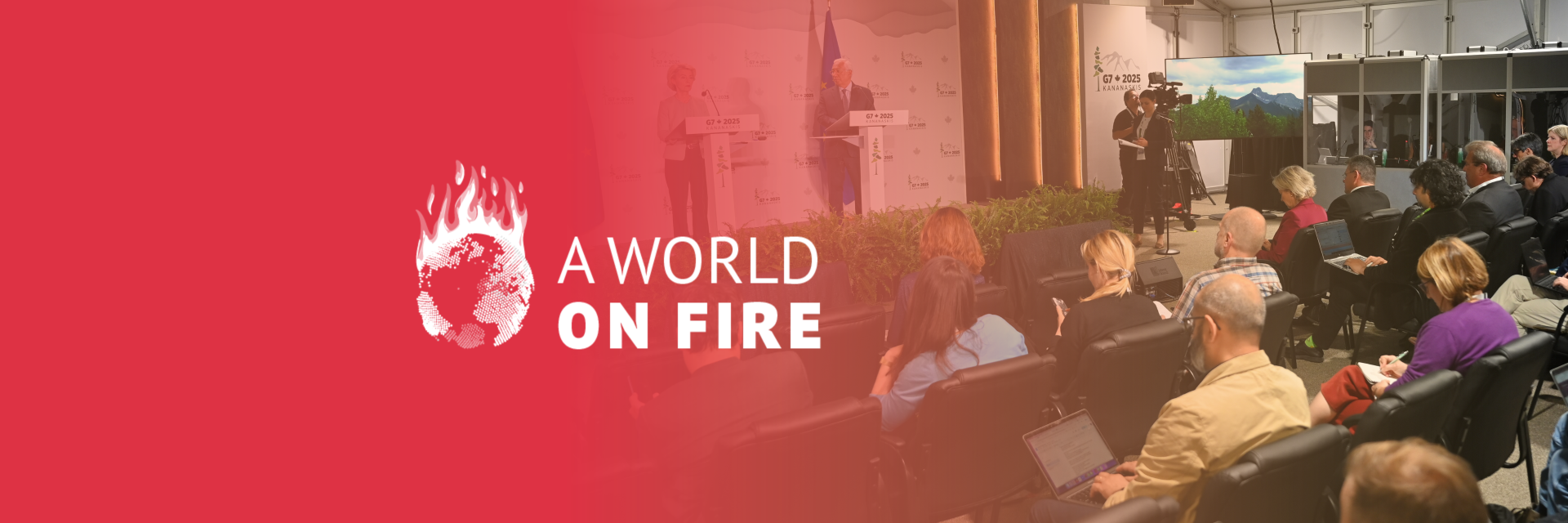
The G7 summit started this Sunday in Kananaskis, Canada and everyone is holding their breath: how will Trump behave? The stakes are high. The G7 is considered the cockpit of 'the West': the democratic world, based on the free market and the rule of law, both domestically and internationally. But with Trump, the US is on a collision course. From Ukraine to free trade, from combating the climate crisis to tax evasion: the US is pulling out. Or worse, they are pressuring their allies with threats and coercion. And with that, the sun seems to be leaving the solar system. Because what is 'the West' without America?
Let's go back to the beginning: since its creation in 1975 (initially the G6, without Canada), the G7 has been a place where leaders meet, without an army of advisors. That informal atmosphere and the relatively long duration of a G7 summit (three days), ensures that people take the time to come together.
Originally, it was about addressing economic problems: the collapse of the Bretton Woods system (the basis for the international monetary system), the oil crises, the stagflation of the 1970s. But the G7 quickly grew into a forum for broader, strategic coordination. With Canada joining in 1976, it became the G7 (since 1977, the European Commission has also joined as a standard member, but not as an official member, because it is a club of countries).
In the 1980s, the G7 played a key role in stabilising the dollar. Think of the Plaza and Louvre Accords, and various debt crises. After the end of the Cold War, the dominance of the West, and the role of the G7 within it, was so great that Russia asked to be allowed to join the inner sanctum of the West. And so it happened, in 1998.
In retrospect, this was the high point of Western dominance. Because the expansion with Russia to G8 was short-lived. Putin killed democracy in Russia. And after the illegal annexation of Crimea in 2014, Russia was expelled from the group. The G7 had to remain a club of democratic countries that adhere to the most basic international rules.
Power shift
At the same time, the world outside the G7 was also changing, with the most important trend being the shift of power from the West to the emerging countries. And they were increasingly contesting the leading role that the West ascribed to itself in the international system, with the G7 calling the shots. This led to increasing frustration and a backlash. The BRICS (Brazil, Russia, India, China and South Africa) met for the first time at the level of leaders in 2009 – and it was no coincidence that this took place in Yekaterinburg, Russia.
What unites the BRICS is not a common ideology, like the West, but the conviction that the international system is unfair and unrepresentative. For China and Russia, it goes further: they see the BRICS as an instrument for power formation against the West. Initially, the group was not taken seriously by many: too many internal contradictions, not enough concrete cooperation. The BRICS lack mortar was what you heard.
But the reality is of course that in politics the will to work things out together is more important than 'objective' differences of opinion - and this certainly holds true for the BRICS. Their cooperation is increasingly taking shape: their own BRICS development bank, agreements on currency transactions outside the dollar, plans for their own credit rating agency, and even a BRICS television channel and other media platforms. In 2024 there was a major expansion with six new members (Iran, Egypt, Ethiopia, the UAE and Saudi Arabia) and this year Indonesia also joined. For many countries in the global south, BRICS+ is therefore a serious alternative to the classic international order in which the G7 has been central for so long.
Competition from BRICS
Partly because of this competition from the BRICS, the G7 has become increasingly active in recent years. Especially after Russia’s invasion of Ukraine in February 2022, the G7 became the coordination platform for Western sanctions policy: exclusion of Russian banks from the SWIFT international payment system, an oil price ceiling of 60 dollars per barrel, freezing of Russian assets and using the interest proceeds for a 50 billion dollar loan to Ukraine. All these decisions were made within the G7. The approach to counter sanctions evasion – especially via Chinese companies – also mainly took shape within the context of the G7.
In addition, the G7 has become the place where Western countries have forged a joint China strategy. Because the US under Biden, but also Japan, were very interested in working together with Europe on China, a whole series of joint steps were taken: export restrictions on advanced technology, screening of investments and cooperation on critical raw materials.
In short: the G7 has really done its job as the nerve centre of the West in the last few years. But the foundations underneath are shaking, and that is because of the Trump tornado. When the G7 foreign ministers met in March, Washington no longer wanted to speak of 'Russian aggression' against Ukraine. The usual joint statement became a pale imitation of the earlier clear language. Canadian Prime Minister Carney has now even decided not to try to reach a joint statement at all for the summit this weekend: the differences of opinion are simply too great and the will to bridge them is lacking. That is unique and unprecedented.
And that puts things into perspective. Trump hinted earlier this year that he would like Russia back in the G7. If the US chairs the G7 in 2027, he could invite Putin. The other countries would then have to choose: go along with Trump, or continue the G7 as the G6, without the US.
What happens in Kananaskis could therefore be a tipping point. The question is simple: does the West still exist as a political entity – or are we witnessing the end of a beautiful idea?
This opinion piece by Steven Everts was originally published in Dutch in NRC on 13 June 2025 under the title 'Dit weekend weten we of het Westen nog bestaat'. It is reproduced here in English with the permission of NRC.