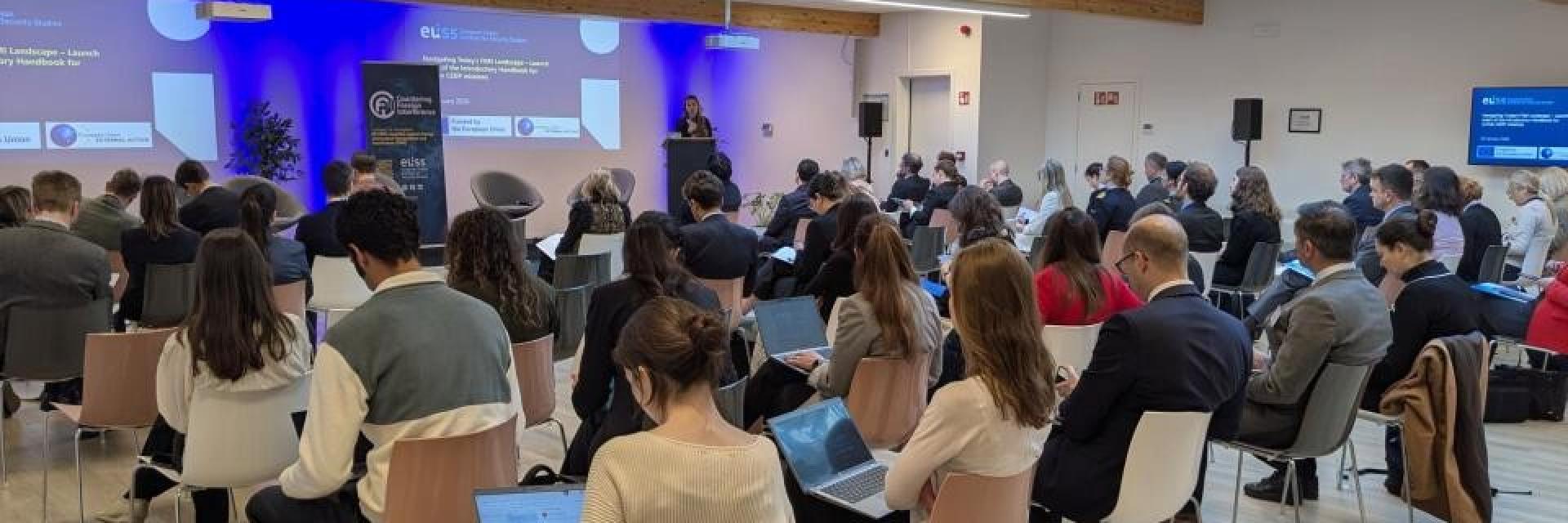
On 20 January 2026, the Countering Foreign Interference (CFI) project hosted a high-level event in Brussels focused on strengthening EU civilian CSDP responses to Foreign Information Manipulation and Interference (FIMI).
The event also offered the possibility to present the CFI project’s results and impact over its different work strands in the last three years. These included applied research and forward-looking analysis on foreign interference, targeted support to policymakers, sustained efforts to build and nurture Community of Practice among EU institutions, expert practitioners and partners, capacity building workshops and numerous awareness raising events and analytical tools.
Funded by the European Commission’s Service for Foreign Policy Instruments (FPI), led and implemented by the European Union Institute for Security Studies (EUISS) with its three university Consortium partners, in close cooperation with the European External Action Service (EEAS), the CFI project has among others also contributed to strengthening EU civilian CSDP capabilities in environments where information manipulation is increasingly used as a means of pressure, disruption and destabilisation.
During the event, the Cyprus EU Council Presidency set the scene for a forward-looking exchange on how the EU can build on the project’s results. It situated these efforts within broader EU institutional and Member States’ initiatives to reinforce the resilience against FIMI and other evolving challenges in the information space, and beyond. In particular, with the aim to equip the staff deployed abroad against the growing FIMI while preserving the Union’s unity, credibility and enhancing effectiveness.
FIMI has become a persistent feature of today’s security environment, increasingly affecting fragile and contested settings where the EU is present. Civilian CSDP missions are often exposed to hostile information activities aimed at undermining their and EU legitimacy, constraining operational space and eroding trust in the EU’s role as a security provider. Against this backdrop, the event framed FIMI as a cross-cutting security challenge and explored operational avenues to enhance awareness, preparedness and coordinated responses.
The panel featured interventions from:
- Matthew Reece, DMD for Policy Planning and Strategic Communication, European External Action Service (EEAS)
- Irène Mingasson, Head of Unit, Rapid Response Europe, Asia & Americas, FPI, European Commission
- Kirsi Henriksson, Deputy Civilian Operations Commander / DMD Civilian Operations Headquarters, European External Action Service (EEAS)
- Steven Everts, Director, EUISS
It was moderated by Nad’a Kovalčíková, Senior Analyst on Transnational Security and CFI project Director, EUISS.
By convening representatives from EU Institutions and Member States, the event reinforced shared understanding of how the FIMI threat landscape is evolving and where EU responses may require further consolidation. Discussions addressed geopolitical dynamics shaping EU resolve, the impact of foreign interference on operational posture in the field, and the areas where collective EU approaches are most needed.