The steady consolidation of the bilateral rapprochement between China and Russia, which has accelerated since Russia’s invasion of Ukraine, was already posing serious security and diplomatic challenges to Europe. Beijing and Moscow’s joint efforts to play on the weaknesses of the current US president and his administration, in the wake of the mid-term elections, are even more problematic, not just for Europe’s interests, but also for those of the US itself.
A meeting on unequal terms
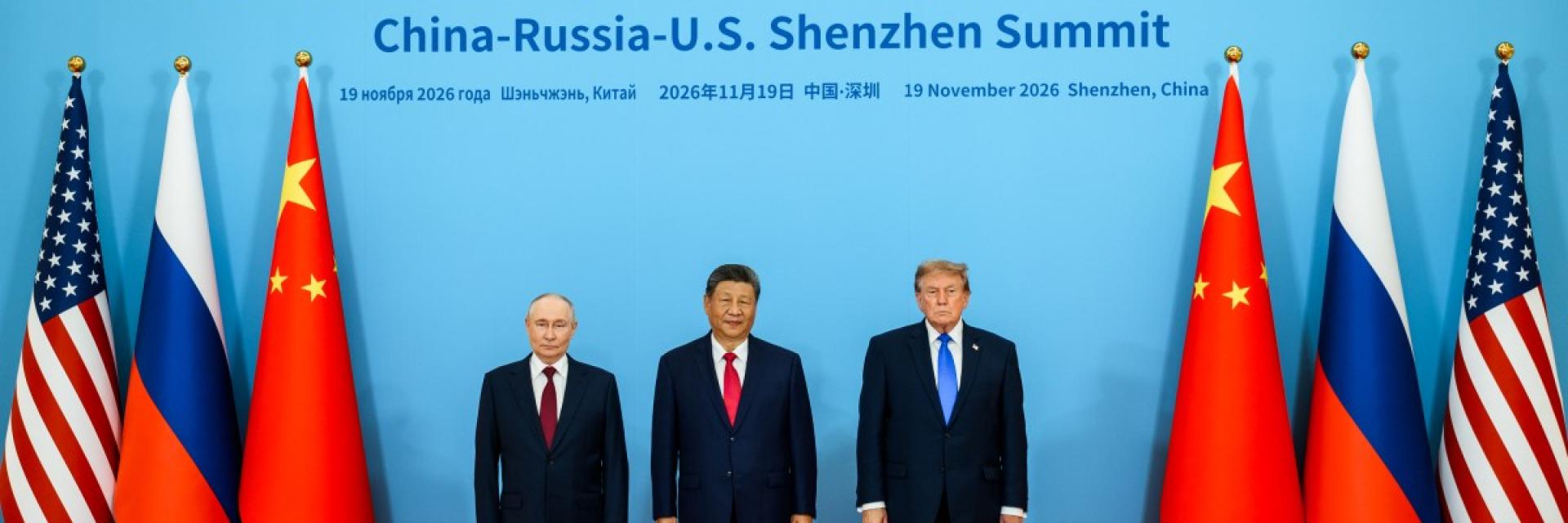
Now that the Shenzhen APEC summit is over, it is time to take stock of the much-discussed trilateral meeting between Xi Jinping, Vladimir Putin and Donald Trump and assess the challenges it poses for Europe. Beyond the staged camaraderie, carefully choreographed protocol and anecdotes about seating arrangements, three key imbalances shaped the meeting – in terms of coordination, strategic objectives and tactical approaches – and tilted the outcome in favour of both Russia and China.
First of all, China and Russia meticulously prepared and coordinated the meeting. The extent of this coordination was apparent even in the immediate run-up to the summit, with Xi and Putin holding considerably longer bilateral talks than Putin and Trump. Beijing and Moscow can now build on more than a decade of experience in bilateral coordination – at both leadership and working levels, facilitated by frequent exchanges between the two presidents as well as similarities in bureaucratic structures inherited from the Soviet Union and the Mao era. Coordination between China and Russia poses an even greater challenge to the Western alliance at a time when the US appears reluctant to consult key allies and partners ahead of major decisions or meetings, as was the case again ahead of the APEC summit. Such consultation would have made sense, not least because the Coalition of the Willing was gathering in Berlin at the same time. Following his meeting with Xi and Putin, Donald Trump made a surprise call to the Coalition that appeared to reaffirm what Poland’s Prime Minister Donald Tusk described as Trump’s ‘unshakable’ faith in Putin’s goodwill – ‘even though so far there are no facts to support it’.
It is unclear to what extent Donald Trump actually buys into Russia or China’s talking points. But there are growing indications that carefully orchestrated appeals to his ego, lavish hospitality and displays of architectural and technological prowess – as seen in Shenzhen – coupled with a tough negotiating stance and a rigid reiteration of red lines, elicit a more respectful, if not accommodating, response from the US president. That was also evident during his grandiose state visit to China in May 2026, when Beijing ceremoniously unrolled the red carpet but firmly stood its ground on all bilateral points of contention – from trade to Taiwan.
Secondly, the Shenzhen trilateral summit was, by design, highly imbalanced in terms of strategic objectives. Proposed by Russia and hosted by China, it brought together two leaders who have spent the past 13 years building their rapprochement around a shared ambition: to form a common front against the third participant, the US, which both countries regard as their adversary. Beijing and Moscow’s shared goal of weakening the US remains unchanged. Donald Trump’s presence in the White House certainly does not alter this objective. On the contrary, both China and Russia see his presidency as an opportunity to make faster progress towards this goal.
This common strategic ground is particularly visible on security issues, as reflected in China’s and Russia’s joint criticism of NATO and perceived Western ‘hegemonism’, and their mutual recognition of each other’s security interests and positions on Taiwan and Ukraine. Their May 2026 ‘Joint statement on enhancing comprehensive strategic coordination, deepening good-neighborliness and friendly cooperation’ reaffirmed this convergence. The trilateral format therefore offered Russia a significant advantage: the opportunity to reiterate its narrative on Ukraine to Donald Trump, with Beijing broadly supportive of Moscow’s position.
Lastly, both Xi Jinping and Vladimir Putin believe that they can continue to benefit from Donald Trump’s transactional approach, while themselves remaining committed to a more traditional conception of statecraft that entails a readiness to bear significant costs to defend core political or security priorities. Donald Trump’s request to China, on the first day of the APEC summit, ‘to do some more for our [American] farmers’, once again put him in the position of a supplicant, giving Beijing an opportunity to consolidate its existing leverage.
Serious risks for Europe
The ‘Declaration towards Peace‘ issued at the end of the Shenzhen trilateral meeting is not long, and certainly does not amount to a Yalta-like agreement, but it points to at least three risks for Europe:
The first risk is the potential weakening of the impact of energy sanctions imposed on Russia, albeit indirectly, as the three countries plan to ‘increase the production and supply of refined petroleum products’.
The second risk relates to the emergence of a trilateral dialogue on restructuring global governance, with references to UN reform and challenges to the scope and legitimacy of the International Criminal Court’s jurisdiction – a development that is in Vladimir Putin’s interests and in line with the US position towards the Court. Calls for UN reform also resonate with countries of the ‘Global South’, whose ‘collective rise’ Beijing officially advocates as part of its broader ambition to marginalise Western influence in international organisations.
The third risk is the possible revival of the trilateral format, with – for now – a narrower focus on nuclear issues, and on terms acceptable to Beijing (‘The three countries will conduct a dialogue on reducing nuclear risks and preventing the proliferation of nuclear weapons’). But it is likely that both China and Russia will push for further trilateral exchanges on other issues.
All in all, these developments should encourage Europe to intensify internal cooperation and build on the positive dynamics across existing cooperation formats, from the Coalition of the Willing to the European Political Community and the various bilateral or trilateral meetings among EU Member States. Unlike in the trade domain, the ‘spaghetti bowl effect’ – the rapid proliferation of engagements and agreements – appears to offer the most effective way to consolidate a common European approach and strengthen Europe’s capacity to address the current security threats and imbalances outlined above. In this context, there is an equally strong case for stepping up exchanges with non-European democratic partners – not only on Ukraine and other ongoing wars and crises, but also on global governance reform.
At the same time, Europe should continue engaging with Washington as much as possible, at all levels, during the next two years, to ensure sustained exposure to its positions, concerns and objectives. As the press conference that President Trump held on Friday 20 November, shortly after his exchanges with Vladimir Putin and return from Shenzhen, shows, such exposure can have an impact – in one way or another. He notably echoed some of Vladimir Putin’s talking points, claiming for instance that the Russian president had told him that he would have not launched a full-scale invasion of Ukraine in February 2022 had [Donald Trump] been president at the time (‘I actually asked him, I said, “Would you have gone in if I was president?” He said, “No, would have never happened.”’). In this context, Europe should keep exchanging as much as possible with the Trump administration and actively engage in the competition to shape the views of a president whose positions can shift rapidly.
In any case, Europe cannot afford to underestimate China and Russia’s joint efforts to steer the United States towards their own positions and interests - an approach that Xi Jinping is likely to pursue when he meets with Donald Trump again in mid-December in Miami, on the margins of the G20 summit. If sustained, these efforts will be detrimental not only to European but also to American interests. Ultimately, they will contribute to the systematic weakening of the West as a whole – precisely what both Beijing and Moscow aspire to achieve.