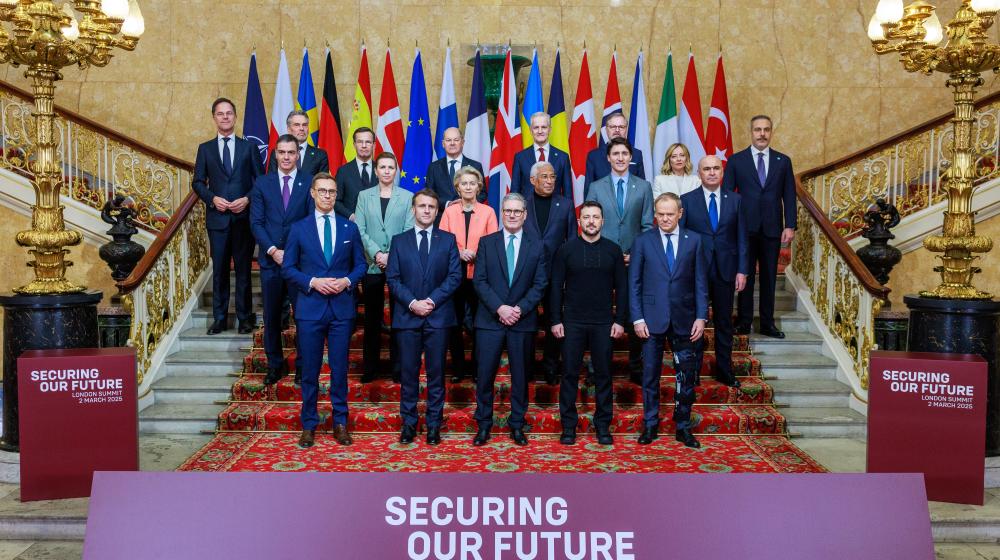
There are different kinds of Europe. There is the well-known Europe of the European Union: 27 Member States bound by treaties, regular summits, the blue flag with the yellow stars, and Beethoven's hymn. But there are also countless examples of constellations of countries collaborating in smaller groups.
Public debate usually focuses on that first Europe, and understandably so: it adopts binding legislation, concludes trade agreements, and distributes large sums of money. But sometimes it is more interesting to look at the Europe of shifting coalitions. That is precisely where the momentum lies now. Because it is becoming increasingly difficult to get 27 countries to agree, people are seeking and finding common ground in smaller groups. These groups not always have the same composition, as is the case with Schengen or the eurozone, but instead form a colourful patchwork of initiatives. More chaotic perhaps, but this is the Europe of our time.
Because it is becoming increasingly difficult to get 27 countries to agree, people are seeking and finding common ground in smaller groups.
European defence is a prime example. In recent weeks, we saw once again how vulnerable Europe is: dozens of drones over Poland and Romania; a MiG fighter jet that flew over Estonia for twelve minutes; and drones that paralysed several Danish airports. There is no official confirmation yet that Russia is behind these latest incidents. But it is quite a coincidence. There is clearly one country that is openly threatening Europe, that wants to test our deterrence and defence readiness – and, above all, to sow division. In this, Putin is succeeding quite well, especially because Trump is repeatedly casting doubt on American support.
In short: Moscow is pushing further and further, and Europe knows it is primarily responsible for its own defence. And that defence is not in good shape. Not only in terms of air defence, but also more broadly.
What then happened in response to the Russian provocations? Yes, NATO convened. But the actual work of neutralising the drones was carried out by only a few countries, including the Netherlands and Italy. NATO then established Operation Eastern Sentry, to which five countries are making a concrete contribution: France, Germany, the UK, Italy and Denmark. The US, while being the majority shareholder in NATO, is keeping a low profile.
Then there is the initiative to build a ‘drone wall’ along Russia's eastern border. Last Friday, a group of ten EU countries met, joined by Ukraine, the country that now best understands how to deter Russian drone attacks with limited resources. The countries quickly agreed to build a layered system using sensors, information sharing, and counter-drones.
Moscow is pushing further and further, and Europe knows it is primarily responsible for its own defence.
These plans for a drone wall build on an earlier initiative. Since 2022, Germany has led a group of fifteen countries (including even non-NATO members, such as Switzerland) in developing the European Sky Shield Initiative (ESSI). This is an ambitious plan to close the significant gaps in European air defences, using drones and counter-drones, as well as air and missile defence, radar, and other technologies.
Then there is the Joint Expeditionary Force (JEF), led by the UK, in which the Netherlands, plus the Scandinavian and Baltic countries, are also participating. This month, the JEF is conducting a major exercise, a so-called ‘multi-domain operation’, i.e. covering land, sea, air, space, and cyber. Not under the NATO flag, but as a smaller coalition.
Furthermore, for years, the EU has been running a series of projects under the name Permanent Structured Cooperation (PESCO), in which 40+ subgroups of countries collaborate on issues such as drones, cyber warfare and artillery.
JEF, PESCO, ESSI ... It sometimes seems like a confusing alphabet soup. That is why it might be tempting to only look at the familiar picture of the EU with 27 members and NATO with 32. But that misses the essence of today’s dynamic.
The truth is that European defence is not built through one major decision or one overarching institution. It happens in smaller, shifting coalitions that move forward pragmatically. And perhaps it is precisely in this patchwork of coalitions that Europe's true strength lies.
This opinion piece by Steven Everts was originally published in Dutch in NRC on 30 September 2025 under the title ' Europa is een lappendeken, en dat is juist een goede zaak'. It is reproduced here in English with the permission of NRC.