The EU needs to look at energy security in terms of the whole system rather than focusing solely on security of energy supply. The old understandings around a fossil fuel-based system do not work for Europe’s security. They make the region reliant on expensive imports and highly vulnerable to external actors who exert a stranglehold over its energy system. A shift towards a renewables-based energy system would not only restore energy supply security within the EU but offer the added advantage of a cheaper and a more resilient energy system. Building this system however requires a more holistic approach, one that incorporates interconnection and demand-side management into the broader conceptualisation of energy security. There are many definitions of energy security but most boil down to a formula of availability, affordability and accessibility. In the EU, however, the focus remains fixed on the problem of security of supply and threats to energy infrastructure. Europe first conceptualised energy security during the oil price spike of 1973 and revisited the concept when Russia weaponised energy in 2009 and 2022. Perhaps unsurprisingly then, energy supply constraints continue to reverberate in thinking around energy security. A future energy system powered by domestic generation would break the link between energy security and fossil fuel supply shocks.
Security in energy supply?
The EU has the simple problem that it does not have sufficient supplies of fossil fuels on its own territory to even come close to guaranteeing its own needs. Within an energy system dominated by fossil fuels, Europe is ever more staggeringly reliant on external actors. As of 2022, it was dependent on imports for 62.5% of its entire energy supply (1). These numbers are even more dramatic for oil and gas, with 97.7% of petroleum products and 97.6% of natural gas coming from outside the Union. The EU spent a staggering €448,800,000,000 on fossil fuel imports in 2023, down from €685,200,000,000 in 2022, due in part to the energy transition, reduced demand and price stabilisation (2). In an era of trade wars this amounts to a significant portion of European GDP, accounting for 17-23% of global imports. Additionally fossil gas poses a particular challenge to competitiveness, with much of the EU’s imports coming from liquefied natural gas (LNG). When importing US gas, the EU ends up paying a premium of up to five times the price (3). Therefore, the EU is not only almost completely reliant on fossil fuel imports but these imports come at huge cost to European competitiveness.
Beyond fossil fuels, the EU does have other supply-side dependencies, although these have different ramifications. In 2023, the EU imported all of its raw uranium for nuclear power, including a security sensitive 23.45% from Russia. Within the value chain, EU-based companies carry out a sizeable share of conversion and enrichment but Russia too accounts for 22.35% of conversion and 37.9% of European domestic enrichment requirements (4). These dependencies expose the EU to risks but with stockpiles estimated at an average of 3 reactor reloads (4.5-6 years), the risk of a short-term supply shock is lower. The longer-term presence of a value chain in Europe as well as considerable raw uranium supplies in close allies such as Australia and Canada means there is less imminent risk of supply shocks. For now though, the development of new nuclear power is plagued by long construction delays and remains one of the most expensive ways to generate electricity.
From a security of supply perspective alone, there is an innate vulnerability in the current energy system due to reliance on external actors to guarantee continuous energy supply. Given these dangers and the evolving nature of the energy system itself, it is worth considering what energy security could and should look like in the future.
Renewables-based energy security
Even in renewable energies, there are supply dependencies. China is a dominant player in solar photovoltaic (PV) production, accounting for 74.7% of modules as well as an astonishing 96.8% of wafers manufactured globally in 2021 (5). While the European wind industry retains a strong market share in wind turbine production, it is nevertheless reliant on China to produce 98% of the permanent magnets which are vital for the turbines’ proper functioning (6).
However, solar PV and wind energy differ from other energy sources in that, once installed, they continue to produce energy for decades thereafter. This minimises the supply-side risks to security of energy supply, although adding capacity could become harder over time. Additionally, Europe could and should scale up domestic renewables industries to guarantee security of supply, something it cannot accomplish with fossil fuels. Especially in the wind industry, Europe has considerable industrial capacity already in place. This could be supported by stronger value chains for critical raw materials and recycling of existing permanent magnets to ease demand for new supplies from China.
A renewable energy system brings at least two further benefits.
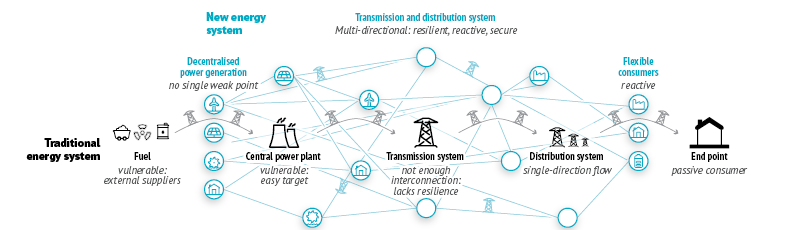
The first is cost. While estimates vary, the cost of generation for an installed renewable energy power plant is a fraction of the cost of a fossil fuel-based system. According to conservative estimates from Deutsche Bank and Wood Mackenzie, the levelised cost of electricity from renewables in Europe is 2-4 times cheaper than gas, coal or nuclear (7). The cost of renewables generation is also continuing to fall as technologies improve, unlike with fossil fuels or nuclear power (8). However, renewables do come with higher system costs, meaning that not all of these savings are passed on to consumers accessing energy through the grid. Even then, with a decarbonised power system target set for 2037, electricity is anticipated to be at least 12% cheaper for households and industries by 2035 (9). Beyond the grid, with locational and time-dependent pricing, renewable electricity can be exceptionally cheap, offering a significant competitive advantage over fossil fuel generation. Perhaps most importantly however, an entirely renewables-based system removes the price volatility associated with supply disruptions in oil and gas markets (often driven by geopolitical upheavals) (10). European energy systems would thus be immune to the future weaponisation of oil and gas supplies by hostile actors or disruptions to fossil fuel supply chains.
decentralised, with generation spread across much greater land or sea areas. This allows generation in a number of locations, making the system much more resilient to disruptions, including physical attacks. A decentralised generation system also encourages a more decentralised grid system, which in turn is also more resistant to disruptions.
The dangers of a conventional system and the benefits of a secure renewable energy system can be seen in Ukraine. There, Russia has made a conscious effort to cripple the generation capacity of the Ukrainian grid and has been especially successful in targeting the country’s thermal power stations. It has also targeted the grid systems connected to nuclear power plants, while stopping short of hitting the nuclear power stations directly, for now. However, Ukraine’s nascent renewable electricity generation sector has proven far more resilient to attacks. One of the unsung triumphs of Ukrainian energy resilience has also been its decentralised energy grid which allows electricity to flow via alternative routes through the system if one part is disabled (11). Ukraine, through experience, is demonstrating how to build a more resilient energy system which is considerably better at providing energy security for its people.
A ‘whole-of-system’ approach
A renewable-based energy system offers the possibility of a resilient, secure and affordable energy system. However, it also brings challenges that require the concept of energy security to include both interconnection and demand-side management.
Interconnection
Interconnection is vital to the successful functioning and resilience of a renewable energy system. The intermittency of renewable energy sources presents the challenge of always ensuring security of supply. This problem can be addressed by reducing the isolation of energy generation sources. Analysis from 2023 shows that renewable electricity generation from multiple sources across the Union exhibits very limited variability, meaning there is always electricity available if Europe is fully interconnected (12). Furthermore, extreme weather has practically never hit all of the European continent at once, meaning interconnection is a strong safeguard against weather-related disruptions.
Interconnection of energy grids between Member States is a shared competency with the European Union and has previously been mainly concerned with the coherent operation of the Energy Union. Interconnection agreements between EU Member States and beyond are often boutique projects negotiated over many years between governments and Transmission System Operators (TSOs) under the supervision of several EU bodies. The EU also provides some limited funding for projects through the Connecting Europe Facility (CEF). However, the current process places too much emphasis on the narrow self-interests of domestic energy systems, system operators and cost-benefit analyses, rather than on the vital strategic importance of integration. As a result, projects take years and even decades to complete, end up being considerably more expensive than they should be, and rarely factor in security considerations. The outcome is very few projects, which are more vulnerable to attack or sabotage. Projects are often irrational and bypass nearby Member States. Most importantly, though, the process is exceptionally slow, which wastes precious time – time that Europe cannot afford to lose, both for its geostrategic security and industrial competitiveness.
The process of interconnection must therefore involve security considerations related to European and Member States’ collective energy security. Ideally the EU should aim for a meshed grid, which will increase its resilience and resistance to external disruptions, especially those originating offshore (13).
Demand-side management
Demand-side management is another technical area that has up to now remained in the hands of utilities and system operators. However, it serves a vital role in future European energy security in a renewables-based energy system.
While interconnection will balance the European energy system, there will continue to be variations in power generation based on factors like solar strength and wind intensity. Intuitively, at moments of higher supply, demand should increase, either through additional usage or in storage. Equally, when supply is lower, there should be mechanisms to lower demand or utilise stored energy. Not all consumers, including some in industry and future data centres, will be able to adjust their energy consumption over the course of the day. Nevertheless, this represents a fraction of total demand and would also be perfectly matched with generation sources, including geothermal and nuclear, which are steady throughout the day. For consumers, offices and industries that can adjust, this means using more energy (charging an electric vehicle, heating a home or turning on machines) at some times more than others. This should be a choice and guided first and foremost by market forces, yet it requires that consumers, especially large consumers, be better exposed to the energy market. Incidentally not only does this increase the security of supply of the system but also lowers energy costs for consumers and reduces strain on the grid, which further drives down costs.
Demand-side management is commonly associated with forcing companies and consumers to lower their energy demand. Blunt measures, such as government calls to lower gas demand in 2022, have been linked to accelerating deindustrialisation in the EU. However, the focus should not be on lowering demand but instead on being smart with demand. With considerable new supply coming online from renewable energy sources there is currently a bigger problem of not enough demand. Instead of curtailing electricity production from renewable energy sources, the goal should be to activate flexible demand within the system. Even in the short term, providing stronger demand-side signals to consumers will help reduce current demand for fossil fuels, thereby cutting off revenue to Russia‘s war machine and easing the EU‘s strained finances. The double advantage of lowering bills to consumers and reducing geopolitical dependencies is within reach.
With extensive interconnection and demand-side management, a renewable energy system would provide true energy security. While the EU has hardly any oil and gas, it is rich in sunshine, wind and water. Renewable energy thus holds tremendous potential to bring the whole energy generation system back into the EU. With a robust system of interconnection and demand management in place, Europe could therefore reestablish its own energy security.
References
(1) Eurostat, ‘Energy Dependency’, May 2024.
(2) European Commission, ‘Imports of energy products’, December 2024.
(3) Heusaff, C., ‘Decarbonising for competitiveness’, Bruegel, 5 December 2024.
(4) Euratom, ‘Uranium Market Observatory’, 2023.
(5) IEA, ‘Solar PV global supply chains’.
(6) Analysis and Research Team, ‘Harnessing Wind Power’, European Council, September 2024, p. 11.
(7) Heymann, E., ‘Cost of electricity generation: System costs matter’, Deutsche Bank, 26 May 2023; Shrestra, R. and Abdullah. A.J., ‘Renewable energy costs continue to fall across Europe’, Wood Mackenzie, 8 March 2023.
(8) Roser, M., ‘Why did renewables become so cheap so fast?’, Our World in Data, 1 December 2020.
(9) Makaroff, N., ‘Energy Council: time to set a new energy security paradigm’, Strategic Perspectives, 29 May 2024.
(10) Elks, S. et al., ‘The UK’s clean power mission: Delivering the prize’, E3G, 15 January 2025.
(11) Discussions with EU power system operators.
(12) EMBER, ‘European Electricity Review 2024’, January 2024, p.37.
(13) North Sea Wind Power Hub, ‘Pathway 2.0 Study’, 24 June 2024.