Summary
- Civil preparedness and resilience are central to European deterrence. The EU, NATO as well as various individual Member States have all launched initiatives to strengthen whole-of-society preparedness and crisis response.
- Yet efforts to strengthen resilience remain fragmented at the European level. The lack of common spending guidelines, difficulties in measuring resilience, divergent threat perceptions and concerns over national competences hinder coordination. Limited information-sharing and civilian-military integration further weaken Europe’s ability to respond to crises.
- The EU should help establish a European resilience planning capability to identify vital societal functions, assess threats and guide capability development. This planning process should bring together relevant EU bodies, Member States and external actors to set priorities and coordinate implementation.
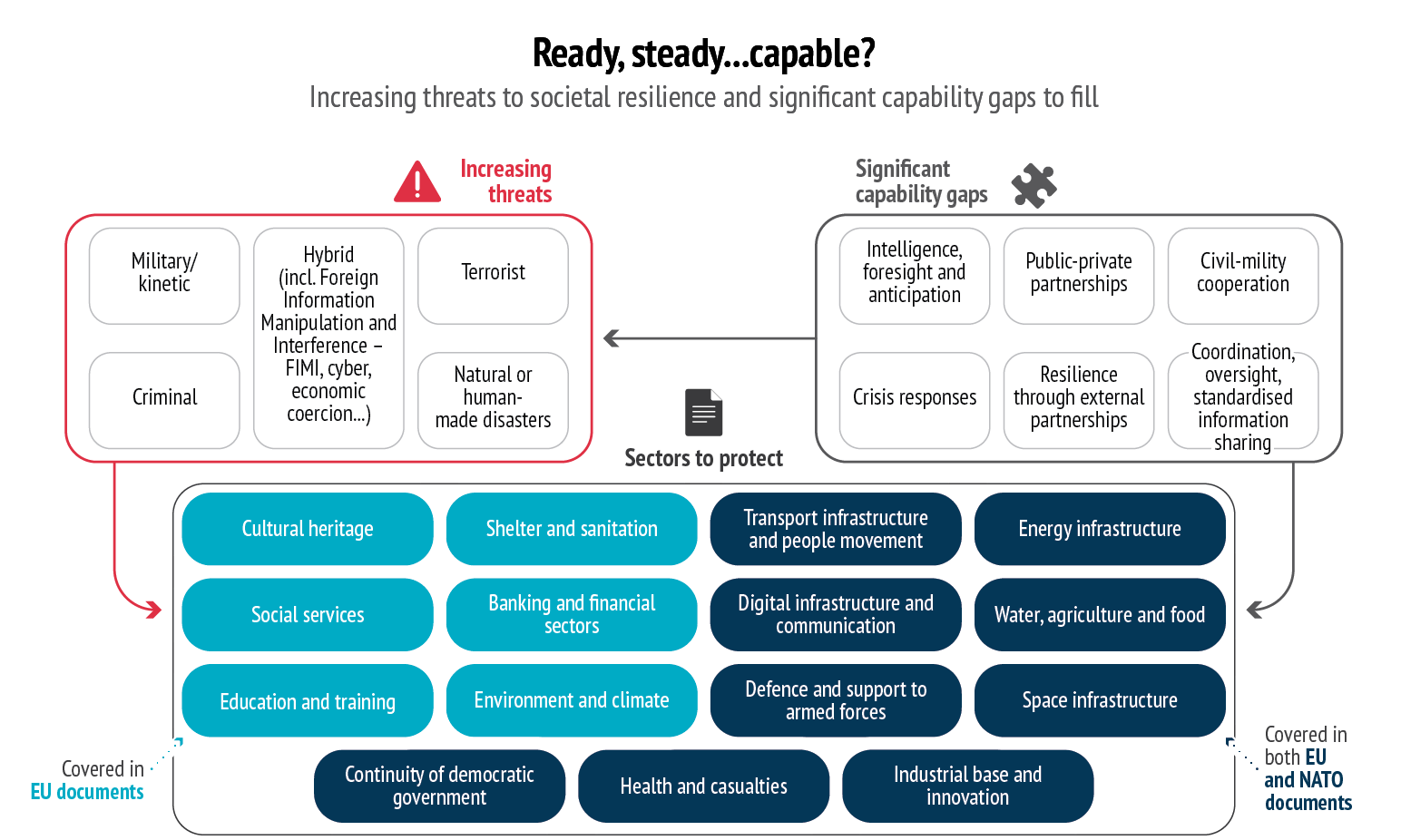
Emphasis on resilience has been growing in Europe since the illegal annexation of Crimea in 2014 and the Covid-19 pandemic. Ukraine’s response to Russian aggression has highlighted the importance of well-prepared and resilient citizens as a key component of deterrence. The growing hybrid attacks and large-scale operations targeting Europe(1) over the past four years have underscored the increasingly blurred line between military and civilian threats. They have included sabotage causing hundreds of millions of euros in physical damage, a wide array of information manipulation operations, including AI-enhanced campaigns, waves of bomb threats against public institutions, and drone incursions into the airspace of several EU Member States(2). Together, these incidents have underlined the importance of bolstering resilience across sectors and at all levels of society.
Over the past few years, Europeans have taken concrete steps to strengthen resilience. They have built shelters, developed alert systems, and conducted crisis exercises to operationalise Article 42.7 TEU, the mutual assistance clause. However, despite numerous initiatives, including the EU’s Preparedness Union Strategy and NATO’s baseline requirements for national resilience, resilience and preparedness remain under-organised at the European level. There is no continent-wide approach that sets out objectives, identifies resources and allocates targets to individual countries. Without a proper planning capability, Europeans cannot systematically address vulnerabilities, allocate resources efficiently, or ensure the continent’s effective defence.
This Brief assesses the current state of Europe’s preparedness and resilience, the progress made over the past few years as well as existing limitations. It then suggests ways to elevate resilience to a core pillar of deterrence and defence, so that European societies can both prepare for and absorb shocks, while also denying adversaries strategic gains. The Brief highlights how the EU can play an enhanced role in this process, complementing national and external actors’ efforts.
Europe’s preparedness jigsaw
The growing number and severity of hybrid attacks, and the prospect of a large-scale war akin to Russia’s full-scale invasion of Ukraine, have highlighted two important elements. First, societies must be prepared: they must take proactive action before a crisis occurs, such as planning, training, and stockpiling supplies. Second, they must be resilient: they need to be able to withstand shocks, adapt to unexpected events, recover rapidly and emerge stronger afterwards.
Sweden’s ‘total defence’ and Finland’s ‘comprehensive security’ models have become benchmarks for a whole-of-society approach to preparedness. They aim to integrate civilian and military planning more closely while adopting a 360-degree approach to managing all hazards and risks before, during and in the aftermath of crises. Several other EU countries have adopted similar approaches in recent years(3). Building on the recommendations of the 2024 Niinistö report, the European Commission is seeking to adapt elements of the Nordic model across the EU.
The EU’s role in civil preparedness and resilience has focused for many years on humanitarian assistance and disaster relief, primarily through the EU’s Civil Protection Mechanism. Although resilience falls mainly under national competences, the growing range of cross-border threats has highlighted the need for stronger coordination at the EU level. To this end, the EU has established several coordination mechanisms, including the Monitoring and Information Centre (replaced in 2013 by the Emergency Response Coordination Centre–ERCC), the Integrated Political Crisis Response (IPCR) arrangements, the EEAS Crisis Response Centre (CRC), and – for CSDP missions and operations – the Military Planning and Conduct Capability (MPCC) and the Civilian Planning and Conduct Capability (CPCC).
The EU has expanded its initiatives in response to a rapidly evolving threat landscape. To counter foreign interference, the European Commission launched the Democracy Action Plan in 2020, followed by the Defence of Democracy Package in 2023 and the European Democracy Shield in 2025. In parallel, it has strengthened cyber and critical infrastructure resilience through the NIS2 Directive (to protect networks and information systems from cyber threats), the Critical Entities Resilience Directive (ensuring continuity of essential services during all types of disruptions) and the Cyber Resilience Act (aiming to make products secure by design throughout their lifecycle).
More recently, the EU has adopted a more comprehensive approach. The Niinistö Report provided the basis for the 2025 European Preparedness Union Strategy, spanning a wide spectrum of sectors requiring greater resilience. The strategy sets out 30 key actions, including EU-wide minimum preparedness requirements, and practical guidance for citizens, such as preparing a 72-hour emergency kit.
The Strategy has further spurred the debate at the national level: for instance, 14 Member States have issued guidance documents adapting the 72-hour emergency kit to their national contexts. In addition, 15 Member States have argued that EU-wide preparedness requirements should cover areas that are beyond NATO’s purview but still relevant to the continued functioning of governments, such as education, the financial sector and health services(4). This points to a clear role for the EU in strengthening civilian resilience.
NATO has also strengthened its focus on resilience and civil preparedness as core elements of deterrence. As part of each NATO Defence Planning Process (NDPP) cycle, allies must provide details about their level of preparedness and resilience. At the 2025 Hague Summit, NATO countries pledged to dedicate up to 1.5% of their GDP to ‘defence-and security-related investments’, including protection of critical infrastructure (physical and digital), civil preparedness and resilience, and strengthening the defence industrial base. While the specific figure was a compromise between President Trump’s request that allies spend 5% of GDP on defence and NATO’s assessment that 3.5% would be needed to implement its regional plans, its adoption nonetheless further linked resilience to deterrence and defence.
Enduring challenges
Despite the growing number of initiatives, several challenges remain. First, it is difficult to ensure coordinated resilience planning. For example, although Member States are expected to develop national risk assessments, the lack of common reporting standards makes it difficult to compare findings and coordinate action across the EU(5).
Second, developing a clear methodology to measure resilience spending comes with difficulties. In some areas (e.g. building factories, shelters or redundant logistical infrastructure), investments can be quantified. In others, quantifying costs is harder and may include non-tangible targets(6). European national security strategies – such as those of France (2025) and Germany (2023) – emphasise the relevance of societal cohesion, a shared sense of identity, and the country’s ability to mobilise not just its military assets but also its society, as key components of deterrence. It is difficult to operationalise these into targets. Yet, any effort to strengthen resilience must also account for these intangible aspects.
Third, allocating resilience targets across European countries will be complex. All Member States should have some common capabilities, such as institutional counter-FIMI responses and resilient infrastructure. At the same time, individual countries or regional groups could specialise in specific capabilities, depending on the national context and nature of the threat. Some of these capabilities could be mobilised to aid other countries, regions or communities across the continent in a crisis. The absence of a coordinated resilience planning structure in Europe that allows for the cost-effective allocation of resources across the continent makes it difficult to address these interconnected issues.
Fourth, differences in national, local and regional contexts complicate efforts to strengthen resilience across Europe. Member States highlight concerns about sharing sensitive information – such as national risk assessments – at the EU level(7). Similar constraints affect EU-NATO cooperation, due to non-overlapping membership. While an EU-NATO staff dialogue on resilience is well-established, the exchange of information remains limited to the unclassified level.
Public support for integrating civilian and military approaches to resilience also varies across Europe. In Western and Southern Europe, where the risk of war is perceived as less imminent, the focus of civil preparedness remains on protection from natural disasters, terrorism and energy crises. In these countries, adopting a model akin to ‘total defence’ may prove politically challenging in the near term, given public concerns about the perceived ‘militarisation’ of society(8).
Lastly, comprehensive whole-of-society preparedness requires enhanced civilian-military cooperation. Military operations rely on civilian sector assets (such as commercial satellite providers for communications, or dual-use infrastructure for logistics). Civilian assets are increasingly targeted by adversaries in hybrid operations. Strengthening resilience therefore requires integrated planning, so that civilian and military authorities have a shared understanding of their respective roles and capabilities during a crisis. To test assumptions about the civilian and military assets that would be available in a crisis, potential scenarios should be regularly simulated and wargamed(9).
Roadmap to resilience
Europe needs a shared plan to coordinate and structure the build-up of capabilities. The EU and its Member States can play a central role in this process.
To achieve whole-of-society preparedness and resilience across Europe, the EU or a coalition of Member States should set up a resilience planning capability. This mechanism should pursue three core tasks. First, identify the vital societal functions that must continue to operate in peacetime, during crises and in wartime. Second, assess the threats to these functions and identify the capabilities needed to protect them. Third, assign the development of specific capabilities to participating countries. This process resembles the defence planning process, where the overall military strategy is defined, minimum capabilities are developed and then apportioned to participating countries. The EU’s Capability Development Plan follows this logic, as does the NATO Defence Planning Process. But nothing of the sort exists for resilience and preparedness.
The EU is well-placed to host this capability planning process. It could bring together relevant EU bodies, Member States and external actors to identify the blind spots in Europe’s resilience and preparedness, and develop strategies and targets to fill the gaps, leveraging existing instruments and creating new ones when necessary. This framework could also facilitate wargaming of crisis scenarios as well as the development of common contingency plans to ensure sustained resilience. Along with the ERCC and other departments of the European Commission, the EU’s civil-military bodies, such as the MPCC, Civilian Operations HQ, EEAS Crisis Response Centre and Civil-Military Group, could all play a role. These exercises could help operationalise Article 42.7 TEU and spell out the capability requirements that the clause entails.
Member States should be involved in the process from the outset as their role is essential to implementation. Some of the more ambitious objectives could be pursued by Member States in regional groupings or coalitions where trust is higher. Such coalitions would also make it easier to involve key non-EU partners who are essential to Europe’s resilience, particularly Ukraine, but also the UK and EU candidate countries.
Despite the Hague pledge, NATO has not provided clear guidelines for how members should organise their spending on resilience. There is an opportunity for the EU to take up that role. The proposed minimum preparedness requirements could provide a common benchmark against which each Member State assesses its own preparedness. The requirements could be the central component of a resilience planning process – while remaining non-binding to reflect Member State preferences. An EU framework would also enable non-NATO EU Member States to maintain comparable standards, and lay the foundations for a Europe-wide resilience planning capability within NATO or beyond.
Dedicating a portion of the next Multiannual Financial Framework to implementing the minimum preparedness requirements would incentivise implementation, and potentially encourage Member States to spend above the 1.5% of GDP they have pledged. While this approach has already been applied in some areas, such as military mobility, it could be extended to resilience more broadly.
Finally, the planning capability should also increase subnational engagementby involving local authorities, the private sector and citizens more closely in preparedness efforts. Building on the example of the 72-hour emergency kit, the EU’s resilience planning process could promote other practical measures, such as strengthening local government capabilities through financial incentives via cohesion policy funds and enhancing volunteering and civil protection skills through conferences, training, and school curricula.
References
* The authors would like to thank Bianca Mihailov, EUISS trainee, for her invaluable support and research assistance.
1. Kovalčíková, N., ‘Hybrid warfare: Dismantling the hypocrisy of Russia’s rhetoric’, in ‘Unpowering Russia: How the EU can counter and undermine the Kremlin’, Chaillot Paper no. 186, EUISS, May 2025, pp. 56-63.
2. IISS, The Scale of Russian Sabotage Operations Against Europe’s Critical Infrastructure, August 2025; EEAS, 3rd EEAS Report on Foreign Information Manipulation and Interference Threats, March 2005, p. 22.
3. O’Neill, P., ‘Episode 11: Finland’s Comprehensive Security Model’, podcast, RUSI, 10 February 2026.
4. Belgium, Luxembourg and the Netherlands, Non-paper – European Baseline Requirements, 28 May 2025.
5. Interview with European Commission official, April 2026.
6. Interview with EU and NATO officials, April 2026.
7. Interview with EU and Member State officials, April 2026.
8. Mölling, C., and Schütz, T., Civil Defence in Europe: An initial assessment, IISS, April 2026.
9. Interview with EU military officials, April 2026.