The imperial war that Russia launched in 2022 has exacted a heavy toll in blood and treasure. Russia has lost up to 1.2 million troops to date, as well as tens of thousands of armoured vehicles. The war is draining around 5% of Russia’s GDP per year, seriously weakening its economy. Having underestimated Ukrainians’ resolve to defend their country, and having prepared its invasion poorly as a result, Russia later shifted its main offensive to the Donbas, only to become mired in a protracted war of attrition. Ukraine continues to hold the line, but it lacks the capacity to recover and liberate occupied territories. Instead, it seeks to inflict severe losses on Russia, which continues to sustain heavy casualties in exchange for slow and strategically insignificant gains.
Russia has adapted and innovated militarily. It may currently have drone superiority. But it has failed to achieve victory on the battlefield and is therefore shifting the conflict to the diplomatic and hybrid domains. Its ‘noncontact’ informational and psychological warfare is waged not only against Ukraine but also against European societies. Moscow is also directing these efforts at the US administration, in the hope that Washington will push Kyiv into concessions that Russia cannot obtain on the ground. Europeans are now subject to campaigns that are escalating both horizontally (with new tactics, for example the recruitment of disposable human assets) and vertically (with increasing operational intensity). These efforts seek to undermine Ukraine’s ‘defence complex’ — its own defence capabilities, as well as the economic and military support provided by partners. The conflict is therefore being fought on multiple fronts: military, but also political, economic and diplomatic.
What is at stake for Europe
In this setting, and as divisions and faultlines continue to appear among Ukraine’s partners — casting doubt on their resolve to sustain support for Kyiv’s defence effort — Europeans need clarity on the basics: what Putin’s Russia wants, where Europe’s fundamental interests lie, and how they can succeed.
Putin’s regime presents Russia as locked in an existential conflict with the ‘collective West’, which it claims seeks to destroy it. While it pushes westwards and escalates this confrontation, it consistently portrays its actions as defensive responses to alleged Western encroachment. In this logic — a blend of strategic calculation and paranoia — the restoration of an empire over Eastern Europe is a means of ‘civilising’ unruly subordinates in the neighbourhood and imposing an imperial ‘peace’ on Russian terms. Europe’s basic interest is to ensure that Putin’s Russia fails in this enterprise: it must be stopped in Ukraine and deterred from further attacks in the future. To achieve this, Europeans must continue to empower Ukraine, ‘unpower’ Russia’s imperial war machine, and engage more forcefully in diplomacy to shape a ceasefire that effectively constrains Russia’s aggressive behaviour.
Support, pressure, engage
The EU and the Member States have already done a great deal to empower Ukraine: providing €103.29 billion to support the country’s resilience, €69.3 billion in military assistance, hosting millions of displaced Ukrainians, and imposing the most complex and comprehensive sanctions regime to date against Russia. In December 2025, the European Council approved an unprecedented loan of up to€90 billion, two-thirds of which is intended to cover Ukraine’s military requirements. Europeans successfully offset the end of US assistance in 2025, increasing their military support by 67% compared with the average of the previous three years. But fewer and fewer countries shoulder the burden, with eastern and southern European states in particular reducing their contributions. The new loan — a joint undertaking — will restore the balance to a degree, and preparations should proceed without delay: too much is at stake. The collapse of Ukraine’s defences or economy would serve no one, least of all its neighbours.
Europeans need to finalise the ‘prosperity package’ which offers Ukraine hope for a peaceful and prosperous future, and ensure that it reflects best practices in development cooperation, including local ownership. They must carefully design incentives so that recovery benefits all regions damaged by the war, including those close to the front line — and for example persuade European utility companies, which are generally not used to operating in challenging environments, to engage in reconstruction projects in Ukraine. A credible enlargement perspective is necessary to anchor reforms and create the right conditions for recovery. However Ukrainians should not be misled by false promises of fast tracks or fanciful concepts such as ‘reverse enlargement’. While some benefits of membership can be offered before accession and others after (as with previous eastern enlargements), a radical redesign of enlargement policy is not on the cards. Finally, a ceasefire would pave the way for political renewal in Ukraine. The EU must help Ukraine prevent destabilisation and counter predictable Russian interference, while ensuring that the various elections that will need to be held are conducted in a way that safeguards their legitimacy.
The EU should also increase pressure on Russia’s wartime economy — working with the United States and other partners where possible — and more assertively target the shadow fleet in particular. Russia’s economy is not collapsing, but it has entered a ‘death zone’: the government has little fiscal space as income from hydrocarbon exports is declining due to the combined impact of sanctions and a strong rouble. Putin appears to believe that Russia is more resilient than Europe and can sustain the mounting costs of war, even as he mortgages the country’s future. He must be proven wrong. Unpowering Russia is essential both to limit its current capacity to do harm, and to narrow the Kremlin’s options for exporting growing domestic instability, potentially paving the way for internal change in the longer term.
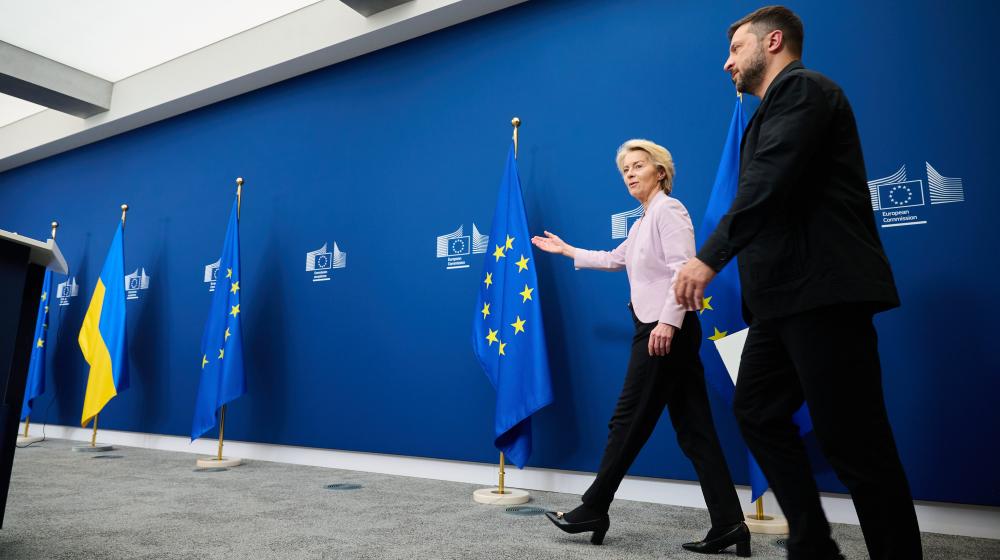
Finally, the EU must find a way to engage in the diplomatic process to halt the war. The current fractured format benefits only one country: Russia. Despite their efforts, the Americans were unable to drive the process to a conclusion, and they are likely to further lose interest as the midterm elections approach. Europeans need to step in by helping to design a ceasefire as an element of a future deterrence architecture along the extended front line with Russia, from Svalbard down to Odesa — while convincing (sometimes doubtful) Ukrainians that this will serve their interests rather than merely opening the door to a host of additional challenges. Given the choices and trade-offs at stake and knowing that Russia may still refuse and stall, these are hard decisions that only Ukraine can make for itself. In conditions where Ukraine cannot rely on goodwill from either Russia or the United States, Europe must credibly act as the partner of first and last resort, indispensable to any future lasting agreement.
Europeans need clarity about what they must do to contribute to a lasting peace — and what they are willing to do to extract concessions from Russia. They should not be held back by their limitations; all parties face constraints, not least a dangerous but weak Russia. Their support for Ukraine should rest on the recognition that a free and independent Ukraine needs Europe on its side — and that a free and independent Europe needs Ukraine on its side, too.