Prime Minister Nikol Pashinyan won a convincing victory in Sunday’s parliamentary election, which validated his vision of a ‘real Armenia’: democratic, secure and independent within its current borders. His Civil Contract party received 49.8 % of the popular vote, and likely 64 seats in the new parliament. This is a comfortable majority, despite the presence of strong and vocal opponents in parliament. However it falls just short of the constitutional majority required to call a referendum on a new constitution, which Azerbaijan has made a precondition for signing a peace treaty. The risk persists that the peace process could still stall or even collapse altogether.
The EU has reason to be satisfied: it has consistently supported Pashinyan’s vision. It convened the first EU-Armenia summit in the country’s capital last month. Ahead of the election, it sent a hybrid response team to Armenia to help safeguard the integrity of the vote. After the election, it plans to deploy EUPM Armenia, a new CSDP mission inspired by a similar one in Moldova, to help the country counter foreign information manipulation and interference (FIMI), illicit finance, and cyber threats. In response to Russia’s economic coercion before the election, the Commission also announced a €50 million financial assistance package and practical measures to shield Armenia from economic pressure by Moscow.
But any sense of EU complacency now that the election is over would be misplaced.
A success in the face of Russia’s pressure
The success of Civil Contract did not come as a real surprise. The party reaped the benefits of incumbency in a political system that remains a fragile, hybrid democracy, dominating the media space and collecting donations from public officials and prominent business representatives. The economy is performing well, registering 7.2 % GDP growth in 2025. Perhaps most importantly, Pashinyan’s vision for Armenia’s future, born out of the traumatic loss of Nagorno-Karabakh in 2023, had no credible alternative in Armenia’s fractured political landscape. Once central to Armenian identity narratives, the mountainous region was home to over 100,000 Armenians who were forced to flee after Azerbaijan regained control of the territory following decades of conflict.
The main challenge came from the Strong Armenia bloc backed by Samvel Karapetyan, a wealthy businessman with close ties to Russia, which received 23.2 % of the vote. Karapetyan made his fortune in Russia in the 1990s, and has long been suspected of having links to the FSB. He openly challenged Pashinyan over the latter’s conflict with the Armenian Apostolic Church, which the prime minister sees as a vehicle for Russian influence that undermines his authority. Karapetyan was subsequently arrested on charges of usurpation of power and money laundering. The Armenia Alliance led by former president Robert Kocharyan – a leading figure of the ‘Karabakh clan’ that dominated Armenian politics for two decades before the Velvet Revolution (2018) brought Pashinyan to power – received 9.9 % of the vote. A third opposition party, Prosperous Armenia, led by Gagik Tsarukyan, another businessman who made his fortune in Russia, narrowly missed the 4 % threshold and will remain outside parliament unless a recount awards it additional votes. Civil Contract will therefore sit alongside two (or possibly three) radical opposition parties.
The opposition from Strong Armenia and the Armenia Alliance to Pashinyan’s programme is rooted in historical nostalgia. Both parties stoked fears that post-election concessions by Pashinyan might lead to the return of hundreds of thousands of Azerbaijanis who left Armenia in the late 1980s. They also promoted a vision of restored relations with Russia. Furthermore, in addition to alleged vote-buying schemes and the mobilisation of the Armenian diaspora in Russia to travel to Armenia and vote in their favour, the radical opposition may have benefited from support from the Kremlin.
For Moscow, the election turned into a geopolitical battlefield as it sought to protect its waning influence in the South Caucasus.
The Kremlin likely assessed that it could not remove Pashinyan from power. It therefore focused on reducing his party’s gains and casting doubt on the legitimacy of his victory. To that end, Russia deployed a range of tactics from its foreign information manipulation and interference (FIMI) repertoire. It also used NGOs like ’Evrazia’ (Евразия), notionally engaged in social welfare and aid, to reach vulnerable constitutiencies, including refugees from Nagorno-Karabakh. Russian authorities imposed embargoes on selected Armenian goods, such as brandy, wine, mineral water, agricultural produce and flowers, citing customer protection but in all likelihood with the aim of ‘reminding’ Armenian voters of existing economic dependencies. Moscow also threatened to cut imports of favourably priced gas and petroleum products. Together with Belarus, Kazakhstan and Kyrgyzstan, it issued a statement warning that Armenia could lose trade benefits offered by the Eurasian Economic Union if it continued to pursue closer ties with the EU. Vladimir Putin even casually invoked the possibility of a ‘Ukrainian scenario’ if Armenia proceeded with integration into the EU.
What next?
The likely loss of 7 seats compared to the last snap election in 2021 should not be seen as a defeat for Civil Contract. The political context has changed dramatically since then, most notably with the loss of Nagorno-Karabakh. However, Pashinyan narrowly fell short of securing the constitutional majority in parliament needed to call a referendum on a new constitution, which he had envisaged as the foundation of his promised ‘Fourth Republic’. Crucially, as Azerbaijan’s key condition for signing the peace agreement, the new constitution was also intended to remove a contentious reference to a past decision on unification with Nagorno-Karabakh.
Pashinyan may seek to enlist potential defectors from the opposition parties for the parliamentary vote on the referendum, or call a snap election once the draft constitution is ready. But securing approval in the referendum may be more challenging than securing an electoral victory. To pass, it will require not only a simple majority of votes cast but also the support of more than 25 % of eligible voters. This is likely where Russia’s efforts to spoil the peace process will now be concentrated. Much will depend on Pashinyan’s ability to champion his vision while bridging rather than deepening the country’s political divides.
His success matters because the failure of the peace process could have grave consequences: it could lead to a new outbreak of conflict and potentially to the occupation of Armenia’s Syunik province, as Azerbaijan might seek to establish a land corridor to its exclave Nakhchivan by force.
To avoid this outcome, the EU should focus on three areas.
It should insist on progress towards a consolidated and robust democracy. Pashinyan is a charismatic leader with a compelling vision for his country that the EU can support. His highly personalised political style, however, means that he has so far shown less interest in building strong institutions. A skilled political communicator, Pashinyan has reversed declining support not only by appealing to voters on an emotional level, but also by trying to portray himself as the sole guarantor of peace and stability in contrast to an opposition (‘the three-headed war party’) who would bring only chaos and destruction. The region offers ample cautionary tales about this kind of populist and polarising ‘saviour’ politics.
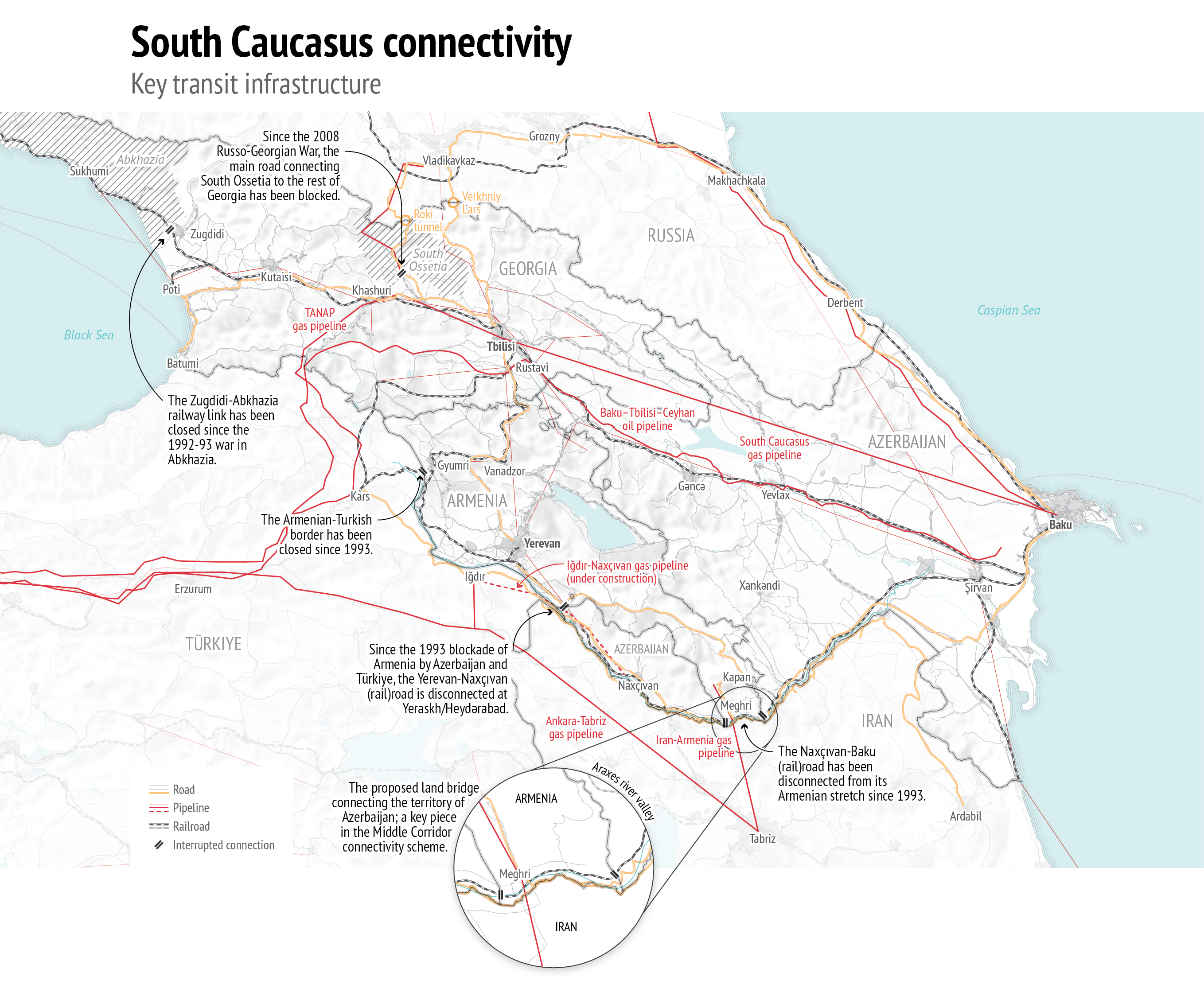
Second, the EU should increase its support for peace efforts. Connectivity initiatives linked to a future peace settlement are one promising avenue – they can lock in the parties’ commitments by creating reliable future gains and raising the opportunity costs of a collapse in the the process. The Trump Road (TRIPP), a US-led investment project to develop local transit routes, has always been an unlikely proposition; with the Iran war, it is less likely still. The EU, by contrast, has tools to support large infrastructural projects and manage trade traffic without infringing the sovereignty of either party. To act as a successful peace broker, the EU needs to make credible offers, secure ironclad commitments to peace and international cooperation in return, and engage in renewed conflict transformation efforts that address questions of dignity and justice rather than sideline them.
Finally, the EU should help Armenia to further reduce its dependencies on Russia. For the foreseeable future, Pashinyan will need to perform a balancing act as he draws Armenia closer to Europe. His choices will be constrained, but they can be gradually expanded, while Russia’s ability to spoil the peace can be diminished.