Summary
- Georgia and Serbia are drifting away from the EU, albeit at different speeds. Georgia illustrates the costs of responding too late to democratic erosion: as authoritarianism takes hold, the EU’s room for manoeuvre and ability to exert influence diminish. Serbia is displaying similar warning signs, such as blurred state-party boundaries, pressure on judicial institutions, and ‘colour revolution’ narratives. The EU should act now to prevent Serbia from following Georgia’s trajectory.
- Democratic backsliding has obvious geopolitical consequences: weakened institutions and the concentration of power create local vulnerabilities that competing external actors can exploit. The EU should therefore be more proactive in defending democracy as a core strategic interest and embed this objective in its broader European security strategy.
- The EU should deploy proportionate counter-measures in response to the early stages of democratic decline. These could include freezing financial assistance, introducing individual visa bans, reversing benefits granted through gradual integration, and suspending preferential tariffs under the SAA and DCFTA.
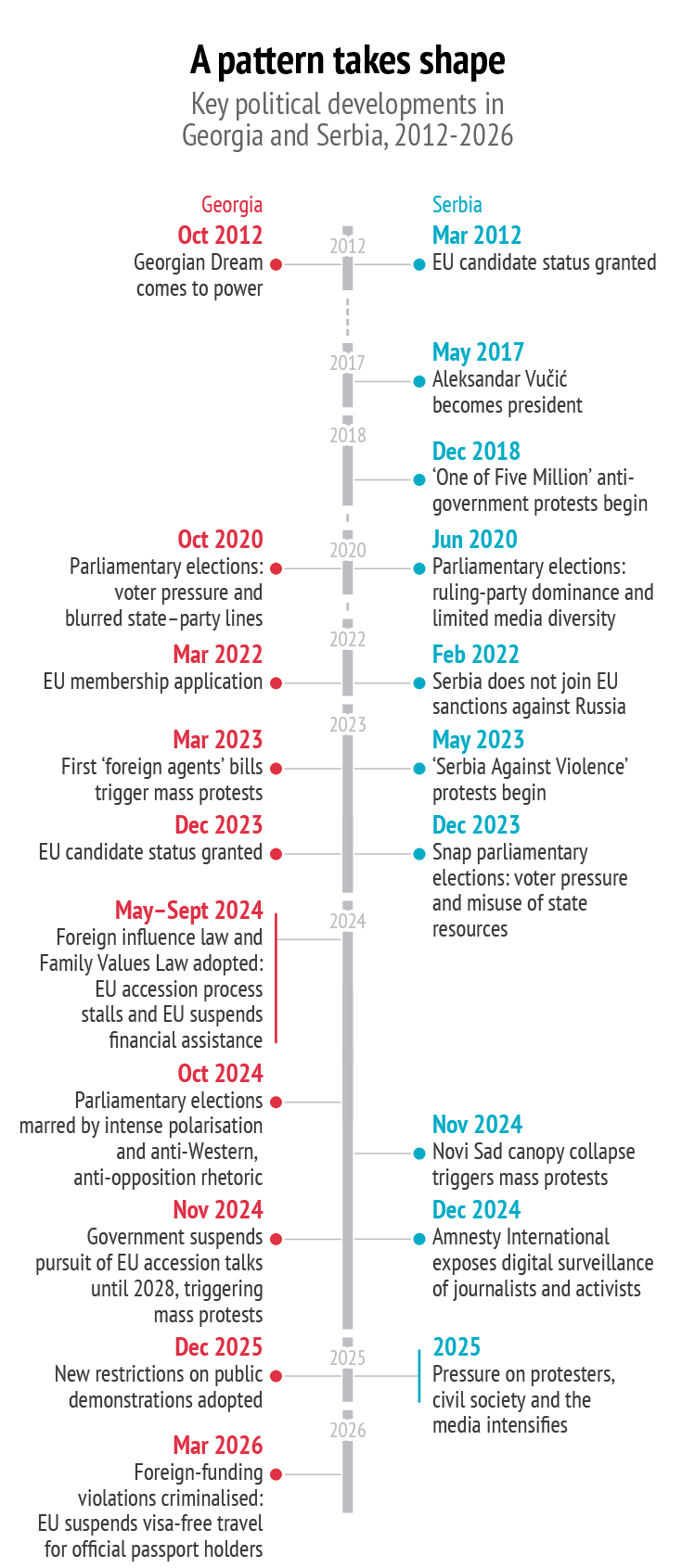
The EU is seeking to anchor its neighbourhood more firmly within Europe. Yet Georgia and Serbia are drifting in the opposite direction. Democratic decline and growing uncertainty over their European orientation are testing the limits of EU leverage.
Data: EUISS research based on EU, OSCE/ODIHR and other open sources
The two cases, however, unfold in markedly different contexts. Three aspects stand out: geopolitics, structural constraints – including geography – and societal mobilisation. First, while both governments have deliberately diverged from democratic norms and values, Georgia has moved considerably further towards state capture. Second, Serbia’s deep economic integration with the EU constrains its room for manoeuvre, while Russia’s de facto control of 20% of Georgia’s territory, the ruling party’s growing alignment with Moscow and Georgia’s more diversified trade ties create a fundamentally different geopolitical environment. Third, the scope for societal mobilisation to shape political outcomes diminishes as democratic erosion advances. Georgia’s experience shows that even sustained mobilisation against democratic regression may struggle to alter an increasingly entrenched political trajectory. In Serbia, there remains greater scope for change from below – at least for now.
Yet a common pattern emerges. Democratic backsliding rarely occurs as a sudden rupture; rather, it is the cumulative result of years of institutional erosion. Georgia demonstrates the consequences of failing to act when the first signs of democratic decline appear(1). Serbia has not yet reached this stage, but several of the indicators that preceded Georgia’s deeper decline are already visible. This Brief argues that EU leverage is strongest before democratic erosion becomes systemic. Its effectiveness depends less on identifying individual deficiencies than on recognising when they form part of a broader pattern – and responding with appropriate political, financial and accession-related measures.
Concentration of power
Georgia’s authoritarian turn is the result of more than a decade of gradual consolidation of power. Yet the country’s modernisation and democratic transformation following the 2003 Rose Revolution never fully matured(2). Despite periods of democratic progress, rule-of-law institutions remained weak, as did institutional checks. This context made it relatively easy for Georgian Dream (GD) and its founder and de facto leader, Bidzina Ivanishvili, to quietly consolidate power over the years, initially by controlling the parliament, the judiciary, and public administrative resources to secure longer-term political dominance. The party’s growing influence over the media space helped it dominate the political narrative and delegitimise the opposition. This process escalated following the 2024 rigged elections, with severe restrictions on independent media and the political opposition.
Despite the presidency’s limited constitutional role(3) in Serbia, political power is effectively concentrated in the hands of the president, blurring the boundaries between presidential authority, state resources and party networks. During the June 2025 local elections in two municipalities, observers recorded 70 cases of potential misuse of public resources and official functions, including to promote the ruling party’s local electoral lists(4). Both lists carried Aleksandar Vučić’s name although he was not – and could not legally stand as – a candidate. The overlap between presidential authority and Serbian Progressive Party (SNS) interests was further illustrated in July 2025, when the president used his constitutional power to pardon four SNS party activists accused of attacking students in Novi Sad the previous January.
Weakened institutions
Both countries show that institutional erosion is cumulative rather than episodic. In Georgia, GD’s constitutional majority after the 2016 elections strengthened its ability to reshape the institutional framework without opposition support. By 2020, the OSCE Office for Democratic Institutions and Human Rights (ODIHR) was reporting pressure on voters and a blurring of the line between the state and the ruling party(5). The 2024 elections took place on an uneven playing field, marked by fear-based rhetoric, ruling-party privilege, concerns about the independence of electoral institutions and widespread intimidation(6). The Commission’s Georgia 2025 Report identified further democratic backsliding, including threats to judicial independence and the use of the justice system against political opponents(7).
Serbia displays several of the same warning signs. In 2025, political pressure on judges and prosecutors continued, including interventions by senior officials in ongoing investigations and judicial decisions, with little or no institutional follow-up(8). Electoral reform has similarly stalled: across successive elections, ODIHR has repeatedly called for a clearer separation between state and party, stronger safeguards against voter pressure and the misuse of public resources, and more effective independent oversight. Parliamentary scrutiny has weakened in parallel: no parliamentary question sessions with the government were held in 2025, while the parliamentary agenda remained almost entirely government-driven.
Delegitimising the opposition
By 2015, almost the entire leadership of the former ruling United National Movement (UNM) had been arrested, prosecuted or investigated(9). Intimidation increasingly evolved into attacks on opposition leaders and civil society actors, cast as Western-backed forces seeking to draw Georgia into a ‘second front’ against Russia. By the 2024 elections, GD was openly portraying the opposition as a threat, using slogans such as ‘No to War! No to Agents!’ and warning that an opposition victory would expose Georgia to the kind of destruction seen in Ukraine(10). After the elections, pressure became increasingly institutionalised: a parliamentary commission initially targeting former UNM officials and their role in the 2008 war was subsequently expanded to other opposition parties labelled by GD as the ‘collective UNM’. Today, there are approximately 82 political prisoners in Georgia(11).
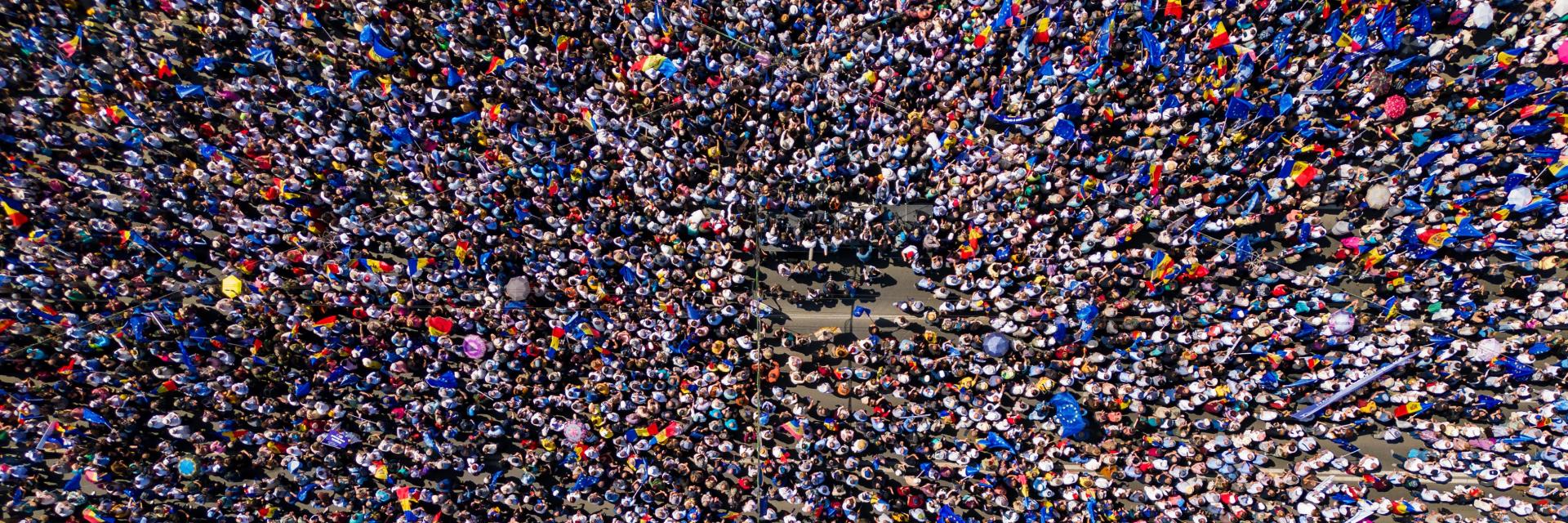
A similar shift in political narrative became visible in Serbia during the 2025 protests. Aleksandar Vučić repeatedly framed the movement as a foreign-backed ‘colour revolution’, making unsubstantiated claims that it was organised and financed from abroad, including through the involvement of Western foreign intelligence services. At a February 2025 rally, he explicitly linked the alleged ‘colour revolution’ to USAID, the National Endowment for Democracy and the European Endowment for Democracy(12). This narrative was subsequently reinforced by Russia: in September 2025, its Foreign Intelligence Service (SVR) accused the EU of orchestrating a ‘Serbian Maidan’ aimed at installing a government in Belgrade loyal to Brussels(13).
Shrinking civic space
Since 2024, GD has introduced legislation restricting foreign funding for civil society organisations (CSOs) and media, requiring them to register as ‘foreign agents’ if more than 20% of their funding comes from foreign sources. It later expanded regulatory control over broadcasters, prohibiting most forms of direct and indirect funding from abroad. Failure to register can result in fines of up to GEL 25 000 (€8 500), with additional fines imposed for failing to submit declarations, and penalties of up to five years’ imprisonment for non-compliance(14). Additionally, amendments to the Broadcasting Law were used to sanction the opposition-leaning channels Formula TV and TV Pirveli. By 2025 major broadcaster Mtavari TV ceased broadcasting amid financial and ownership disputes, while 17 regional broadcasters stopped operating during 2025 due to financial difficulties(15).
In Serbia, the same trend has been reflected primarily in mounting pressure on CSOs and journalists, including surveillance and coercive measures. In February 2025, police entered the offices of four civil society organisations in an investigation into the alleged misuse of USAID funds. At one organisation alone (CRTA), around 20 officers remained on the premises for 28 hours and confiscated some 8,500 pages of project documentation(16). Cases involving incidents against journalists increased by 106% in 2025, from 65 to 134, while cases concerning physical assaults rose from six to 28, an increase of 367%(17). The use of digital surveillance has also become a growing concern. In 2025, two investigative journalists were targeted with NSO Group’s Pegasus spyware, while forensic analysis by Amnesty International confirmed the use of Cellebrite technology to access the phone of a student activist detained by Serbia’s Security Information Agency (BIA)(18).
Act before crisis strikes
Georgia and Serbia highlight the importance of a well-timed and well-designed response. Georgia shows the cost of waiting: once democratic erosion gives way to entrenched political control, the EU’s ability to influence the trajectory becomes considerably weaker. Serbia presents an opportunity to apply this lesson earlier. As the accession process loses its transformative momentum, the EU should shift from documenting democratic decline to preventing it:
Make democratic resilience a geostrategic objective. Georgia and Serbia illustrate the risks of the EU treating democracy and geopolitical imperatives as competing priorities. The EU granted candidate status to Georgia in 2023 despite a significant deterioration in democracy. In Serbia, the EU continued political and economic engagement despite persistent democratic backsliding and large-scale protests demanding accountability. The EU therefore has a strategic interest in embedding the democratic resilience of enlargement partners within its broader European security strategy. Democratic consolidation can facilitate their gradual integration into the EU’s economic, security and institutional architecture. In turn, deeper integration can strengthen the EU’s strategic position and leverage amid growing geopolitical competition involving Russia, China and the United States, among others.
Reward resilience, raise the cost of backsliding. The EU should treat the democratic resilience of enlargement partners as integral to its own. Democratic progress should be rewarded through accelerated integration into EU programmes, agencies and parts of the Single Market, building on the Reform and Growth Facility. Early signs of backsliding should make these benefits reversible and trigger targeted measures. These could range from individual visa bans and the freezing of financial assistance to the suspension of preferential tariffs under the Stabilisation and Association Agreement (SAA) and Deep and Comprehensive Free Trade Area (DCFTA) and, where applicable, measures under the EU Global Human Rights Sanctions Regime. Where EU-wide action is blocked, Member States and partners such as the UK could coordinate national sanctions. Broader measures, including suspension of visa-free travel, should remain a last resort. Conditionality should be accompanied by reorientation of financial assistance towards independent media and civil society.
Account for new forms of democratic backsliding. Democratic erosion increasingly unfolds through informal (geo)political, economic and societal channels that are not fully captured by traditional rule-of-law and electoral benchmarks. The EU should expand its monitoring to include indicators of emerging state capture, such as party financing practices, informal influence networks and partisan use of state resources. It should also consider geopolitical and economic vulnerabilities, including shifts in foreign-policy alignment, external influence through religious networks, and foreign investment and ownership in strategic sectors. Deterioration across several of these dimensions should prompt the EU to assess a broader pattern of democratic backsliding and apply proportionate conditionality.
References
* The authors would like to thank Alessandro Vitiello, former EUISS trainee, for his invaluable research assistance.
1. Akhvlediani, T., Delcour, L. and Vancic, D., REUNIR Blog, Centre for European Policy Studies (CEPS), July 2025.
2. Rimple, P., ‘Georgia’, in Nations in Transit 2014, Freedom House, 2014.
3. Under Serbia’s Constitution, the president represents the state, promulgates laws, nominates the prime minister, makes certain appointments and commands the armed forces.
4. CRTA, Local Elections in Zaječar and Kosjerić: Long-Term Observation Report Summary, 5 June 2025.
5. ODIHR, Georgia, Parliamentary Elections, 31 October 2020: Final Report, 5 March 2021.
6. ODIHR, Georgia, Parliamentary Elections, 26 October 2024: Final Report, 20 December 2024.
7. European Commission, Georgia 2025 Report, SWD(2025) 757 final, 4 November 2025.
8. European Commission, Serbia Report 2025, SWD(2025) 755 final, 4 November 2025.
9. Parliamentary Assembly of the Council of Europe, Abuse of pretrial detention in States Parties to the European Convention on Human Rights, 7 September 2015.
10. ODIHR, Georgia, Parliamentary Elections, 26 October 2024: Final Report, 20 December 2024, op. cit.
11. Transparency International Georgia, ‘List of political prisoners’, 21 July 2026.
12. United Nations Interim Administration Mission in Kosovo (UNMIK), ‘UNMIK Media Observer, Afternoon Edition, February 20, 2025’, 20 February 2025.
13. EUvsDisinfo, ‘The EU is plotting a Serbian Maidan’, .
14. Brachveli, S. ‘Deeper look: Foreign Agents Registration Act’, Civil Georgia, 4 March 2025.
15. European Commission, Georgia 2025 Report (SWD(2025) 757 final), Directorate-General for Enlargement and Eastern Neighbourhood, 4 November 2025.
16. United Nations Special Procedures, ‘Communication to Serbia’, Ref. AL SRB 1/2025, 3 April 2025.
17. OSCE Mission to Serbia, 2025 Activity Report of the Permanent Working Group for Safety of Journalists, 30 April 2026.
18. See also: Amnesty International Security Lab, ‘Serbia: Journalists targeted with Pegasus spyware’, 27 March 2025; and ‘Cellebrite zero-day exploit used to target phone of Serbian student activist’, 28 February 2025.