Summary
- Ukraine has developed one of the world’s most capable and innovative defence industries. Deeper EU-Ukraine industrial cooperation will bolster Kyiv’s ability to resist and deter Russia while also strengthening Europe’s deterrence posture. Both constitute key European security interests.
- While there are real obstacles to deeper cooperation, Ukraine and Europe possess complementary strengths: Ukraine offers unique experience and know-how, while Europeans can provide capital and advanced technology and generate long-term demand.
- The EU should combine sustained support for Ukraine with efforts to accelerate its integration into Europe’s defence industrial base. It can do this by providing financing, creating stronger incentives for Ukrainian participation in EU instruments, supporting production in Ukraine and in the EU, and fostering deeper partnerships between Ukrainian and European firms.
From assistance to integration
EU-Ukraine defence-industrial cooperation is moving from a logic of support to one of partnership. Following Russia’s full-scale invasion in 2022, European support initially took the form of arms deliveries, including through the EU’s ammunition initiative and the Czech ammunition initiative. Later, Europe’s focus broadened to financing production in Ukraine, a model pioneered by Denmark and subsequently adopted by the EU, which began channelling windfall profits from Russia’s frozen assets into Ukrainian defence production. The volume of EU support expanded further with the approval of a €90 billion support loan for 2026-27, around €60 billion of which will be directed to defence, on top of bilateral assistance by Member States. Over the past year, the relationship has increasingly evolved from one based on assistance towards one centred on industrial cooperation and integration. However, the transition is not complete. Crucially, much cooperation still focuses on maintaining and producing existing systems rather than jointly developing new ones.
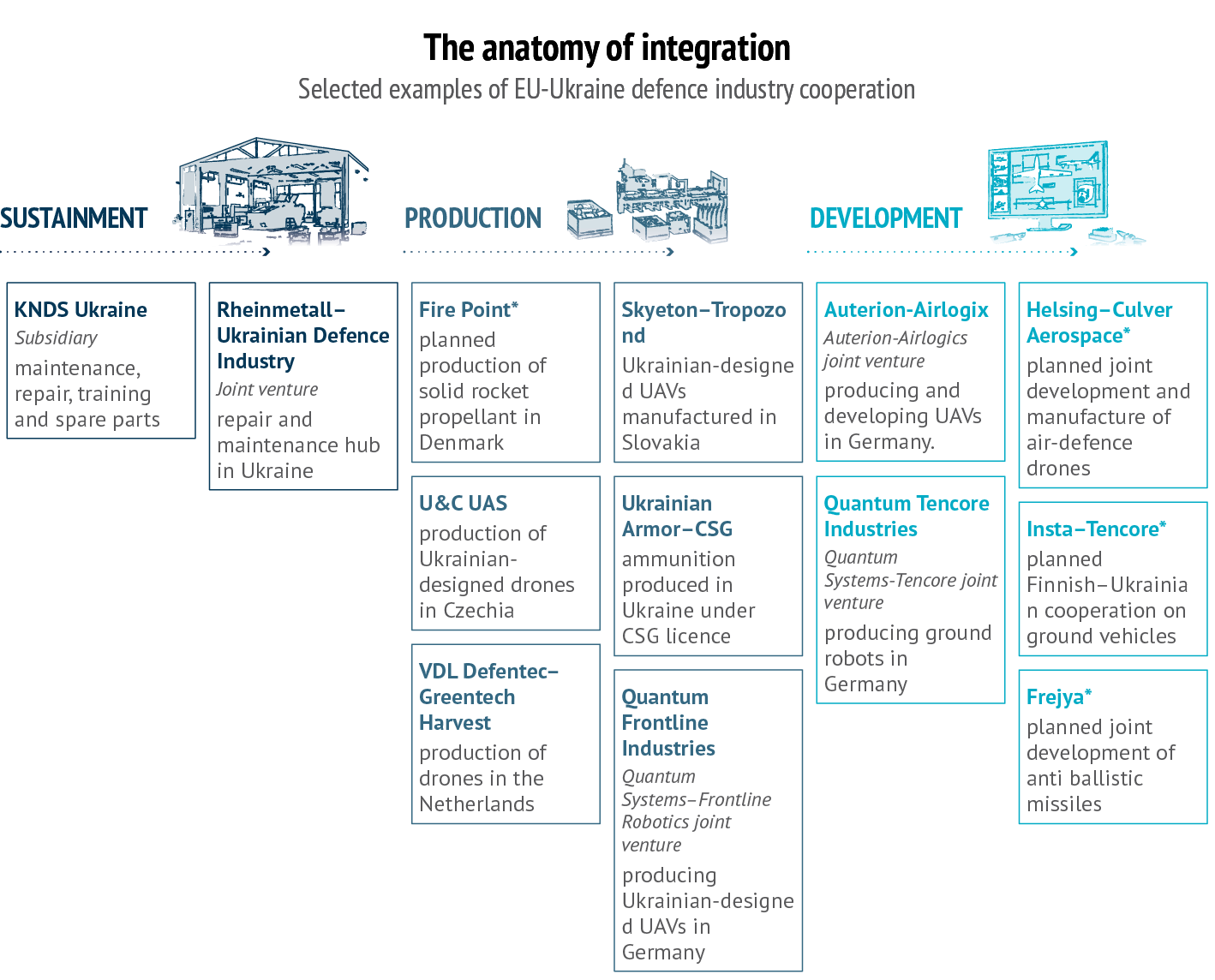
The partnership is driven both by governments and by an emerging network of industrial partnerships linking Ukrainian defence companies to their European counterparts. European firms have established maintenance and repair operations in Ukraine, as with the joint venture between Rheinmetall and Ukrainian Defence Industry (UDI) or the KNDS subsidiary focusing on maintaining and repairing tanks and artillery. European companies have also established production in Ukraine, such as the ammunition production operation set up by the Czech company CSG with Ukrainian partners. European governments and companies have been reluctant to localise advanced production in Ukraine, but that position is beginning to shift. In July 2026, France authorised licensed production of SCALP missiles in Ukraine, while France and Italy authorised licensed production of Aster 30 air-defence interceptors(1). Industrial integration is also proceeding in the opposite direction. Quantum Frontline Industries, a German-Ukrainian joint venture between Quantum Systems and Frontline Robotics, began producing Ukrainian-designed drones in Germany in 2026. Ukraine’s Fire Point is establishing production for rocket propellant in Denmark, although the project has been delayed until late 2027(2).
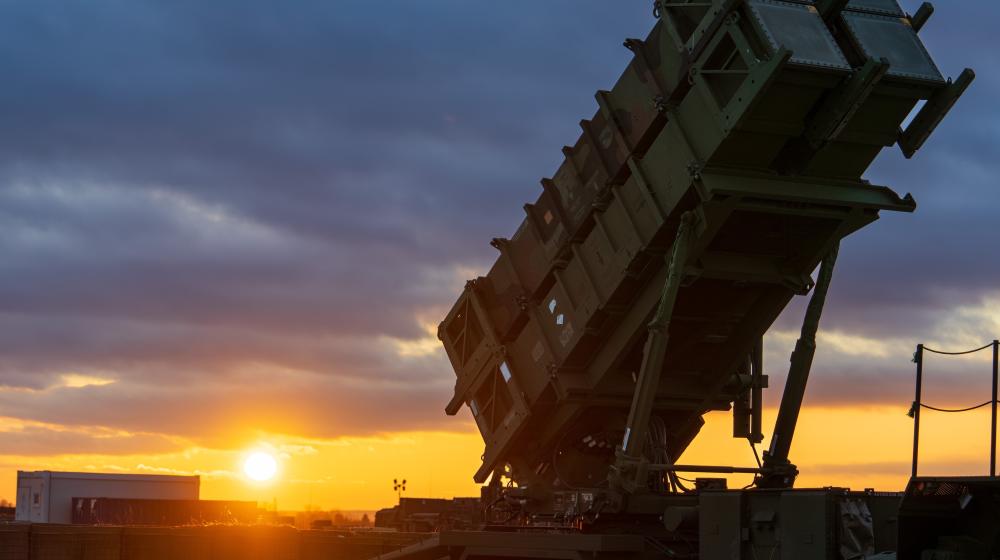
Joint capability development is gaining momentum, with Europeans increasingly seeing Ukraine as a contributor of technology and know-how. Several European governments, including Germany, France and Denmark, have concluded agreements with Ukraine focusing on joint development and production of capabilities such as drones and air defence systems. Perhaps the most ambitious example of this new trend is Project Freya, which emerged in July 2026 as a potential flagship project for a ten-country anti-ballistic missile coalition including Ukraine. Ukraine’s Fire Point could supply a launcher and the FP-7 interceptor missile while over a dozen European partners provide radars and other critical components. While assembling all these pieces together is no easy task, the direction of travel is clear(3).
The EU has a substantial toolbox to support Ukraine’s integration into the European Defence Technological and Industrial Base (EDTIB). Member States can use SAFE loans to buy Ukrainian equipment, and production can take place in Ukraine. 15 of the 19 national SAFE plans submitted to the Commission include projects with Ukraine. Additionally, Ukrainian companies can participate in EU instruments such as the European Defence Fund (EDF) and the European Defence Industry Programme (EDIP) which also includes the Ukraine Support Instrument, a financial envelope dedicated to supporting the integration of Ukraine’s defence industry. The EU has also taken on a major role in fostering cooperation by bringing companies together and facilitating partnerships, for example through the Defence Innovation Office in Kyiv or the BraveTech EU initiative. The EU–Ukraine Defence Industrial Partnership announced in July 2026 should further deepen cooperation.
Ukraine’s defence industry reload
The war has led to a deep transformation in Ukraine’s defence industry. Ukraine has substantially scaled up defence industrial production to sustain its war effort against Russia since 2022, reversing a long decline following the dissolution of the USSR. It is set to produce around 7 million drones this year, almost a tenfold increase over the past three years(4). Domestic production now covers around 50% of Ukraine’s defence needs, and localisation of component production is advancing. However, reducing critical dependencies on batteries and sensors remains difficult due to China’s dominance in critical raw materials combined with export controls and bottlenecks in areas such as semiconductor production.
The speed of Ukraine’s innovation is equally impressive(5). It directly contributes to strengthening Ukraine’s defences but has also become a valuable asset that the government seeks to leverage to generate more support for resisting Russia’s aggression, as demonstrated by recent drone deals with the Gulf States and the US. These reflect both rising global demand for the drone and electronic warfare systems that Ukraine has mastered, and its own spare production capacity: estimated at €30.5 billion, public procurement (even with EU assistance) now uses only 30 % of this capacity(6). According to some estimates, Ukraine could export up to €1.8 billion worth of arms in 2026, excluding the production generated by joint ventures(7). The government has established a new mechanism to approve export licences designed to attract more international financing while safeguarding sufficient deliveries for Ukraine’s own defence – and directing a portion of the proceeds from sales (20 % in the case of finished products and technologies) to a special industry development fund.
Despite this remarkable progress, challenges persist. The security of production lines remains a critical concern, part of the skilled workforce has been deployed to the front line, and progress on reforming the governance of state-owned enterprises (SOEs) and public procurement has been uneven. The dismissal of Defence Minister Mykhailo Fedorov in the summer raises concerns about whether the drive for innovation and reform, which has at times had to overcome systemic inertia, can be sustained.
The Ukrainian defence industry is a Janus-faced creature. There is the open innovation ecosystem comprising around 800 companies that account, among other things, for up to 90 % of FPV drone production. The Brave1 coordination platform serves as an interface for this ecosystem and as a technological accelerator for defence projects, supplying funding, testing and feedback loops, as well as links to procuring entities including battlefield units. It is this ecosystem that, if maintained and developed, will provide most assets for the future defence of Ukraine – not by removing troops from the front line as some in Ukraine would hope, but by better countering the acute threats posed by the fast missiles or jet-powered drones that Russia is now fielding. It can also play a valuable role in devising cooperative, or even integrated, solutions with the EU.
Yet the neoliberal, market-driven logic that defines the innovation ecosystem also comes with challenges. These include scaling up and standardising production and reducing dependence on competitively priced Chinese suppliers despite structural disincentives. They also include legal and broader normative concerns over sharing data collected from drone strikes with partners developing advanced AI targeted algorithms.
In addition to the dynamic innovation ecosystem, however, a conglomerate of around 100 legacy defence companies operates under the aegis of UDI, the restructured former Ukroboronprom. Governance reform of these SOEs, including their transformation into joint stock companies with independent supervisory boards responsible for defining strategies, KPIs and controls, is ongoing. While reform of the UDI’s governance as a whole has advanced rapidly, progress at the level of individual constituent companies has been slow. This is where the EU can help, both by removing obstacles to greater efficiency and by facilitating deeper cooperation with European partners. Beyond red tape and insufficient incentives, such cooperation has to contend with not only security but also political risks related to corruption and the protection of intellectual property.
Strengthening the partnership: Five priorities
The first priority for the EU should be sustaining and ideally expanding financial support so that Kyiv can make full use of its defence industrial capacity. The current level of EU financing, with the support loan in place, should be sufficient to keep Kyiv supplied until the end of 2027, but more support will be necessary to sustain Ukraine’s defence after that. To that end, the EU should reconsider the issue of Russia’s frozen assets. Mobilising more private financing for Ukrainian defence will also be crucial. At the same time, the EU needs to ensure that Ukraine, first and foremost, and then other European partners, are key beneficiaries of any technological innovation EU funds help to advance.
The second priority for the EU should be ensuring that its instruments in support of Ukraine’s defence needs are effective, and minimising the time between identifying requirements and allocating funding. EU instruments should also do more to promote the uptake of Ukrainian innovation and expertise across Europe’s defence industrial base. The EU should develop stronger incentives to give Ukraine a more significant role in defence integration programmes. Possible future iterations of SAFE could encourage Ukrainian participation by linking loans to EDIP grants, or by making Ukrainian participation a positive criterion when assessing national plans. Much will also depend on the degree to which the award criteria in the proposed European Competitiveness Fund actually incentivise, rather than merely allow, cooperation by awarding higher scores and financing rates to projects involving Ukrainian companies.
Third, European production in Ukraine should be encouraged where possible. Producing arms in Ukraine would allow European firms to access a skilled labour force, especially after a possible future ceasefire, and to more easily test equipment. Localising assembly or component production can be feasible in a limited timeframe, but setting up full production lines is a much more complex endeavour, and requires better mitigation of risks.
Fourth, the EU should encourage Ukrainian companies to establish production in Europe. This would provide Ukraine with additional production capacity protected from direct attacks, and improve access to European markets. Beyond inevitable security concerns that only Member States can assess, financing and permitting remain significant constraints to localising production, as shown by the delays faced by Fire Point in starting production in Denmark. To make Ukrainian production in Europe viable, Member States and the EU should focus both on financial support and addressing regulatory and permitting obstacles to avoid delays.
Fifth, the EU should support joint development and production as one of the main channels of defence-industrial integration with Ukraine. Joint development and production can combine Ukrainian and European technology and help Ukrainian firms access European production capacity, funding and assistance in meeting relevant standards and entering European and NATO procurement markets. In particular, EU-based joint ventures (JVs) can deepen cooperation establishing more lasting ties and potentially making projects more attractive to funders. Cooperation through EU-based structures can also make intellectual property and export control arrangements more manageable for European companies. Dedicated EU funding to support joint development and production, for example through the support loan as foreseen in the proposed Defence Industrial Partnership, is important, but support could also entail facilitating access to testing and certification facilities and assistance in navigating procurement. EU programmes should give greater weight to such partnerships, while the EU could also help design financing packages combining Member State support, EU funding and private capital.
Ukraine’s deeper integration into the European defence industrial base will support Kyiv’s struggle while harnessing Ukrainian experience and innovation expertise to strengthen the EU’s own defences. More integration can also consolidate the defence partnership with Ukraine at a time when Ukrainian defence technologies are attracting growing global demand, from the US to the Gulf States. Deeper integration will not necessarily come with fewer conditions than cooperation with other partners. However, it promises to deliver lasting economic benefits as well as a strong shared defence industrial base on which to build European security. An offer like that should be hard to beat.
References
* The authors would like to thank Alessandro Vitiello, EUISS trainee, for his research assistance.
1. Presidency of the French Republic, ‘Joint Declaration by the President of the French Republic and the President of Ukraine’, 14 July 2026.
2. ‘Ukraine’s Fire Point plant in Denmark delayed until 2027’, Euractiv, 19 August 2026.
3. Office of the President of Ukraine, ‘First meeting on implementing the FREYJA anti-ballistic missile program took place in Paris’, 13 July 2026.
4. ‘There Is no better spur to military innovation than war’, The Economist, 23 April 2026.
5. OECD, OECD Review of the Corporate Governance of State-Owned Enterprises in Ukraine 2026, OECD, Paris, 2026.
6. Kushnikov, V., ‘Production capacity of Ukrainian defense industry increased by 75%’, Militarnyi, 26 February 2025.
7. Balmforth, T. and Hunder, M., ‘Ukraine’s drone masters eye Iran war to kickstart export ambitions’, Defense News, 30 March 2026.