Summary
- EU enlargement partners hold significant assets that could strengthen European economic security and strategic autonomy.
- Enlargement can help the EU diversify supply chains by integrating partners more closely in the European industrial ecosystem. However, mining alone will not reduce strategic dependencies. The EU should support the development of local value chains in the enlargement partners, spanning not only extraction but also refining and advanced component manufacturing and recycling. This would enable them to capture a greater share of the economic value generated by their resources.
- The EU must demonstrate that its interest in enlargement partners extends beyond the extraction of their raw materials. By upholding robust environmental, social and governance standards, strengthening rule of law and governance reforms and investing in sustainable industrial development, it can advance both its economic security and enlargement objectives.
The technologies underpinning the EU’s green transition (batteries and wind turbines), digital transition (semiconductors) and rearmament (advanced weapons systems) rely on a narrow set of materials whose supply and processing remain concentrated in a handful of foreign countries. Around 98% of the EU’s borates supply originates in Türkiye while over 90% of rare earth elements used in permanent magnets globally are refined in China(1). This poses a critical challenge for European economic security.
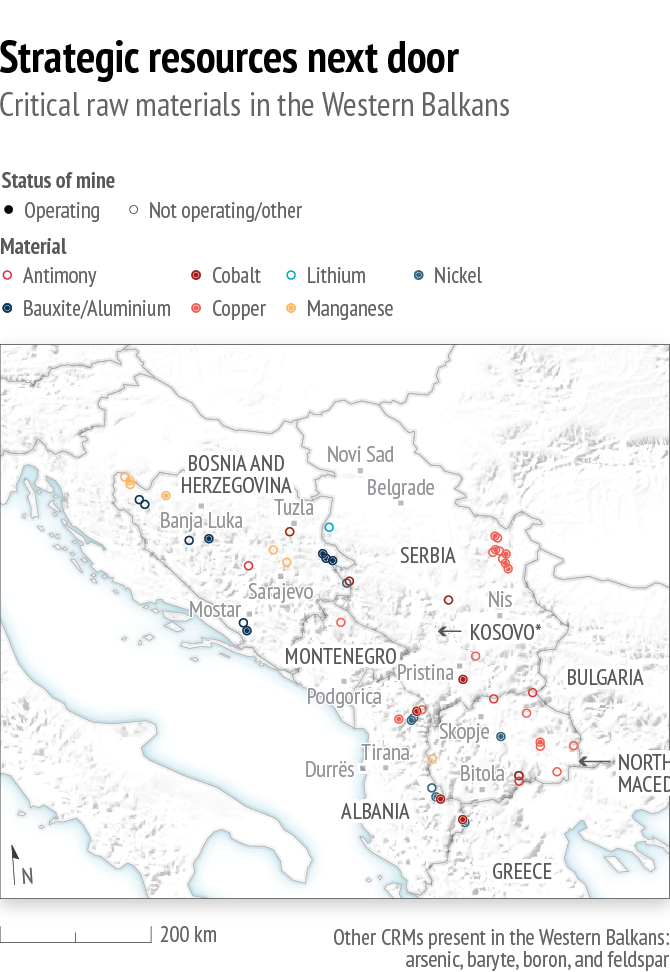
Data: Geological Service for Europe, 2026; Reeserve, 2026
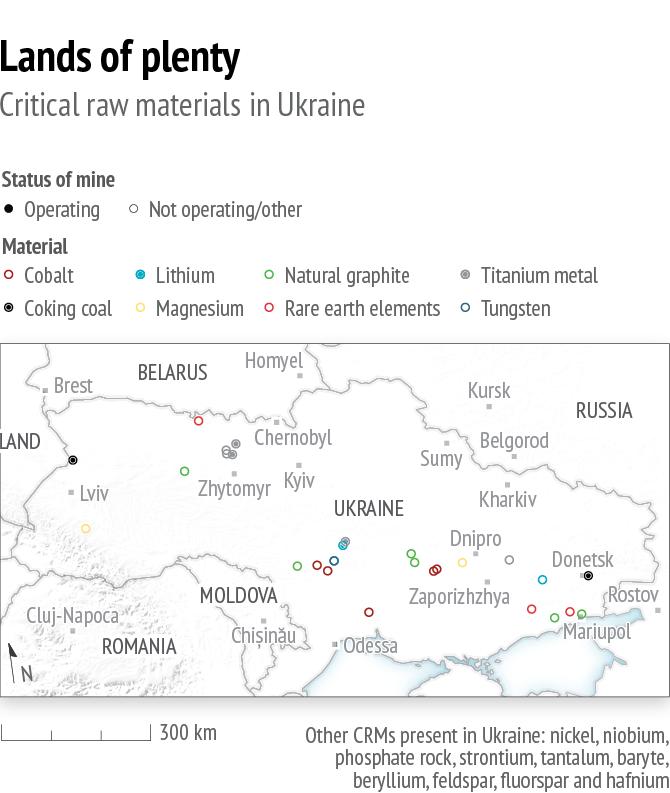
The 2024 Critical Raw Materials Act (CRMA)(2) aims to reduce the EU’s dependencies by promoting diversification, resilient value chains and strategic partnerships. Enlargement partners hold substantial reserves of critical raw materials (CRMs) that the EU can leverage to achieve greater global supply autonomy. Ukraine sits on significant deposits of graphite, titanium and manganese (holding the largest deposits of these three CRMs in Europe(3)) as well as lithium, cobalt, nickel, magnesium, baryte and rare earth elements. In the Western Balkans, Serbia possesses significant copper and borates reserves in addition to lithium. Bosnia and Herzegovina and North Macedonia hold important deposits of bauxite, aluminium, cobalt, copper, manganese, nickel and antimony. Albania contributes additional deposits of copper, cobalt, feldspar and nickel.
Serbia’s Jadar lithium-boron project and Ukraine’s Balakhivka graphite deposit have been recognised as strategic projects under the CRMA, enabling them to benefit from coordinated support for financing and commercial partnerships, due to their importance for European battery and clean technology supply chains. However, much of the region’s mineral deposits remain underground. Altogether, 26 out of the 34 CRMs identified by the EU can be found in Ukraine. The economic viability of exploiting some of these deposits has yet to be ascertained owing to information on depth, ore grade and byproducts being incomplete in available surveys. Moreover, access to some more significant deposits is constrained due to Russia’s war and occupation of Ukrainian territory.
This underscores the strategic value of enlargement for the EU. It will not remove critical dependencies tomorrow, but it is an investment in economic security that will pay off in the longer term. For enlargement to deliver in this strategic area will require more than securing access to CRMs. Working together with enlargement partners should include investments in localised value chains spanning refining, processing and component manufacturing. It should also be underpinned by the application of environmental, social and governance (ESG) standards. Even if this may modestly extend the lead times for new projects, it is essential to avoid the perception that the EU is a (neo-)colonial entity primarily interested in raw commodity extraction. Such a perception carries a real risk of undermining the EU’s leverage in advancing both its economic security objectives and the enlargement process.
The extraction trap
A less discussed but equally important aspect is anchoring the CRM partnerships with candidates in ESG standards. The EU promotes ESG standards as a defining feature of its approach to CRMs globally. Its commitment is reflected in the CRMA which links supply security to environmental protection, respect for human rights, socially sustainable practices and transparent business conduct. Yet ensuring the consistent implementation of these principles remains a challenge, particularly in states with weak governance, insufficient institutional capacity and low public trust. As demand for CRMs grows, there is a risk that securing supply takes precedence over governance concerns, widening the gap between formal compliance and implementation on the ground. Ukraine’s new Critical Minerals Strategy(4), a long-term roadmap for developing the country’s mineral resources released in June 2026, also emphasises a standards-based approach. However, it frames it largely in terms of geoeconomic necessity – as a condition for attracting foreign capital and ensuring foreign market access – rather than as a normative commitment to protecting the environment and local communities.
Furthermore, there is a risk that this will reinforce the portrayal of the EU as a (neo-)colonial entity primarily interested in extracting raw commodities. Such perceptions frame the EU as ‘locking partners’ into uneven and exploitative relationships, demanding perpetual reforms that are never considered sufficient, while ultimately applying pressure and double standards for its own benefit. For local communities, where the investors come from is ultimately secondary to the social, environmental and economic consequences of mining. If projects associated with the EU are perceived as falling short of the standards the Union promotes within the single market, support for enlargement may suffer.
This is not a hypothetical scenario. Mining projects in the Western Balkans, some associated with the EU, already create public controversy.
In Serbia, the Jadar project by Rio Tinto aims to produce around 58 000 tonnes of battery-grade lithium carbonate annually(5) in addition to borates, used in electric vehicle batteries, renewable energy technologies and other clean-tech industries. Its scale makes it one of Europe’s largest lithium projects. However, surveys conducted between 2024 and 2025 consistently found a majority opposed to lithium mining, rising from 55.5% in mid-2024 to 63.5% in March 2025(6). Large segments of the public perceive the project as posing risks to water resources, agricultural land and biodiversity. The controversy furthermore reflects broader concerns about governance, transparency and the extent to which strategic decisions are shaped by political elites, foreign investors and external actors. Civil society organisations warned(7) that proceeding with the project risked further undermining public confidence in EU integration. As a result, the investor, Rio Tinto, decided to place the project in a ‘care and maintenance’ phase for the time being.
The EU needs to demonstrate that its approach differs from more transactional models of resource extraction.
Developments in Bosnia and Herzegovina suggest that public resistance to CRM projects is becoming a broader regional phenomenon. In the Majevica region around Lopare, since late 2023 local authorities, residents and environmental groups have opposed lithium surveys. Around Vareš, Olovo and Zavidovići, civil society organisations and local communities have called for the termination of concessions for chromium exploration and mining since 2024, while in Tuzla Canton environmental groups continue to challenge plans that could enable future extraction of lithium, nickel, cobalt and other minerals. These developments serve as a cautionary tale for the EU, highlighting the need to demonstrate that its approach differs from more transactional models of resource extraction.
In war-torn Ukraine, the dilemma is currently linked more to the perceived need to secure as much US support as possible in the short term. The government responded to the Trump administration’s relentless interest in gaining access to Ukraine’s CRMs by agreeing to a memorandum in April 2025 that reaffirmed Ukraine’s ownership of its minerals but granted US companies preferential development and offtake rights – effectively barring third countries from receiving more favourable conditions. The risk is that, unless competition between the EU and the US is managed and deconfliction in Ukraine’s reconstruction and recovery is achieved, efforts to create a sound and predictable business environment for long-term investment will be undermined. This could tempt the EU to lower its standards in order to secure a greater role in future critical raw materials projects.
The EU can hit two targets at once
The EU should develop the linkage between economic security – a central focus of the forthcoming EU Security Strategy – and enlargement through investment in strategic CRM projects. Efforts to achieve these strategic objectives can mutually reinforce each other, but only if they are properly aligned.
The EU should engage in strategic CRM investment projects in the region. Public financing will be critical for new projects to succeed. However, it should also insist on stringent application of ESG standards as well as rule of law and governance reform in enlargement partners. These projects will not eliminate the EU’s critical dependencies tomorrow. They should instead be seen as long-term investments in the EU’s economic security. Although adherence to high standards may extend the time needed for projects to become operational, it will help preserve the EU’s credibility as a transformative actor among local populations and avoid reinforcing – already existing – (neo-)colonial narratives. Moreover, by giving up on standards the EU would hardly gain a competitive advantage over China or the US, both of which already have a growing footprint in the region. China is already deeply embedded in the mining sector in the Western Balkans. In Serbia, for example, Zijin Mining controls the Čukaru Peki mine and the Bor mining complex, which encompasses several of the country’s largest copper deposits. The US is expanding its role in prospective mining in Ukraine, including through the concession awarded for the Dobra lithium project. Short-sighted pragmatism could therefore result in strategic failure on all fronts.
The EU should regard the governance framework it brings to CRM development, together with safeguards protecting the environment and local communities, as a valuable asset rather than a burden. Properly anchored investment initiatives will provide a sustained strategic advantage over competitors that often prioritise short-term gains and face sometimes strong local resistance.
Second, the EU should support projects that develop localised value chains integrating mining, clean processing, advanced manufacturing and recycling, thereby contributing to the clean and sustainable development of the enlargement partners. Integrated value chains were already envisaged in the EU-Ukraine Strategic Partnership on Raw Materials initiated in 2021. However, the EU should put more emphasis on localising key stages of the chain – including processing chemicals or secondary production, such as phosphate fertilisers – to create greater added value in Ukraine, for example by supporting battery and defence industrial production. A similar logic applies to the Western Balkans where mining projects are often framed through the lens of resource extraction rather than broader industrial development.
Investing in local value chains is the best way in which the EU can challenge the notion that it seeks its own enrichment at the expense of living standards in partner societies, while demonstrating that CRM partnerships can serve as a pathway to sustainable development, EU membership and shared economic security. By focusing on comprehensive designs for integrated value chains, the EU can furthermore address the issue of processing monopolies held by third actors that would leave Europeans dependent even if additional extraction capacities were created. This may also contribute to deconflicting reconstruction and recovery efforts with the US in Ukraine.
Both economic security and enlargement are strategic objectives – and they should be conceived as such. CRMs in the neighbourhood will not remove EU’s strategic dependencies in the short term. With new mines taking more than 16 years on average worldwide to reach production stage, the goal is a long-term yield(8). Support for strategic CRM projects should be embedded in broader efforts to reinforce rule of law and governance reform among enlargement partners, rather than serve as an excuse to lower standards that would ultimately harm local constituencies and undermine support for enlargement. Enlargement conditionality and pre-accession funding should reinforce governance reform, build regulatory capacity, ensure democratic participation, including at the local level, and promote the consistent application of the same governance, transparency and environmental safeguards that apply within the EU. Only then can CRM partnerships strengthen both Europe’s economic security and the strategic rationale for enlargement.
References
* The authors would like to thank Josef Mayr and Alessandro Vitiello, EUISS trainees, for their invaluable research assistance.
1. Teer, J., ‘Beijing’s critical raw material weapon – and how to dismantle it’, Chaillot Paper no. 189, EUISS, May 2026.
2. European Commission, ‘Critical Raw Materials Act’, 2024.
3. Kyiv School of Economics and SYSTEMIQ, ‘Strategic Roadmap for Unlocking Ukraine’s Critical Raw Materials Potential’, 2025.
4. Cabinet of Ministers of Ukraine, ‘Strategy for the Development of Industries Based on Minerals and Components of Strategic and Critical Importance’, 2026.
5. ‘Jadar lithium-borates project, Serbia – update’, Mining Weekly, 13 June 2025.
6. ‘Lithium and public opinion’, Vreme, 23 April 2025.
7. See the letter sent by a coalition of civil society organisations to European Commission officials.
8. International Energy Agency (IEA), ‘Critical Minerals Policy Tracker’, 2026.