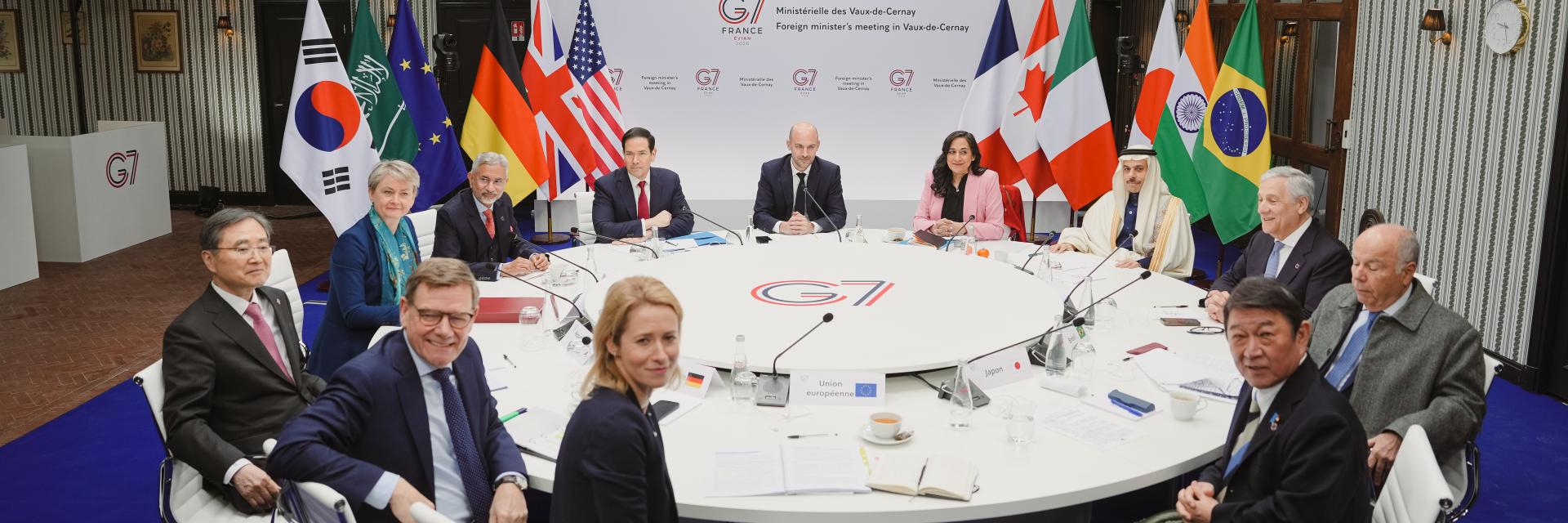
The G7 summit that will take place in Évian, France, on 15-17 June, comes at a critical moment for relations between the United States and its allies. It offers an opportunity to forge new coalition dynamics. The summit, which will extend beyond the seven G7 leaders – France has also invited India, South Korea, Brazil and Kenya – will be the right place to do so. It would also be the right time to do so, and quite urgently: the Western alliance is weakening while an anti-Western coalition led by China is rapidly consolidating. And this is a major difference from the Trump 1 era.
Coalition wars
Xi Jinping has called for the ‘enlargement of China’s circle of friends’ since the end of 2018, about two years after Donald Trump took office as the 45th president of the United States. Beijing knows that it cannot achieve its ambition to overtake the US by 2049 on its own: a narrow G2 approach would be counterproductive. It needs to be able to count on the support of a large number of countries across the globe. On the basis of this assumption, Chinese diplomacy now frequently invokes the ‘collective rise of the Global South’.
When President Trump concluded his first term in office in 2021, China’s ‘circle of friends’ had begun to take shape but had not yet acquired the reach and political weight that it has today. Since then, the Sino-Russian rapprochement has deepened considerably, withstanding the ‘test’ of Russia’s full-scale invasion of Ukraine and the international outcry that followed. Together, Beijing and Moscow successfully pushed for the expansion of the BRICS grouping in 2023. China has continued to be very active within this group but also within the Shanghai Cooperation Organization (SCO), the G20 and other informal economic and security forums it has created or helped develop. At the same time, it has gradually reduced its engagement in forums and institutions it perceives as too Western-dominated, as illustrated for instance by its decision to send only low-level representatives, for the second year in a row, to the last Shangri-la dialogue. Over the past five years, it has also launched a wide range of diplomatic initiatives. Some of these initiatives (such as the four ‘Global’ initiatives or the numerous ‘Groups of Friends’ established at the UN) may appear to be little more than diplomatic window-dressing – widely promoted but thin in substance. But this is part of the game: they are first and foremost conceived by Chinese diplomacy as convening mechanisms, designed to provide a framework for the informal coalition-building dynamics that China seeks to foster.
The fact that China does not sign formal alliance treaties does not mean that its coalition-building strategy should not be taken seriously. China, like Russia, is officially opposed to the concept of ‘alliance’. In practice, however, this emerging coalition of countries is increasingly shaped through security and military cooperation. This ranges from the promotion of alternative security concepts and norms, to the conduct of joint military exercises, to direct arms exports and the development of police and military training programmes. These security partnerships are consolidating more rapidly in times of wars, as countries come under growing pressure to take sides: Russia’s war against Ukraine is a case in point. Moscow has received direct military support from Iran, notably through the supply of Shahed drones, and from North Korea, which has supplied ammunition and soldiers. China’s support to Russia’s war effort has been less direct but nonetheless substantial, ranging from the export of dual-use components to expanding trade and energy ties with Moscow. China, as well as Russia among other countries, are now rallying behind the Islamic Republic of Iran – more or less openly. This alignment appears to reflect more than just a simple exchange of favours. Rather it points to a convergence of threat perceptions: the US – and the US-led alliance in general – is identified as their principal adversary. As Manichean as this worldview may appear, it is deeply entrenched in Beijing and increasingly drives China’s coalition-building strategy. Its effects are increasingly visible at the UN, where China and Russia frequently coordinate their positions and voting behaviour, including recently on resolutions related to the Strait of Hormuz.
The China-led alternative order is also increasingly structured through technological and financial cooperation. Examples range from the deployment of Huawei’s 5G infrastructure and the development of 6G networks to the use of Chinese AI platforms and services. Financial cooperation is expanding as well, from trade settlement in local currencies to cooperation on digital currencies and emerging cross-border payment systems. Through these efforts, China aims to promote alternative norms and standards across the ‘Global South’, ultimately marginalising those established by the United States and Europe.
However, China’s coalition-building efforts and its rapprochement with Russia face certain constraints. For instance, no final agreement on the Power of Siberia 2 gas pipeline was reached during President Putin’s visit to China two weeks ago, despite the signing of a Memorandum of Understanding last year. But the joint declaration issued at the end of the visit served as a reminder of just how broad and ambitious Sino-Russian cooperation has become, spanning AI governance, technological norms and standards, joint military exercises and the recognition of mutual security concerns, including Taiwan.
China’s coalition-building efforts have evolved into a structural trend that reaches far beyond the Sino-Russian rapprochement and now encompasses a large number of countries from the ‘Global South’.
Right now, two rival coalition-building projects are gaining momentum: on one side stands the established US-led alliance system. On the other is an emerging China-led informal coalition of countries that openly seeks to challenge and marginalise that alliance system, especially at a time when it is under pressure. This divide is far from absolute, and many countries strive to remain non-aligned. However, whether consciously or not, a growing number are engaging in Chinese-led initiatives that form part of this alternative coalition-building effort.
Évian: A wake-up call?
In this context, tensions between the US and its allies are particularly serious. They are amplified by two forms of asymmetry. The first stems from the fact that these competing coalition-building efforts are moving in opposite directions: while the Western alliance is showing signs of strain, the alternative coalition powered by China continues to consolidate. The second stems from a different approach to time. China acts as the convening power of an informal group of countries whose leaders, for the most part, do not have to worry about elections, and often approach diplomatic partnerships with a long-term horizon in mind. Nor do they appear eager to bring ongoing wars to a swift conclusion, at least not before their ultimate strategic goals have been achieved.
All this makes the current period a critical one for the Western alliance.
A successful G7 summit would revive cooperation between the US and its allies by proposing concrete joint solutions to reduce existing dependencies, in particular by securing critical mineral supply chains, building on the G7 trade ministers' communiqué issued last month. It would also launch an ambitious normative agenda in the field of AI and technological governance. The upcoming summit should also be an opportunity for G7 members to fully acknowledge the scale of China’s coalition-building strategy and the challenge that it poses. While they are grappling with internal divergences, Beijing and its partners are steadily laying the foundations of an alternative world order. Could the Évian summit serve as a wake-up call?