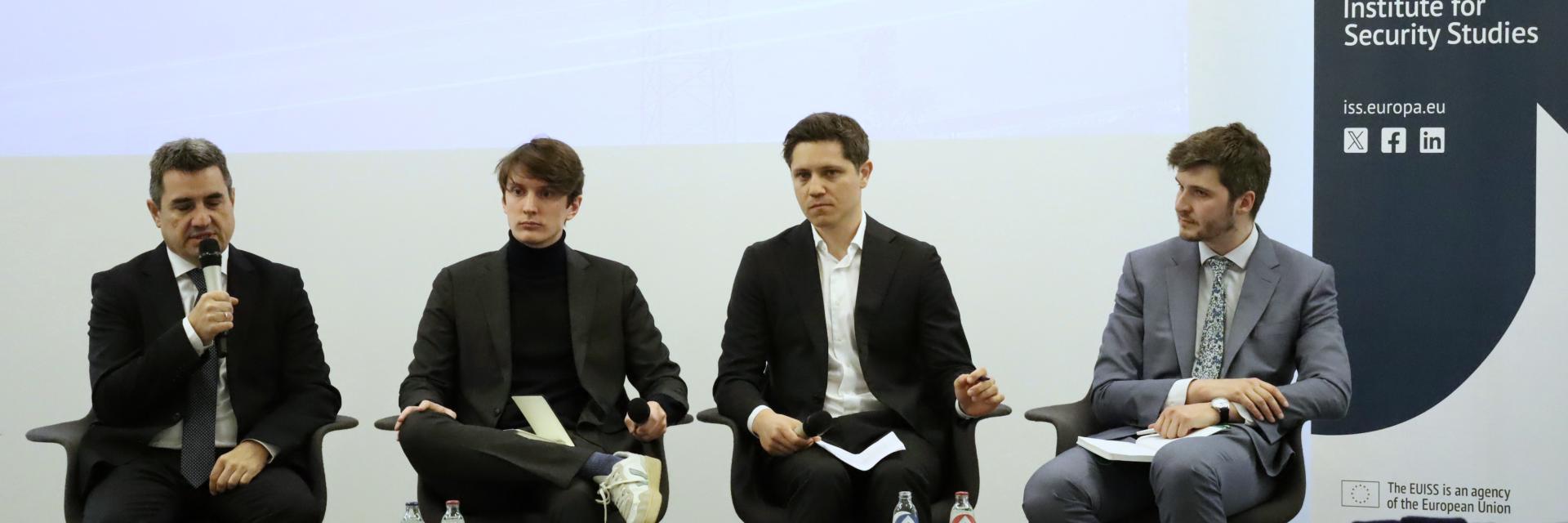
On 17 March 2026, the Institute hosted an event in Brussels on European energy geopolitics, examining how the European Union can position itself in an increasingly competitive global energy landscape shaped by the United States and China.
The discussion brought together Tibor Stelbaczky (European External Action Service), Brieuc Posnic (European Commission, DG ENER), Ruben Davis (Cleantech for Europe), and Caspar Hobhouse (EU Institute for Security Studies).
The war in Iran has once again exposed Europe’s vulnerability to external energy shocks. Speakers highlighted that energy is now a central arena of geopolitical competition: the US is pursuing fossil-fuel 'energy dominance', while China is consolidating its position through leadership in clean technologies.
In this context, the EU finds itself at a crossroads. While progress has been made in reducing dependence on Russian gas, Europe remains structurally reliant on imported fossil fuels. In the short term, US LNG has been essential in closing this gap, alongside supplies from Norway and other partners. However, this raises broader questions about new dependencies and long-term resilience.
Looking ahead, the discussion emphasised that Europe’s response must focus on strengthening its domestic energy system. This includes accelerating renewable energy deployment, alongside investment in grids, storage, energy efficiency and electrification. At the same time, the role of nuclear energy remains part of the policy debate.
A key theme was the growing convergence between energy and industrial policy. As competition shifts from control over resources to control over technologies and supply chains, Europe faces increasing pressure from China’s scale and cost advantages in clean tech. Strengthening industrial capacity and maintaining technological leadership were identified as essential to Europe’s future competitiveness and security.
Speakers also stressed that Europe’s strategy should combine greater resilience with stronger international partnerships. Rather than turning inward, the EU should build diversified, rules-based cooperation with trusted partners, while avoiding excessive dependence on any single actor.
The discussion underscored a clear message: the geopolitical landscape of energy has fundamentally changed. Europe must now define a distinct path that aligns energy security, decarbonisation and industrial strength in a more contested global environment.