Summary
- Africa's demographic dynamism, accelerating growth and strategic resources are vital to Europe's economic resilience and green transition. Yet the EU faces intensifying competition from China, the US and emerging powers across sectors from critical raw materials to space and digital innovation.
- As trade, investment and security cooperation expand, implementation and clear communication of results will be decisive. A credible AU-EU follow-up mechanism and stronger coordination are needed to translate the Joint Vision 2030 into measurable outcomes and sustained dialogue.
- Long-term political commitment, coherence among EU Member States, and deeper people-to-people ties will determine whether the EU remains Africa's most reliable partner in a rapidly evolving global order.
- This Brief inaugurates the Africa Next series, dedicated to examining forward-looking themes and policies crucial for the Africa-EU partnership.
Africa and the European Union are bound by deep economic, political and societal ties of growing strategic significance in a rapidly shifting global landscape. While persistent development gaps remain, Africa’s sustained growth, dynamic demographics and expanding industrial ambitions position the continent as a central partner for Europe’s economic resilience, security and strategic autonomy, particularly in raw materials, value chains and labour markets. At the same time, African countries are diversifying their partnerships, with global actors intensifying their engagement across both traditional and emerging sectors – from critical raw materials and infrastructure to space and digital technologies. Keeping Africa high on the EU agenda is therefore integral to Europe’s strategic priorities in an increasingly contested global order.
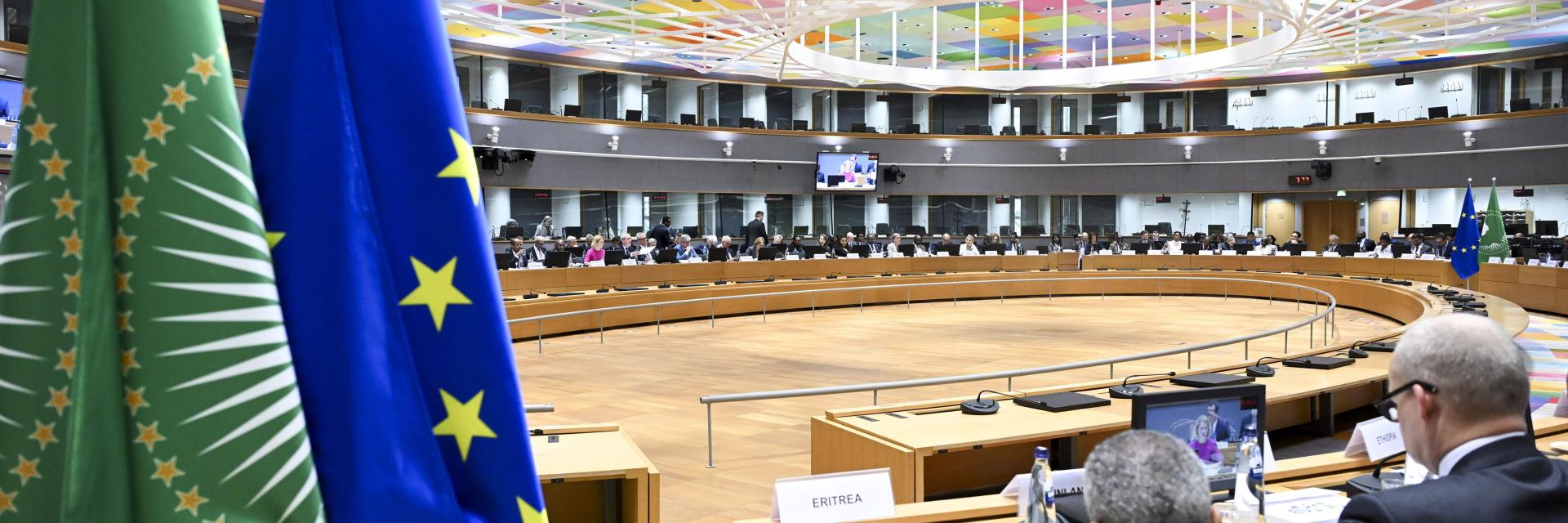
The November 2025 AU-EU Summit in Luanda sent a clear political signal, reflected through high-level participation on both sides. The real test, however, lies in sustained follow-through and in effectively communicating concrete results to the public. For the EU, maintaining momentum on Africa is increasingly challenging as the war in Ukraine, defence and strategic autonomy dominate the agenda. Yet sidelining Africa would be a serious mistake. Delivering tangible outcomes, strengthening institutional follow-up, deepening people-to-people ties, and demonstrating long-term reliability through enhanced dialogue will determine whether this ‘shared momentum’ translates into lasting strategic impact for both continents.
Shared momentum
Africa is an increasingly important economic partner for the EU, and one whose relevance is set to increase. While GDP per capita in sub-Saharan Africa remains below one tenth of the EU average (€5,446.7 compared to €57,410.4 as of 2025(1)), the growth trajectory of the continent tells a different story. Africa’s economy grew by 3.5% in 2024 and an estimated 3.9% in 2025(2), compared to an average of 0.38% in the EU(3).
This growth is driven by powerful demographic trends. Africa’s population of 1.5 billion people – 38% of whom are aged under 14 – is projected to double before 2070(4), fuelling demand for jobs, infrastructure, energy, digital services and consumer goods.
These dynamics make the partnership mutually strategic. The EU is already a key economic partner for Africa. In 2024, EU–Africa trade reached €356 billion, a 28% increase since 2014, although exchanges remain unevenly distributed, with 55% concentrated in North Africa. By comparison, China’s trade with Africa reached €273 billion in 2024 – a 64% increase over the same period – with 84% directed towards sub-Saharan Africa, while US–Africa trade amounted to €67 billion (+21% since 2014), with sub-Saharan Africa accounting for 68%(5). The EU’s reported stock of foreign direct investment (FDI) stood at €205 billion in 2023, compared to €39 billion for China in 2023 and €46 billion for the United States in 2024(6).
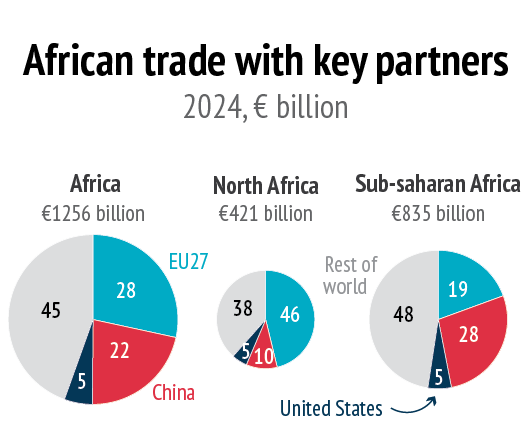
Data: ITC, Trade map, 2025

At the same time, African countries are courted by a growing number of external partners – from China to the Gulf states, Russia and Türkiye.
Competition is particularly acute in the mining sector. In 2024, the EU imported critical raw materials (CRMs) from Africa worth €1.25 billion, compared to €339 million for the United States and €16.6 billion for China(7), with African imports contributing to China’s quasi-monopoly in critical raw materials processing. Acknowledging Africa’s importance in this strategic competition, the EU has signed memoranda of understanding with the Democratic Republic of Congo (DRC), Namibia, Rwanda, South Africa and Zambia(8). In 2025, cooperation expanded to the space sector through the Africa-EU Space Partnership Programme, aimed at strengthening the capacities of the newly established African Space Agency, notably in early warning systems and disaster risk management linked to climate and green transition objectives. More broadly, the Global Gateway initiative reflects a shift from traditional development assistance towards an investment-led approach, prioritising projects in infrastructure, connectivity, pharmaceuticals and education. In October 2025, the European Commission announced that Global Gateway had mobilised more resources than initially expected, alongside the launch of a platform designed to better match private investment with EU and African public policy priorities(9).
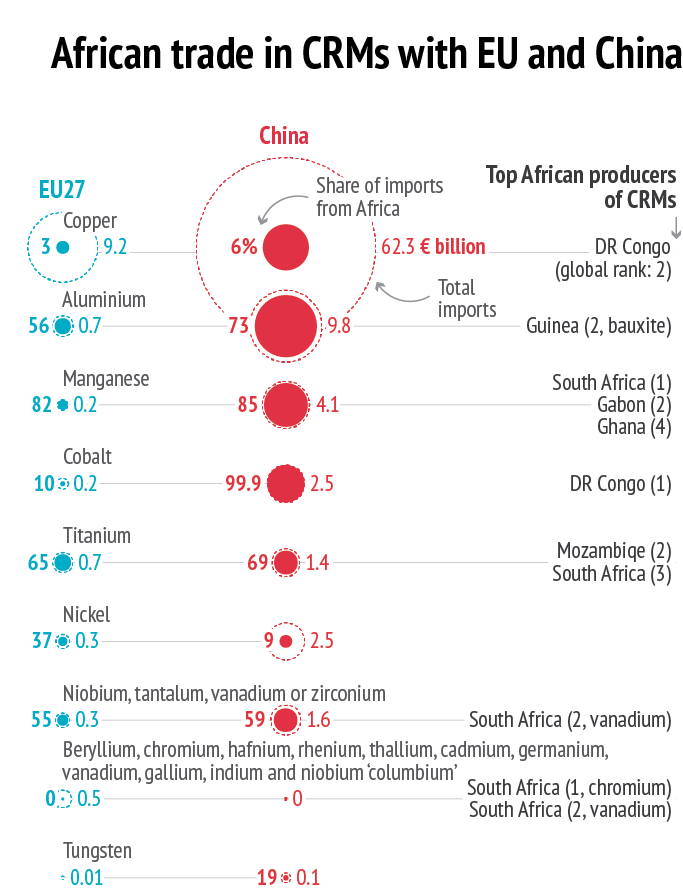
NB: Cobalt value is the sum of ores (HS 2605), oxides and peroxides (HS 2822) from 2023. Beryllium et al. correspond to the category HS 8112. All other materials belong to the ore category (HS 26) and refer to 2024.
Support for the African Continental Free Trade Area (AfCFTA) constitutes another key pillar of EU engagement. However, implementation remains uneven: intra-African trade accounted for only 14% of total trade in 2024, compared to 57% within the EU(10). This reflects limited industrial capacity in many African economies, which continues to drive imports of manufactured goods, but also persistent trade and non-trade barriers. African countries and regional organisations are seeking to address these constraints through continental and national industrialisation strategies, aimed at job creation and domestic resource mobilisation(11). These objectives intersect with broader global debates on access to finance, debt sustainability and international tax reform, areas in which African actors have been increasingly vocal.
In the security domain, the EU and the African Union (AU) have a long-standing partnership, with the EU having been the first major financial supporter of the African Peace and Security Architecture and African peace support operations (PSOs), notably in Somalia, and an advocate of UN-assessed contributions to finance AU PSOs (UN Security Council Resolution 2719). However, conflicts in Sudan, the DRC and the Horn of Africa are increasingly regionalised and internationalised. Peace processes are also more often conducted outside the continent, particularly in the US or Gulf states, frequently yielding agreements that are difficult to implement. In this context, the EU has sought to reaffirm the centrality of African-led efforts, while welcoming complementary external initiatives such as US engagement on the DRC-Rwanda dispute, previously addressed through the Luanda Process and through the Quintet for Sudan.
After the applause
The AU-EU Summit, together with the May ministerial meeting, has given new impetus to the partnership. History, however, shows that the real test lies between high-level meetings, when leaders must translate political commitments into sustained follow-up and clearly communicated results. With more than 80 national delegations and regional institutions involved, the AU–EU partnership is inherently complex. In this context, the establishment of an AU–EU monitoring mechanism for the Joint Vision 2030, as proposed by the African side, represents a meaningful step forward. It would strengthen dialogue and joint working-level assessment and coordination not only between the two continental organisations, but also with Member State capitals on both continents.
Provided it enhances transparency and accountability in information-sharing and policy recommendations, such a mechanism could significantly reduce coordination costs and address persistent information gaps, which often exist not only among countries but also between capitals and embassies.
Some structural frictions are unlikely to disappear, given differences in institutional capacity, resources and historical grievances. Yet recent international developments are pushing Africa and the EU towards similar imperatives, including greater self-reliance, diversification of partnerships, and parallel – although contrasting – demographic challenges, with rapid population growth in Africa and ageing societies in Europe. Mounting pressure on multilateral institutions, as well as challenges to international law and to the international system based on the UN Charter, also draw the two closer in advocating for a rules-based international order. Against this backdrop, differing positions on key issues – such as Russia’s war of aggression against Ukraine or the situation in Palestine – should not necessarily be seen as obstacles. Rather, they point to the need for pragmatic convergence instead of systematic alignment. Thus, while many African countries have abstained from condemning the Russian invasion of Ukraine, some have been more vocal in condemning Russia’s recruitment of Africans to fight against Ukraine(12). African partners traditionally value long-term engagement, gradual partnership-building and the importance of personal relationships.
People-to-people relations are another core dimension of the AU–EU partnership. While steadily expanding, they remain crucial to sustaining broader strategies in investment, connectivity, education and training. Prevailing narratives about Africa still tend to overemphasise conflict, poverty and fraud, reinforcing perceptions of high risk and driving up loan interest costs by an estimated €3.9 billion a year(13). While conflict and humanitarian distress remain realities in parts of the continent, other dynamics – entrepreneurship, creativity and societal resilience – are also gaining momentum(14). These are reflected, for instance, in the rapid expansion of creative industries and the growing number of limited liability companies, which stood at around 870 000 in Africa in 2022, with South Africa and Nigeria leading, compared to approximately 873 000 in the EU(15).
With deeper and broader mutual understanding – strengthened through institutional, media and societal exchanges – the Africa-EU partnership could take a qualitative leap forward in advancing the Joint Vision 2030 and the strategic priorities of both continents. Ultimately, implementation and clearly communicated results – not intent – will shape its future.
Making it count
Beyond summits and declarations, the Africa–EU partnership will ultimately be judged by its capacity to deliver and communicate tangible outcomes, sustain political attention, and adapt to a rapidly changing international environment. To advance its partnership with Africa, the EU should focus on four key priorities.
First, the AU and the EU should establish a joint follow-up mechanism, as suggested after the 2025 summit. This mechanism could play a pivotal role not only in mapping commitments and tracking implementation and follow-up, but also in building a structured evidence base. A jointly managed database would enhance transparency and reduce information gaps.
Second, people-to-people exchanges should be treated as core strategic assets rather than ancillary components of the partnership. Migration and mobility has long been a contentious topic in the partnership, with the EU focusing on curbing irregular migration and African partners calling for expanded legal pathways. In this vein, academic and professional exchanges, and more granular country-to-country engagement, are essential to sustaining private investment, improving risk assessment, and enabling effective public–private partnerships. In a context where perceptions directly affect financing costs and investment decisions, better mutual knowledge and more differentiated approaches across African countries can significantly enhance the EU’s economic and strategic impact.
Third, sustained commitment is essential. As external engagement with Africa intensifies, the EU’s comparative advantage lies in being a reliable, long-term partner. This requires consistent political engagement beyond moments of crisis, including more frequent high-level visits. This is particularly important as Member States hold dedicated summits with Africa, such as the Italy-Africa summit in February 2026 and France’s forthcoming summit in Kenya. Ensuring coherence between national initiatives and the broader EU framework will be key to strengthening Europe’s credibility, particularly in responding to African calls for industrialisation and the development of local value chains.
Fourth, dialogue and coordination in multilateral forums must be enhanced to demonstrate a shared commitment to multilateralism. This should include issues of mutual concern where positions align – such as support for the UN and climate action – as well as areas of disagreement, through regular exchanges in key hubs including New York, Geneva, Nairobi, Rome and Paris, where major multilateral institutions are based.
Although the EU is understandably absorbed by Ukraine and the transatlantic relationship, Africa remains a key partner for Europe’s long-term security, economic resilience and strategic autonomy. Delivering on commitments, investing in trust and coherence, and remaining engaged for the long haul is therefore not only in Africa’s interest, but central to Europe’s own strategic priorities.
References
* The author wishes to thank Luca Guglielminotti, EUISS trainee, for his research assistance.
1. IMF, Data Explorer, GDP per capita at PPP.
2. UN, World Economic Situation and Prospects 2026, 8 January 2026, p. 6.
3. Eurostat, ‘Gross domestic product (GDP) and main components (output, expenditure and income)’, 2025.
4. UN, Data Portal – ‘Population division’.
5. International Trade Center, Trade Map.
6. IMF, ‘Direct Investment Positions by Counterpart Economy’.
7. CRMs here are aluminium, beryllium, chromium, hafnium, rhenium, thallium, cadmium, germanium, gallium, indium, cobalt, copper, manganese, nickel, niobium, tantalum, vanadium, zirconium, titanium and tungsten. See: EU Regulation establishing a framework for ensuring a secure and sustainable supply of critical raw materials, 2024/1252, 11 April 2024, pp. 55-58; Data on volumes: ITC Trade Map.
8. European Commission, ‘Raw materials diplomacy’.
9. European Commission, ‘Keynote speech by President von der Leyen at the Global Gateway Forum’, Brussels, 9 October 2025.
11. UNIDO, ‘The new era of industrial policy in Africa: From SDG assessment to policy solutions, Insights on industrial development’, Insights on Industrial development, Issue No. 20, March 2025.
12. Mwangangi, P. and Booty, N., ‘Kenya to confront Russia over “unacceptable” use of its nationals in combat’, BBC News, 10 February 2026.
13. Africa No Filter, ‘The cost of media stereotypes to Africa: The relationship between media, investment and economic development’, October 2024, p.3.
14. Lora-Mungai, M. et al., Success Stories in the Creative Industries in Africa and Other Emerging Markets, Proparco, October 2024.
15. World Bank, Entrepreneurship database.