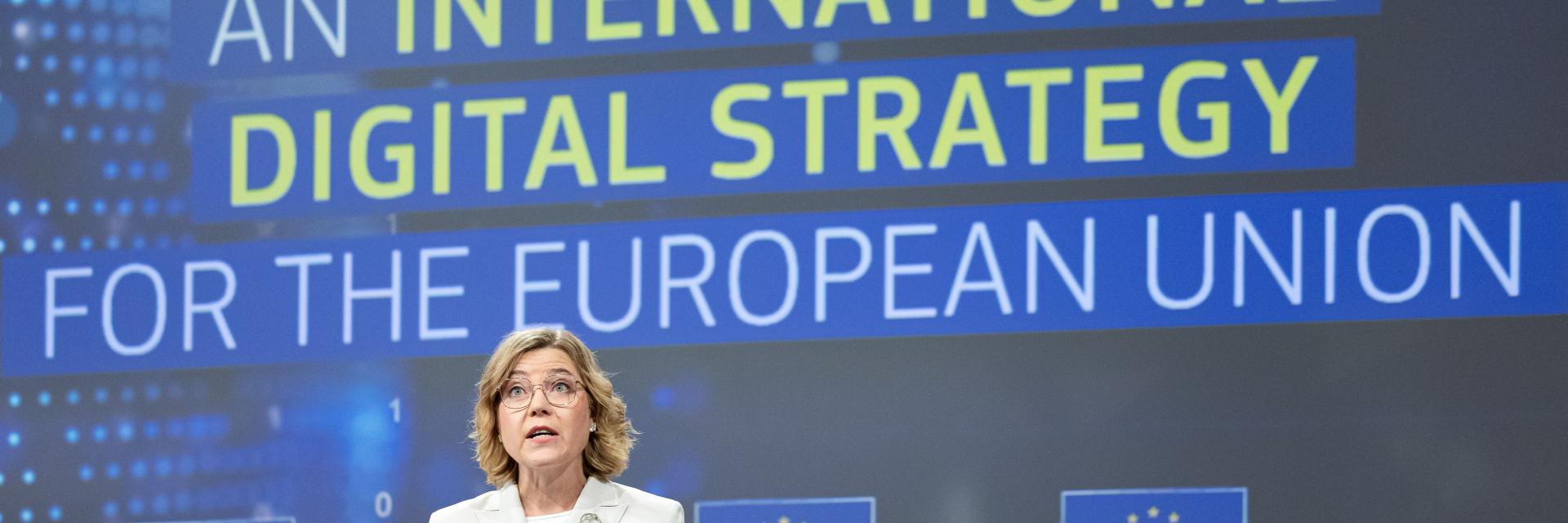
The publication of the EU’s International Digital Strategy on 5 June 2025 serves as a timely reminder that the pursuit of greater autonomy in the digital domain must not be conflated with a turn towards autarky. By expanding its international cooperation, the EU not only strengthens its influence in global digital affairs, but also gains access to external resources that bolster its digital capabilities and enhances its security by diversifying partnerships and reducing its dependence on the United States. The Strategy provides a much-needed and coherent framework to coordinate the EU’s various external digital initiatives. However, it stops short of embedding these efforts within a broader geopolitical context, resulting in an ambiguous global strategic posture that may be interpreted as indecision by prospective partners and could impede effective coordination among Member States.
Strengthening digital security through partnerships
The Strategy builds upon the conclusions of the European Council of 18 April 2024, in which the EU27 underscored the imperative for the EU ‘to ensure its long-term competitiveness, prosperity and leadership on the global stage’, highlighting the importance of ‘digital sovereignty’ in advancing this objective. The ambition to bolster Europe’s digital sovereignty has gained renewed momentum following the election of Donald Trump to a second term in the White House last January, as the American president has shown no hesitation in leveraging Europe’s dependence on US technology firms as a tool in his broader global trade confrontation. EU institutions have acknowledged the need to reduce vulnerabilities stemming from these dependencies as a strategic priority and a security concern. In response, several initiatives aimed at strengthening regional capabilities have been proposed within the Brussels policy ecosystem, notably in reports such as EuroStack and The European Way.
The ambition to bolster Europe’s digital sovereignty has gained renewed momentum following the election of Donald Trump to a second term.
However, Europe’s efforts to strengthen its digital capabilities should extend beyond a purely domestic focus, and be complemented and reinforced through the EU’s external actions and partnerships with other states and regional organisations. The EU’s International Digital Strategy itself states that ‘no country or region can tackle the digital and AI revolution alone’. The supply and value chains of digital technologies are indeed highly globalised, and data flows can no longer be confined to a single territory but circulate across the world. In light of this reality, the EU must diversify its partnerships to reduce its technological and industrial dependencies and seek support within international digital governance forums. Moreover, the digital sector is partly driven by economies of scale and network effects; while the EU must first address the fragmentation of its own regional market to enable its firms to compete effectively, it can also leverage external agreements to strengthen its digital industrial base or to secure economic support for the development of regional initiatives. The European pursuit of greater autonomy in the digital domain is therefore not incompatible with the expansion and strengthening of external partnerships. On the contrary, this ambition must be pursued on both fronts – internal and external – as the development of the EU’s internal capacities shapes the scope of its external action, while, in turn, partnerships help to compensate regional shortcomings.
Bringing coherence to the EU’s external action in the digital domain
The EU’s International Digital Strategy thus aims to demonstrate that the EU ‘is a stable and reliable partner’ and serves as a framework to expand the EU’s action worldwide through a multilateral and multi-stakeholder approach, giving significant emphasis to private investments and public-private cooperation. It relies on a diverse array of programmes covering infrastructure, connectivity, research, development and innovation, digital skills, platform accountability, standardisation, and disinformation, as well as cybersecurity. With a scope as broad geographically as it is sectorally, the strategy encompasses initiatives spanning from the Arctic to Sub-Saharan Africa, and extends across Latin America and the Caribbean, the Mediterranean, the Pacific, and Central Asia.
This strategy was necessary, as the EU needed to bring greater coherence to its various digital initiatives, which, although numerous and substantial, could appear fragmented, especially with regard to its external action. The document published on 5 June offers a comprehensive overview of all the EU’s international digital initiatives and opens multiple avenues for future engagement. By bringing together and structuring these various efforts, the strategy reflects an evolution in European strategic thinking, increasingly adopting a systemic approach to digital technologies. In connecting such diverse areas of action, it acknowledges the deep interdependence of these sectors and embraces the concept of a technological continuum, also known as the ‘technological stack’.
The EU’s lack of strategic clarity on the US and China could prove detrimental
However, despite high expectations, the strategy does not, at this stage, provide answers to several pressing questions. The EU’s ambition to strengthen its autonomy, including through partnerships, largely stems from the United States’ dominance in the digital sector and the escalating Sino-American rivalry over technology. Europe has repeatedly found itself caught in the crossfire between Beijing and Washington, for instance in 2019-2020, when the White House imposed sanctions on the Chinese telecoms firm Huawei following allegations of data transmission to the Chinese government, or amid the intensifying US-China battle over export controls, particularly targeting the semiconductor industry. Beyond economic security concerns, Europe’s reliance on American technologies also raises serious questions about privacy and data protection, as US intelligence agencies operate under laws such as the Foreign Intelligence Surveillance Act (FISA), which grant them broad access to data, including that of European citizens. The EU should not aim at fully replacing American actors, if that is even possible; but nor should it accept this dependence as inevitable, or turn towards Chinese providers instead. A clear strategic stance from the EU on how to navigate this particularly tense international context would have been welcome in a document intended to guide its external action on digital matters. Yet, the Joint Communication mentions only the EU-US Trade and Technology Council, and China is not referenced at all. The US and China are scarcely alluded to in the annex to the document. Geopolitical rivalries appear to have been deliberately set aside in the Strategy in favour of a focus on international cooperation, as suggested by EVP Henna Virkunnen during the press conference following the strategy’s adoption. She stated that these issues would be addressed at the July 2025 EU-China Summit and offered only a brief acknowledgement of the dominance of US-based solutions, reiterating the significance of the European market for Big Tech.
Geopolitical rivalries appear to have been deliberately set aside in the Strategy in favour of a focus on international cooperation.
While this omission in the International Digital Strategy allows the EU to maintain a degree of ambiguity to safeguard its interests, especially in the face of a powerful ally seemingly intent on applying pressure, this absence of a clear stance risks being perceived as indecisiveness and undermines coordination among Member States. Rather than allowing this ambiguity to persist, the EU should seize this window of opportunity to assert itself on the global digital stage. This requires a clearer articulation of the political vision underpinning European technological development: what kind of society does the EU aim to build through these technologies? The ideologies promoted by Silicon Valley or the Chinese Communist Party do not align with European aspirations, nor with those of many other states and organisations globally, as evidenced by the broad range of agreements, partnerships and dialogues referenced in the EU’s International Digital Strategy. Clarifying the EU’s position and political vision would also support a strategic allocation of efforts across the various sectors identified in the strategy, enabling the establishment of clear priorities and a more efficient use of financial, human, energy, and computing resources.