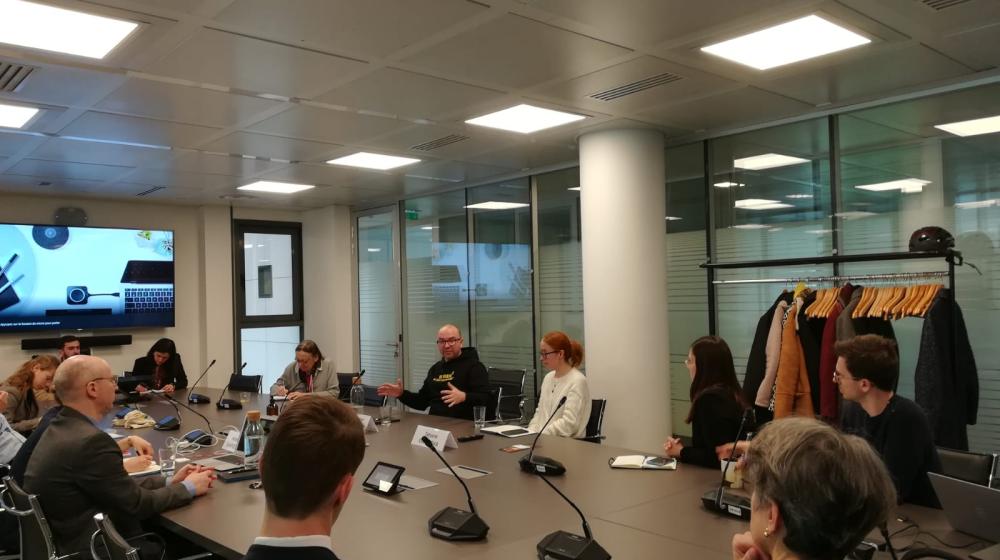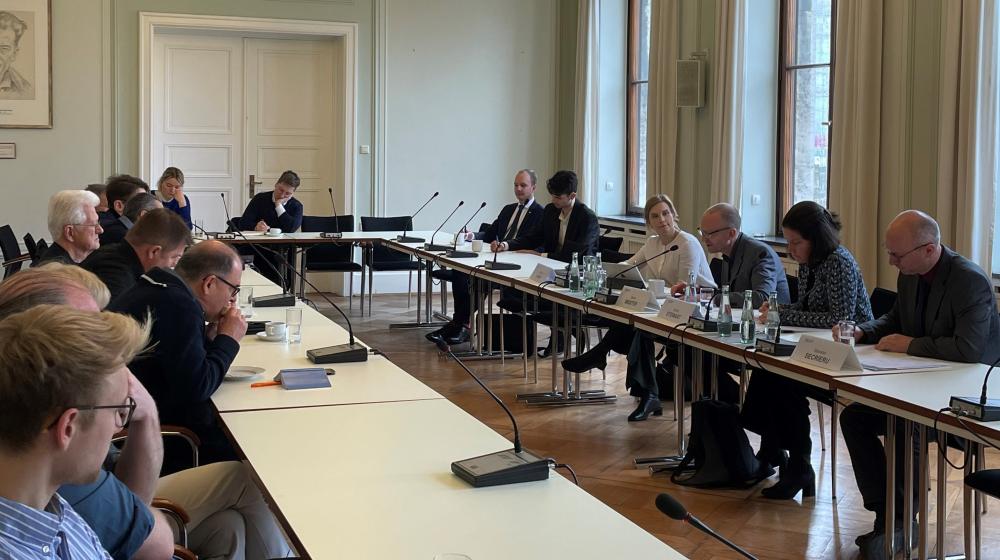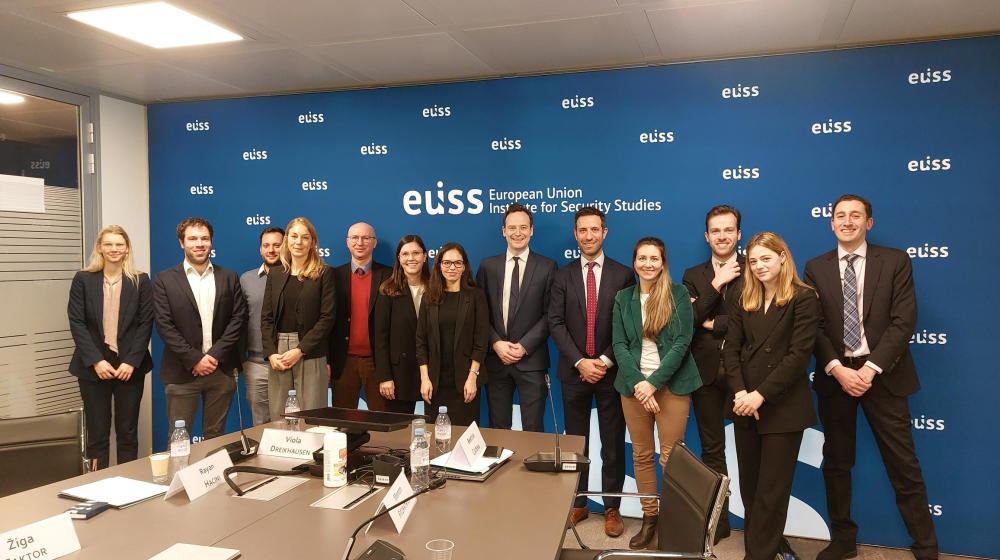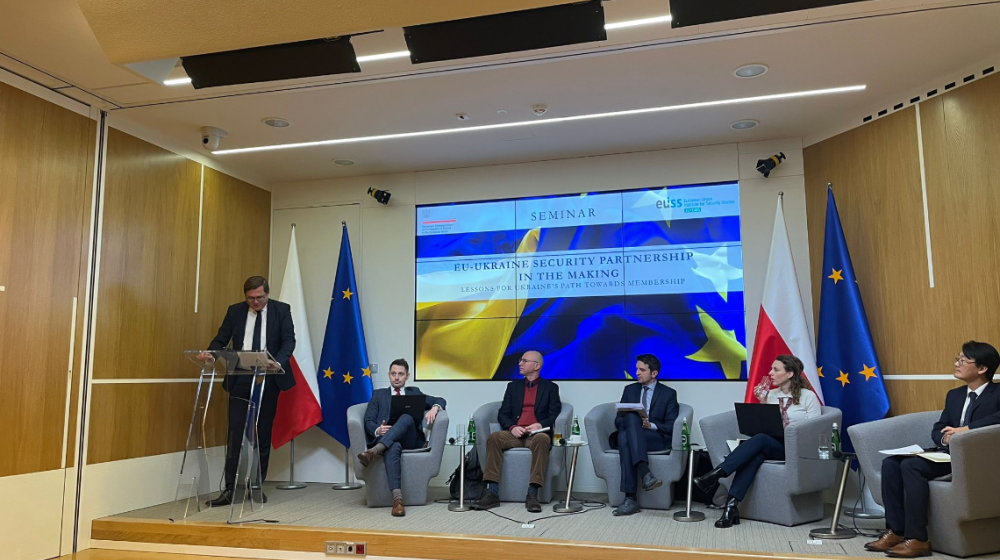
On 19 September 2018, the EUISS in collaboration with the George C. Marshall Center’s European Center for Security Studies organised a workshop on transatlantic security.
You are here
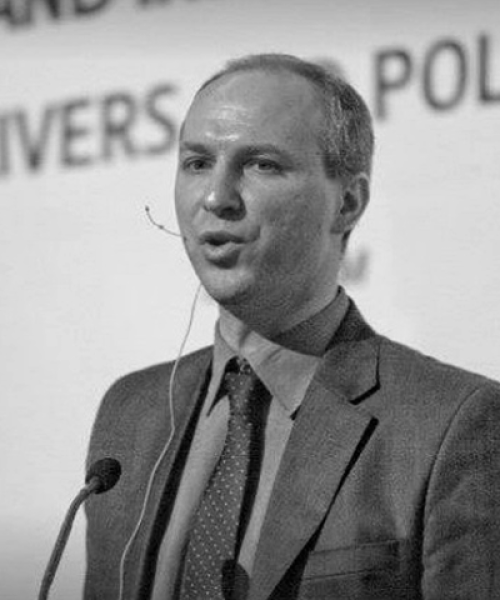
Stanislav Secrieru

Stanislav joined the EUISS as a Senior Analyst in September 2018, where he covers Russia and the EU’s eastern neighbourhood. His research interests focus on EU-Russia relations, Russia’s foreign and security policy in the post-Soviet region, protracted conflicts and the EU’s relations with the Eastern Partnership (EaP) states.
Before joining the EUISS, Stanislav was a Senior Research Fellow at the Polish Institute of International Affairs (2014-2016) and a Policy Analyst at the Open Society European Policy Institute in Brussels (2016-2017). He also previously had been a Research Fellow at the NATO Defence College in Rome (2006), the Institute for European Politics in Berlin (2009-2010) and the New Europe College in Bucharest (2011-2012). He worked on research projects addressing political and security developments in EU’s eastern neighbourhood for the European Council on Foreign Relations (2007-2009) and Freedom House (2012-2013).
Stanislav holds a PhD from the National School of Political Science and Public Administration in Bucharest.
-
25January 2019Edited by Florence GaubWith contributions from Marko Čeperković, Giovanni Faleg, Daniel Fiott, Florence Gaub, Gustav Lindstrom, Roderick Parkes, Annelies Pauwels, Patryk Pawlak, Eva Pejsova, Stanislav Secrieru, Nathalie Van Raemdonck, John-Joseph Wilkins
This Chaillot Paper, the 150th produced by the EUISS, aims to alert decision-makers to potential developments with significant strategic impact while they can still prepare for, or even avoid them. This is done using two methods combined: horizon-scanning as well as single scenario-building.
-
19November 2018
Russia’s political system appears strong and durable at first glance. However, on closer inspection, several factors are gradually undercutting Putin's standing, a process which, in turn, is likely to have future knock-on effects for Russia’s entire political edifice. What vulnerabilities does President Putin face in his fourth term in office? What are the drivers behind them? And how might these play out in the future?
-
23October 2018Edited by Nicu Popescu, Stanislav SecrieruWith contributions from Siim Alatalu, Irina Borogan, Elena Chernenko, Sven Herpig, Oscar Jonsson, Xymena Kurowska, Jarno Limnell, Patryk Pawlak, Piret Pernik, Thomas Reinhold, Anatoly Reshetnikov, Andrei Soldatov, Jean-Baptiste Jeangène Vilmer
What role do cyber operations play as an instrument of Russia’s coercive diplomacy? This Chaillot Paper explores how Russia’s increasingly assertive behaviour in cyberspace has lent new urgency to the debate about cybersecurity in the West.
-
31July 2018Edited by Nicu Popescu, Stanislav SecrieruWith contributions from Julien Barnes-Dacey, Dimitar Bechev, Timofey Borisov, Dmitriy Frolovskiy, Florence Gaub, Dalia Ghanem-Yazbeck, Mark N. Katz, Vasily Kuznetsov, Anton Lavrov, Carole Nakhle, Dmitri Trenin
Russia’s political, diplomatic, military and economic footprint in the Middle East and North Africa has expanded visibly over the last decade. This Chaillot Paper provides a detailed account of Russia’s spectacular return to the region.
-
13March 2018Edited by Nicu Popescu, Stanislav SecrieruWith contributions from Ozlem Demirtas-Bagdonas, Thomas S. Eder, Arzu Geybulla, Richard Giragosian, Julia Lisiecka, Michal Makocki, Anaïs Marin, Vadim Pistrinciuc, Hanna Shelest, Ariane Tabatabai, Ekaterine Zguladze
This Chaillot Paper examines the geopolitical repercussions of the rising presence of third powers in the region, and how the growing constellation of partnerships between the EaP countries and these powers serves a range of strategic purposes for the actors involved.
-
28February 2018
In recent years, Russia has resorted more and more frequently to military force to advance its foreign policy objectives. This overreliance on force, however, came with a price tag attached. Will Moscow continue with its combative stance?
-
25October 2017
Visa liberalisation processes have offset the slow pace of reforms in the eastern neighbourhood by drawing partner states closer to the EU. What have been the effects of this success story for the Eastern Partnership (EaP)?
-
24September 2015With contributions from Sara Bazoobandi, Thomas Biersteker, Richard Connolly, Francesco Giumelli, Clara Portela, Stanislav Secrieru, Peter Seeberg, Peter A.G. van Bergeijk
This Report, the outcome of an EUISS Task Force on sanctions, offers valuable insight into a practice that is now part and parcel of the Union's ‘security’ policy toolbox. It aims to shed more light on an EU policy area that is still under-researched at a time when sanctions are becoming more important in terms of their number, scale and political salience.