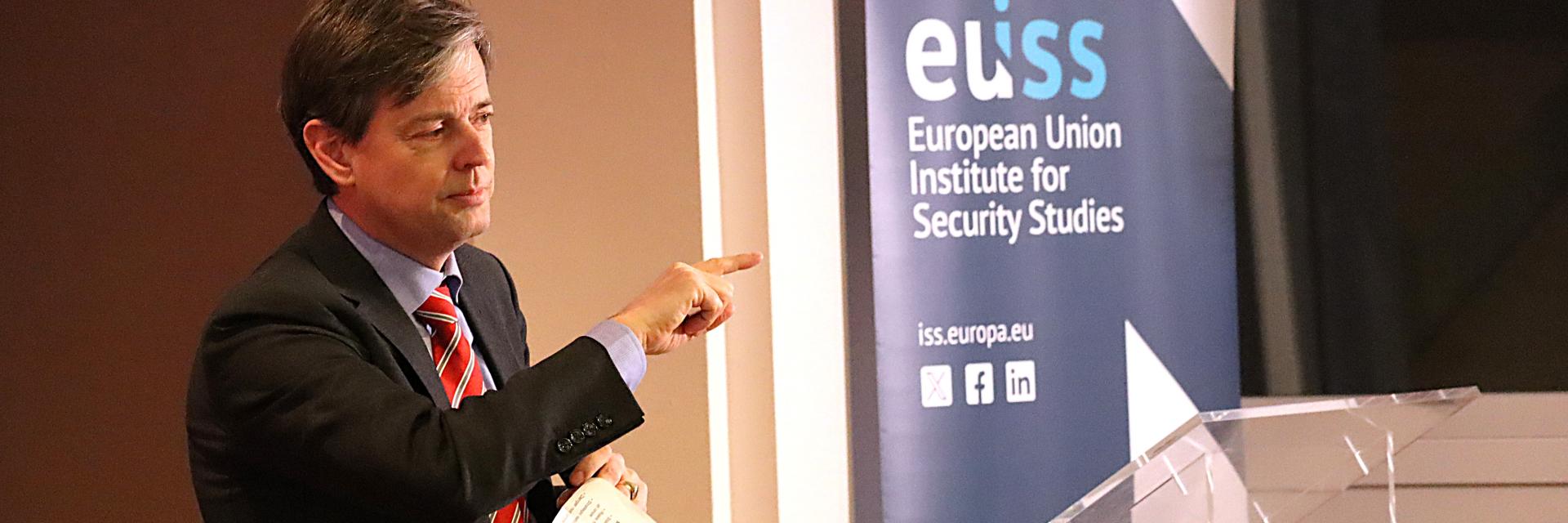
A long-form interview on Europe's geopolitical challenges.
“Phenomenal.” It will not be Donald Trump’s long, rambling speech that Steven Everts remembers from Davos, but the impressive address by Canadian Prime Minister Mark Carney. Everts spent twenty years in the cockpit of European diplomacy, working for High Representatives for Foreign Affairs Catherine Ashton, Javier Solana and Josep Borrell. Today he heads the EU Institute for Security Studies, a think tank founded by EU member states.
The world in which he grew up, studied and worked is over. That is exactly what, according to Everts, Carney made clear to the West:
“Stop living in a lie, wake up to the truth. The old world order is over, we will have to build a new one. I find that a very unifying idea. You could hear a pin drop. Of course the observation isn’t original, but Carney said it so honestly and clearly.”
Carney also said we should not mourn that world.
“In the five stages of grief, Europe is still too stuck in denial. I would rather see us evolve toward anger. We’ve seen more anger over the past week. Psychologically, it is important to detach from a worldview that no longer exists. As Carney said: sovereignty is no longer based on rules, but must rest on one’s own power.”
What a crazy week. How do you interpret Trump’s threats, speech and U-turn?
“It was the classic Trump show. He is a master at grabbing attention. He says or does something that destabilizes the other side. In Europe that causes panic: all leaders get on the phone, there are emergency meetings. Europe can develop some counter-pressure and then Mark Rutte still has to do some manual work to take the sting out of it. Some already think Rutte deserves the Nobel Prize. But really it’s just waiting for the next episode of the show.”
A much more fundamental rupture in transatlantic relations, according to Everts, was the new US National Security Strategy published in December. “Until last year his administration mainly wanted to withdraw from Europe — which has long been an American ambition anyway. Hence the pressure, including through trade tariffs, to raise NATO contributions and make Europe finance the war in Ukraine itself. Trump demanded that more brutally than we are used to, but for such disputes diplomatic solutions could always be found.”
“In December, however, he made clear that he also wants to change Europe politically. He sees Europe as a civilization in decline and therefore the US will support political forces to change the continent from within. Last week a territorial claim was added to that. This is really about sovereignty now. It’s about us. My assessment is that something broke in Europe over the past weekend.”
Denmark even warned that the Greenland claim could mean the end of NATO.
“I don’t know whether Trump wants to destroy the transatlantic relationship. But he does want to fundamentally reshape it. No longer a relationship between allies, but an order under American dominance where coercion and intimidation replace consultation and rules. That threat with tariffs was pure intimidation. Since the operation in Venezuela, Trump has been escalating and radicalizing faster, at home and abroad.”
Europe was remarkably united and resolute.
“Thank God. I am a big supporter of a strong Europe, and for me this was the most important news of the past week. A Europe that says: this far and no further. With all the nuances in tone and statements that go with that. Macron immediately threatens with the bazooka, Meloni says it was a misunderstanding. But Europe did push back much more forcefully than in the summer, when it concluded the trade deal. The gun was put on the table: €93 billion in countermeasures, the anti-coercion instrument… The gun was not fired, but it made an impression.”
You called the summer trade deal a bad deal.
“The EU should at least not have presented it as a ‘great’ deal — at most as a ‘necessary’ one. And the promise that the deal would bring stability was false. We’ve clearly seen that this week. But what we Europeans should also remember is that counter-pressure works. Even inside the US The public opinion, Congress, the financial markets, the approval ratings… Trump was looking for a way out.”
And then there are the US midterms, which may further constrain his power.
“Indeed, but the most dangerous sentence in Brussels right now is: ‘let’s wait for the midterms.’ The idea that this soup won’t be eaten as hot as it is served, that we just have to sweat Trump out for six more months. This is not just about Trump. He is both a symptom and an accelerator of an America that is fundamentally changing anyway. The middle class is being hit, the Republican Party will never be what it was, and demographically the country is turning toward Asia. The ancestral ties with Europe grow weaker with every generation. The country is repeatedly dragged back into old conflicts in Europe and the Middle East against its will, but it actually wants to turn its back on that part of the world. If Europe wants to remain free in this new order, it will have to do so from its own strength. Only the strong are free.”
The problem is that Europe has little strength. We have no oil or gas, few raw materials and no real military power. And the so-called Brussels effect — the idea that we exert influence through economic power — seems exhausted.
“There is still a whole world outside the US that wants to develop political and trade relations on the basis of rules instead of intimidation. That is why it is so dramatic that the European Parliament voted against the Mercosur agreement with South America. That is not the signal you want to send to parts of the world that are looking for reliable partners and economic growth.”
“But we also shouldn’t be too negative. We can build up a strong defence industry quickly, together with Ukraine, which now truly knows what warfare is. We still have top industries. What Europe needs now is a crash program to address its weaknesses: refining critical raw materials, defence, more digital sovereignty, the internal market, the capital market… The projects are known. And we need a change in mentality. We must dare to convert our strength into power. China needs ASML’s chip machines. Why don’t we make those deliveries conditional? If China doesn’t comply with agreements, there will be no more software updates.”
Is the euro a strength?
“Absolutely. Every year we export tens of billions of euros in capital to the US. That is European savings flowing to Silicon Valley instead of scaling start-ups here into global players. That is entirely our own fault. Why don’t we create a European stock exchange? Of course there are many obstacles and objections, but we managed to create the euro too.”
“Early January, when all attention was on Venezuela, China issued a government bond in Hong Kong denominated in dollars. China has a lower credit rating than the US, yet it could place that bond at the same interest rate as US Treasuries. Demand was thirty times higher than supply. That means international investors currently have more confidence in China than in the US. The power of the dollar is eroding.”
So if the EU issues Eurobonds to support Ukraine, there will also be a stampede.
“Europe already borrows more cheaply than the US or China. That is enormous power. International investors have more confidence in the euro than in the dollar or the renminbi.”
Yet you recently wrote that our financial dependence on the US is an underestimated weakness.
“There was already a plan circulating to force US government bonds in foreign hands to be converted into some kind of perpetual loans, in exchange for American military protection.”
That sounds Putin-like.
“It’s absurd that we have to consider such a scenario, but it’s not unthinkable. Take our gold stored in the US. Are we sure we would get it back if things went completely wrong between the US. and Europe? Maybe we should spread those gold reserves more.”
“What I mainly mean is that for our security we really need to think about where we are too dependent, what our strengths are, and how to turn weaknesses into strength. The old world ran on trust. That is gone.”
Europe’s weak point is of course Ukraine. Without US support we cannot keep that country militarily afloat. That is why the EU swallowed the trade deal with Trump this summer.
“But by then there was already no more American support for Ukraine. Intelligence, yes — and that is crucial — but with concessions you no longer buy certainties. We are now pumping enormous amounts of money into infrastructure — bridges and roads — to move American weapons as quickly as possible from Antwerp or Rotterdam to Eastern Europe. But what if those tanks don’t come when Russia escalates? Shouldn’t we then invest part of that money in building our own intelligence and satellites? Europe must build the capacity itself to keep Ukraine standing. We are talking about 0.25 percent of European GDP. Don’t tell me this club of rich countries can’t mobilize that. The Ukrainians are fighting the Russians so that we don’t have to. Doing nothing will cost incomparably more. But Europeans look at each other a bit: can’t you do more?”
Then we create structures to use Russian billions at Euroclear as collateral for a loan to Ukraine. You thought that was a good plan.
“Yes, that seemed defensible to me. In this power-based world we must dare to think about how we deploy the power resources we have. But when it came to covering the risks, everyone suddenly looked the other way. De Wever had a point there: you have to ‘Europeanize’ those risks. At the same time, I want to add that Belgium never Europeanized the proceeds of those Russian billions.”
“But Plan B also has advantages. Financing the war in Ukraine is in our common interest, and then we should also be willing to do that from general taxation. The advantage is that all EU countries contribute. Today many applaud Ukraine, but only about ten really put money on the table.”
Historians write that when an empire can impose its will only through coercion, it is the beginning of the end. But empires have also collapsed because of bureaucracy, sluggishness and internal division.
“Ha, Europe as the old Habsburg Empire. Yes, we are divided, bureaucratic and slow. And we are under pressure from three sides: an aggressive Russia, an unreliable and ideologically hostile America, and economic coercion from China. We’ve never experienced that before. But we have also often shown that at five minutes to midnight we make the right choices. I worked for Josep Borrell when Covid broke out and two years later when the Russians invaded Ukraine. I admit we did not see that invasion coming, despite American warnings. But in every crisis we throw taboos overboard and we move. We showed that again this week. In the end we draw the red line and do what is necessary.”
“And Russia, China and the US also have their weaknesses. I am not yet convinced that China will dominate the world in twenty years. It has enormous hidden debt, high youth unemployment and a dramatic demographic situation. China is not a country where migrants knock on the door because life is so good there. Russia certainly isn’t. America still is, but people are starting to wonder whether it is still a place where you want to grow up. Europe still is.”
According to Trump, that is a weakness. Mass migration is the cause of Europe’s decline.
“I’m talking about the attractiveness of a societal model to the rest of the world. Ultimately the question is which kind of society is most resilient to the challenges ahead. Take the climate crisis. I think Europe is relatively better equipped for that than the US or even China. And yes, there is a lot of polarization and populism here too, but not to the same extent as in the US. There you can no longer exclude large-scale violence. Social cohesion, legitimacy, being attractive to your own population… The fact that Europe is still a place people want to go to is also a strength.”
This interview of Steven Everts was originally published in Dutch in De Standaard on 23 January 2026 under the title, 'Steven Everts kent Europa van binnenuit: “We moeten een nieuwe wereldorde opbouwen. Wat een verbindend idee”'. It is reproduced here in English with the permission of De Standaard.