To deter, compel, or corrode capabilities? Oftentimes, a combination of these goals drives the EU’s imposition of sanctions, either implicitly or explicitly.
The EU Council threatened “severe consequences […] coordinated with allies” in December 2021 to deter Russia from invading Ukraine 1. Together with the US and other partners, the EU imposed comprehensive sanctions on Iran (including an import ban on the country’s oil), aiming to compel Tehran into abandoning its nuclear programme 2.
EU officials also make claims about the success of sanctions to corrode (military) capabilities of rivals 3. In the words of European Commission President Ursula von der Leyen: joint sanctions have led to “the Russian military […] taking chips from dishwashers and refrigerators to fix their military hardware, because they ran out of semiconductors. Russia’s industry is in tatters.” Similarly, to cap the Democratic People’s Republic of Korea (DPRK)’s military capabilities, the EU in 2006 imposed an arms embargo and a boycott on “a range of imports and exports that could contribute to […] nuclear-related, [and] ballistic missile-related [...] programmes”, thereby implementing UN Security Council Resolution 1718.
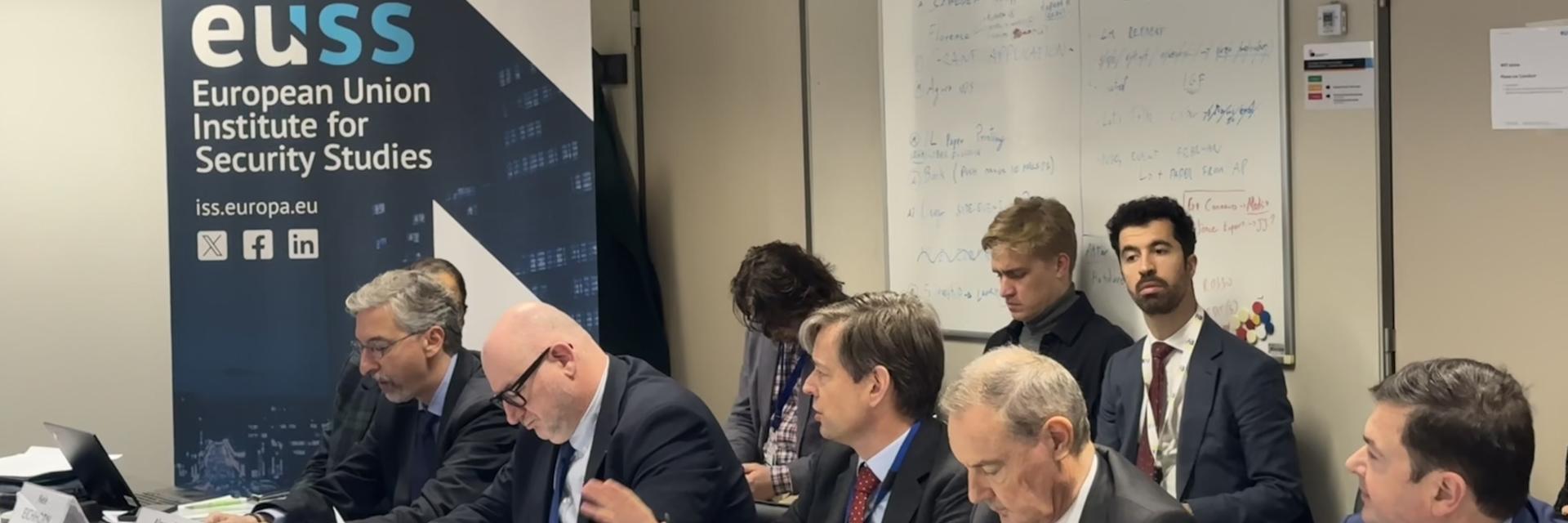
This 18 November EUISS closed-door workshop examined the effectiveness of European Union (EU) sanctions as a tool of foreign policy, focusing on their capacity to deter, compel, or corrode the (military) capabilities of rival states and other regimes.
EUISS was happy to receive Mr. David O’Sullivan, EU Special Envoy for the Implementation of EU Sanctions at the European Commission for a keynote speech. Denis Redonnet, Chief Trade Enforcement Officer (CTEO) at DG Trade, Brice de Schietere, Head of the Sanctions Division at the European External Action Service (EEAS), and EUISS analysts Ondrej Ditrych and Joris Teer were among the other speakers that presented their research during the workshop. Our Director, Steven Everts, moderated the event.
The event sought to help strengthen EEAS and Commission design of sanctions, by identifying sanctions best practices and formulating concrete policy recommendations.
Participants examined under what conditions these aims are best achieved and how to create these conditions. They explored the impacts of three different sanction regimes: sanctions against Russia (since 2022), Iran (until 2006-2015 and beyond), and the DPRK (2006-present).
The discussion aimed to uncover whether EU sanctions have succeeded in achieving their intended objectives of deterrence, compellence, or corrosion of adversarial capabilities, or whether they fell short. Have Russia, Iran and the DPRK desisted from taking actions they otherwise would have taken because of EU sanctions? Has the use of sanctions degraded the means available to these regimes to act aggressively internally and towards third parties? By comparing the sanctions' design, implementation, and geopolitical context of three distinct uses of EU sanctions throughout the past two decades, the workshop provided insights into the conditions under which EU sanctions are most effective and whether these have changed over time.
Participants also highlighted the limitations faced by the EU in leveraging economic statecraft and identified sanctions best practices of allied states. The workshop paid special attention to the challenges of sanctions circumvention through EU Member States or third parties and the role of allies, particularly the United States, in providing crucial sanctions intelligence. Participants also assessed the diplomatic consequences that arise from sanctions efforts, including their impact on EU relations with allies, neutral third parties, and adversaries. Overall, the workshop assessed the effectiveness and strategic objectives of EU sanctions policy.
1. Deterrence means “the practice of discouraging or restraining someone – in world politics, usually a nation-state, - from taking unwanted actions, such as an armed attack. […] A state can deter using threats of economic sanctions, diplomatic exclusion, or information operations.”
2. Compellence means “an effort to force an actor to do something.”
3. Corrosion means “to destroy or degrade capabilities.”